 Historical Figure MBTI
#1069 · 8-10-26 · The Ramesside Age
Ramesses II
The Great Ancestor
r. c. 1279 – 1213 BCE
9 min read
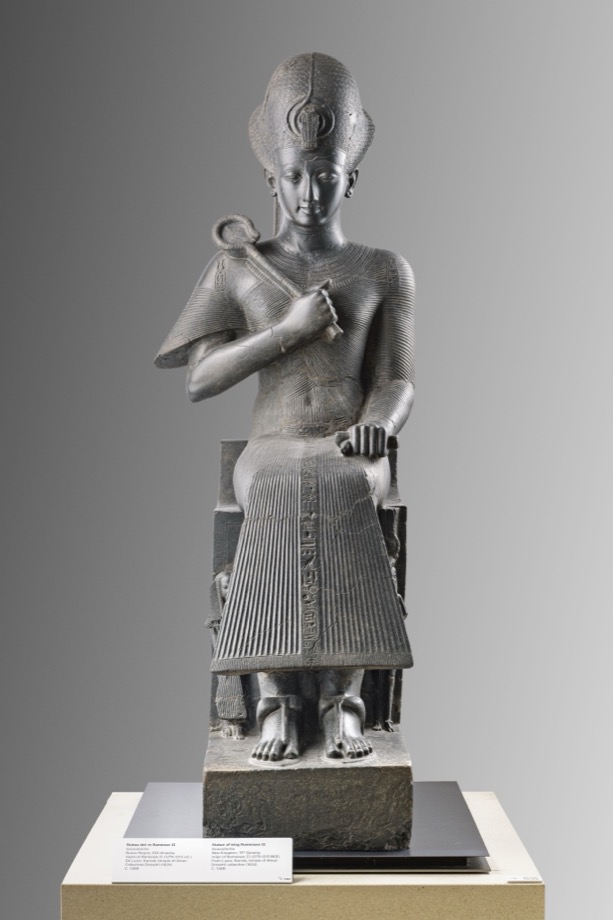
Statue of Ramesses II
The Man Who Carved His Own Verdict
In the spring of his fifth regnal year, somewhere north of the Orontes, Ramesses II walked into a trap. Two captured Bedouin — planted, it turned out, by the Hittite king Muwatalli II — told him the enemy army was far away at Aleppo. He believed them. He pushed his lead division across the river and made camp outside Kadesh with the rest of his army strung out for miles behind him. The Hittite chariotry came through the Egyptian column like a blade through cloth. By any honest accounting, the young pharaoh had lost half a battle before he had understood there was one.
What happened next is genuinely impressive, and it is not the interesting part. Ramesses rallied, counterattacked with his household guard, held the camp until the Nearin reinforcements arrived from the coast, and fought Muwatalli to a standstill. The campaign ended with the Hittites still holding Kadesh and Egypt marching home. A draw. A costly, embarrassing, instructive draw.
The interesting part is that Ramesses then spent decades having that draw carved into stone at Abydos, Karnak, Luxor, the Ramesseum, and Abu Simbel — the same triumphal reliefs and the same poem repeated across the length of his kingdom, describing how the god-king, abandoned by his troops and encircled by two thousand five hundred chariots, called upon Amun and broke the enemy alone. It is the most widely reproduced piece of military reportage in the ancient world, and it is false. He did not merely spin the result. He built the spin into the load-bearing architecture of Egypt, in granite, at a scale no rival account could ever reach. Sixteen years later, having lost nothing that mattered, he signed a treaty with the Hittites recognizing exactly the border the battle had failed to move.
Ramesses II is the archive’s purest study in dominant Te: an ENTJ who treated the historical record itself as a resource to be mobilized, budgeted, and deployed — because a result that can be rewritten is not a result, it is an input.
Command as Building Material
Extraverted Thinking is the function that looks at the world and asks what can be organized, measured, and made to produce. Ramesses ruled for sixty-six years and spent nearly all of them answering that question in sandstone. He built more than any pharaoh before or since: the Ramesseum on the west bank at Thebes, the great hypostyle hall at Karnak completed and covered in his reliefs, the court and pylon at Luxor, the Nubian temples at Beit el-Wali, Gerf Hussein, Wadi es-Sebua and Derr, and above all the two rock-cut temples at Abu Simbel, where four seated colossi of himself, each some twenty metres high, were carved directly out of a cliff face aimed at the river traffic of a subject province. He also founded a new capital from nothing — Pi-Ramesses in the eastern Delta, with bronze foundries, chariot works, and stabling for thousands of horses, sited not for tradition but for logistics, four hundred miles closer to the Levantine frontier than Thebes.
None of this is decoration. Abu Simbel is a supply-chain problem: quarry crews, stonemasons, sculptors, scribes, grain to feed them, boats to move the grain, overseers to account for the boats — all sustained for roughly two decades in a place with no city to draw on. Te does not experience this as burden. It experiences it as the pleasure of a system that runs. The same instinct shows in the small administrative habits: Ramesses had his cartouche cut deeper than his predecessors’ so it could not be recarved, and he cheerfully usurped older monuments, chiselling his own names over those of Middle Kingdom kings. A finite stock of existing masonry was, to him, simply underused capital.
And the Kadesh reliefs are the same faculty pointed at narrative. Te is not allergic to truth; it is allergic to unresolved outcomes. A tactical draw is an open item on the ledger. Rather than hold that ambiguity, Ramesses closed the item by manufacturing the version of events he needed and then out-producing every competing account. He did not persuade Egypt that he had won at Kadesh. He simply ensured that no Egyptian could stand anywhere significant and read anything else.
The Sixty-Six-Year Horizon
Introverted Intuition supplies the ENTJ with the thing that separates an administrator from an empire-builder: a single image of the future, held for decades, that everything else is bent to serve. Ramesses had one, and it was remarkably clear — an Egypt in which the Ramesside line was not a dynasty but a permanent feature of the landscape, indistinguishable from the gods. He pursued it with a patience that looks almost inhuman. At Abu Simbel he had himself depicted seated among Amun, Ra-Horakhty and Ptah, receiving offerings from himself: not a king favoured by gods but a god in the company of gods, a claim made in his own lifetime rather than deferred to death.
The long game also explains the treaty. In year twenty-one, with Assyria rising behind the Hittites and Muwatalli’s successor Hattusili III needing a secure southern flank, Ramesses concluded what survives as the oldest peace treaty in the world whose text we have from both sides — the Egyptian version on the walls at Karnak and the Ramesseum, the Akkadian on clay tablets recovered at Hattusa. It fixed the frontier, bound each king to aid the other against invasion, and provided for the extradition of fugitives. Thirteen years after that he married Hattusili’s daughter, Maathorneferure, and had the arrival of the Hittite princess carved up as tribute delivered to a conqueror. The strategic content was accommodation; the presentation remained victory. Both were sincere, because to Ni under Te the point was never the frontier — it was the story the frontier would be remembered inside.
He also planned for a succession the way one plans a quarry rotation. With something on the order of a hundred children by a stable of wives, he outlived at least a dozen crown princes, and built KV5 in the Valley of the Kings — a labyrinth of more than a hundred and twenty chambers — as a dynastic tomb for his sons. The throne eventually passed to Merneptah, his thirteenth son, a man already in his sixties. Ramesses had lived long enough to need a redundancy plan for his own heirs, and he had one.
The Chariot Turn at Kadesh
Tertiary Extraverted Sensing is the ENTJ’s physical nerve — the willingness to put the body where the plan is, and the taste for the moment when a situation becomes tactile. Ramesses had been given it early. He was named co-regent by Seti I as a boy, taken on his father’s campaigns into Libya and Nubia in his teens, and given his own household and troops before he was twenty. By the time he inherited he had already fought.
So when the Hittite chariots broke his camp, the reaction was not paralysis. Every account, hostile reading included, has him mounting up and counterattacking into the flank of an enemy force that had stopped to loot — the one real error Muwatalli’s men made, and Ramesses found it in minutes. That is Se: reading the field as it is, not as the briefing said it would be, and moving before the window closes. It saved his army, and it is the kernel of truth around which the propaganda was built.
But Se sits third for a reason. The Kadesh brilliance was recovery from a failure of exactly the kind Se is supposed to prevent — he had believed two men because their story fitted his plan. And in the campaigns of years eight and nine he showed what he had learned: no more lunges at fortified Kadesh, but methodical reduction of Amurru and the Galilean towns, siege by siege, until the map was consolidated to the line the treaty would later ratify. The improviser had been folded back under the planner, which is where an ENTJ keeps him.
What He Could Only Say in Stone
Inferior Introverted Feeling in an ENTJ is not absence of feeling. It is feeling that has no fluent private language and therefore emerges as monument. The evidence for Ramesses’s inner life is almost entirely architectural, and it is not thin.
The smaller temple at Abu Simbel is dedicated to Hathor and to Nefertari, and its facade carries statues of the queen the same height as those of the king — a proportion essentially without precedent in Egyptian royal sculpture, where wives stand knee-high beside their husbands. The dedication reads that it was made for her “for whose sake the very sun does shine.” Her tomb in the Valley of the Queens, QV66, is the most beautifully painted burial in Egypt. When she died, somewhere around his twenty-fifth year, he did not write an elegy; he commissioned the finest walls in the kingdom and then went on ruling for another forty years.
The same function shows its shadow side in the vanity — the hundred-plus statues, the recut cartouches, the insistence in the Kadesh poem that his own troops and officers had abandoned him and that only he and the god had held. That last detail is the tell. A confident commander credits his men. A dominant-Te ruler with an unmetabolized need to be seen as personally indispensable writes them out of the story on every temple wall he owns. Fi at the bottom of the stack does not produce introspection; it produces a monument to the self that never quite stops being built.
Why ENTJ Over ESTP
Why not ESTP?
The Kadesh counterattack is a genuinely ESTP moment — situational, physical, decided inside a minute — and if that hour were all we had, the case would be strong. But an ESTP’s Se-dominance is organized around the live present, and Ramesses’s life is organized around a horizon: two decades of quarry work at Abu Simbel, a capital sited for a war he had not yet fought, a hundred and twenty-chamber tomb for sons not yet dead, a peace signed sixteen years after the battle it settled. Ti-Se improvises around fixed structures; Te-Ni builds the structures and improvises only when they fail. Ramesses improvised once, learned from it, and spent sixty-six years making sure he would never need to again.
The propaganda campaign settles it. An ESTP who fought Muwatalli to a draw would have taken the draw, banked the reputation of a king who survived an ambush, and moved to the next opportunity. Ramesses could not leave the ledger open. He identified the outcome he required, costed the campaign to produce it, and executed it across five temple complexes and thirty years — treating public memory as infrastructure, subject to the same mobilization of quarries, scribes and grain as anything else he built. That is Te dominant, aimed by Ni, with Se serving as the hand rather than the eye.
Connected Figures
Further Reading
- Pharaoh Triumphant: The Life and Times of Ramesses II — Kenneth A. KitchenThe standard scholarly biography, by the Egyptologist who catalogued the Ramesside inscriptions.
- Ramesses: Egypt's Greatest Pharaoh — Joyce TyldesleyA readable modern life that is especially good on the gap between the monuments and the man.
- Ramesses the Great: Warrior and Statesman — Bernadette MenuShort illustrated survey pairing the Kadesh campaign with the Hittite treaty that followed it.
- Ramesses II — T. G. H. JamesMonument-led account, strongest on Abu Simbel, the Ramesseum and the Theban building programme.
- The Kadesh Inscriptions (the Poem of Pentaur and the Bulletin) — Ramesside royal scribesThe primary source for the battle — and the primary artefact of the propaganda campaign it launched.
