 Historical Figure MBTI
#1071 · 8-10-26 · The Ramesside Age
Merneptah
The Elderly Heir
r. c. 1213 – 1203 BCE
4 min read
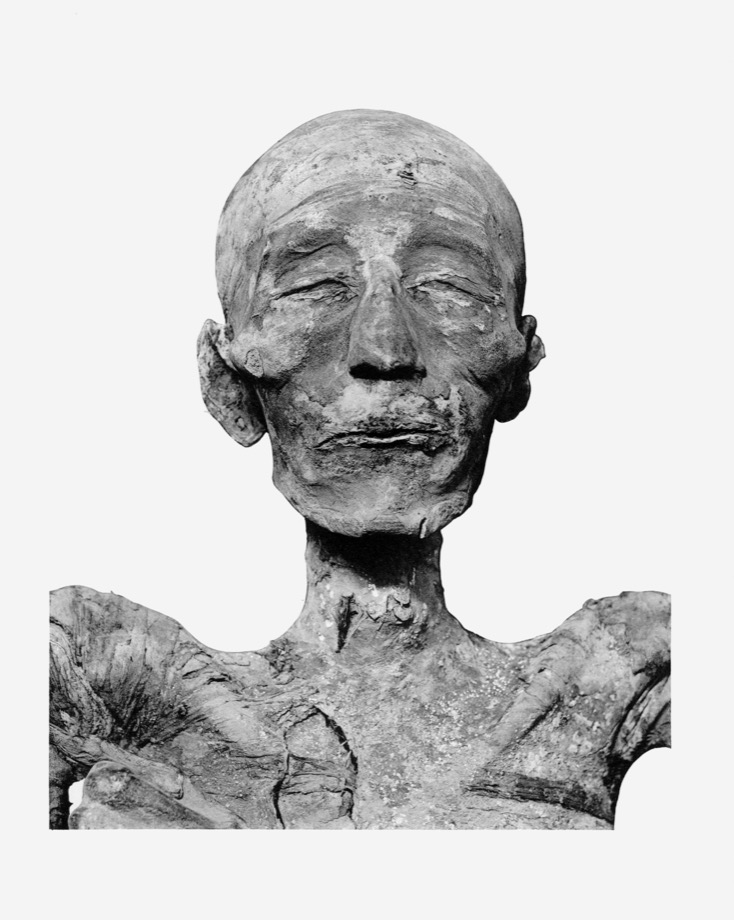
Mummy of Merneptah
An Inheritance Defended, Not Expanded
Merneptah was the thirteenth son of Ramesses II, and he only reached the throne because he outlived every brother ahead of him in line — arriving as pharaoh in his sixties, after decades spent as his aging father’s deputy rather than as heir apparent. He inherited an empire built by one of history’s longest and most expansive reigns, and his own task was never to match that expansion. It was to hold what Ramesses II had built.
That test came almost immediately. In his fifth regnal year, a large coalition of Libyan forces, joined by groups later identified among the "Sea Peoples," invaded the western Nile Delta. Merneptah met and defeated them decisively, and commemorated the victory on a granite stele that also contains the earliest known Egyptian reference to a people called "Israel" — a single line that would outlive the battle itself in historical significance by three thousand years.
Merneptah is an ISTJ, and a late-inherited empire defended with careful, well-documented force rather than reshaped by new ambition is dominant Si doing exactly what it does best.
Guarding What His Father Built
Merneptah’s entire reign reads as an exercise in preservation rather than invention. He made no attempt to outdo his father’s monumental building program or push Egypt’s borders further; instead he maintained the fortifications, the diplomatic relationships, and the administrative machinery Ramesses II had spent sixty-six years assembling. Dominant Si treats an inherited order as something to be carefully upheld, not casually redesigned.
Even the Libyan invasion, the defining crisis of his reign, was fundamentally a defensive test — a threat to an established status quo that he met by restoring the prior order, not by using the opportunity to seize new territory once the invaders were broken. Having won, he consolidated and stopped.
His victory stele itself, meticulously recording the campaign’s details for posterity, is Si’s instinct made monumental: a concrete, permanent record ensuring this defense of the realm would be remembered accurately, in its specifics, rather than left to fade into vague legend.
A Late Start, Efficiently Spent
Ascending in his sixties left Merneptah little time to waste, and his reign shows the marks of efficient, results-focused governance rather than exploratory ambition. The Libyan coalition was met with organized, decisive force — the stele records enemy casualties and captured material with the blunt precision of a man documenting outcomes, not glorifying the drama of battle.
Auxiliary Te also shows in how quickly the threat was resolved and the kingdom returned to stable administration afterward: a short, sharp campaign followed by a return to maintenance, rather than a prolonged war of conquest that a more expansion-minded ruler might have pursued with the same momentum.
The Weight of a Name to Live Up To
Tertiary Fi surfaces in the stele’s careful self-positioning relative to his monumental father — Merneptah is explicit about defending "the land of his father," framing his own legitimacy and duty in personal, inherited terms rather than purely institutional ones. Succeeding Ramesses II, arguably Egypt’s most consequential pharaoh, at an advanced age, carried a private burden of living up to that legacy that shows through in how insistently his monuments invoke it.
That quiet undercurrent of personal obligation to an inheritance — rather than to abstract statecraft alone — is Fi supporting Si and Te: the record-keeping and the decisive defense both aimed, in part, at proving himself a worthy custodian of a name larger than his own reign.
Why ISTJ Over ESTJ
Why not ESTJ?
An ESTJ pharaoh inheriting Ramesses II’s empire at any age would likely have looked for opportunities to expand it further after a decisive military win — pressing the advantage outward. Merneptah instead stopped once the immediate threat was neutralized and returned to careful maintenance of the existing order. That preference for consolidation over expansion, for defending known borders rather than pursuing new command opportunities, points to introverted Si leading, with Te in a supporting, executing role rather than an outward-driving one.
Ascending so late in life likely reinforced this instinct further — a man in his sixties inheriting a finished masterwork has every reason to protect it, and little left to prove by remaking it.
Connected Figures
Further Reading
- The Merneptah Stele — trans. James Henry BreastedPrimary source recording the Libyan war and the earliest mention of Israel.
- Pharaoh Triumphant — Kenneth KitchenRamesside military and political context for Merneptah's defensive reign.
- A History of Ancient Egypt — Nicolas GrimalDynastic overview of the transition after Ramesses II's long reign.
