 Historical Figure MBTI
#1072 · 8-10-26 · The Ramesside Age
Ramesses III
The Last Great Pharaoh
r. c. 1186 – 1155 BCE
9 min read
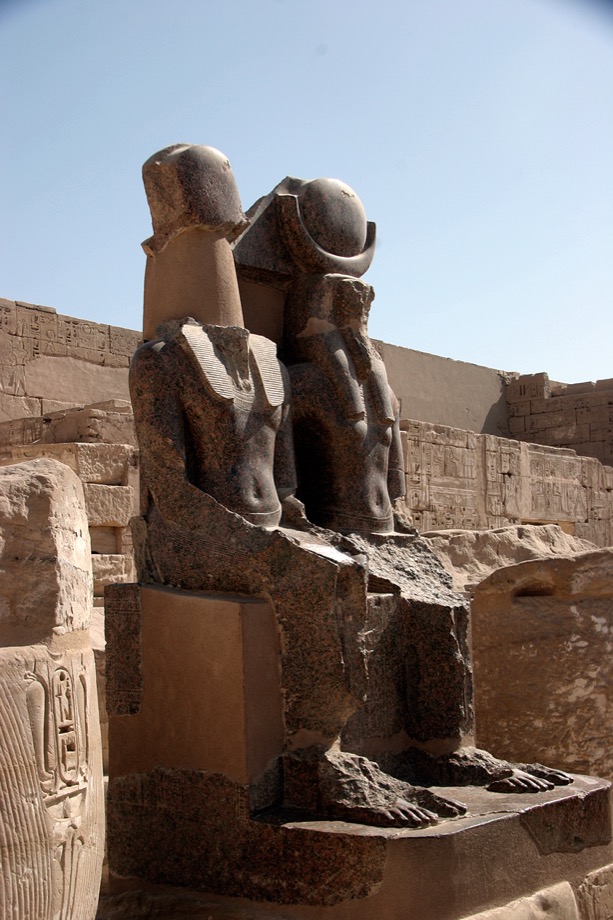
Statues at the mortuary temple of Ramesses III
Holding the Line While the World Burned
Around 1180 BCE the eastern Mediterranean came apart. Hattusa was sacked and the Hittite Empire ceased to exist. Ugarit burned, and its last tablets, still in the kiln, report enemy ships offshore. Mycenae, Pylos, and Tiryns fell; Cyprus and the Levantine coast went with them. In the space of perhaps a generation, every great power of the Bronze Age was destroyed except one. Egypt survived because Ramesses III met the crisis twice and beat it both times.
His account of it covers the walls of his mortuary temple at Medinet Habu in exhaustive, almost bureaucratic detail: the coalition of Peleset, Tjeker, Shekelesh, Denyen, and Weshesh moving by land with their families in ox-carts and by sea in ships with bird-headed prows; the land battle in Djahy; and then the sea fight in the Nile mouths, where he lined the shore with archers, packed the river channels with warships, and destroyed a fleet that had never lost. The reliefs show enemy vessels capsized, men in the water, grappling hooks — the earliest depiction of a naval battle in human art. He also drove back two Libyan invasions, in his fifth and eleventh years, and settled the prisoners in military colonies.
And it still was not enough. The same reign that saved Egypt from the catastrophe that ended the Bronze Age produced the first recorded labour strike in history, and ended with a conspiracy inside the harem that cut the king’s throat.
Ramesses III is an ESTJ whose dominant Te held a failing empire together by sheer administrative and military structure — right up to the moment the structure was subverted from inside his own household.
Fortify, Garrison, Audit
The Delta victory was not a feat of inspiration. It was preparation. Medinet Habu records that he stationed troops at the river mouths in advance, fortified the Levantine frontier, and manned warships “from bow to stern with brave fighters” before the enemy arrived — he had watched the coalition dismantle Hatti and Alashiya and he built the trap while there was still time. Extraverted thinking’s defining move is to convert a threat into a set of concrete dispositions, and he made every one of them.
The same mind is visible in the Great Harris Papyrus, the longest papyrus that survives from ancient Egypt — some forty metres of it, compiled at his death. It is not a poem or a chronicle. It is an accounting: temple by temple, the lands, cattle, ships, personnel, gold, silver, and grain he transferred to Amun, Ra, and Ptah, with totals. He reopened the turquoise mines at Serabit el-Khadim, sent expeditions to Punt for incense, worked the copper of Timna, planted trees, dug wells along the roads. A king with a lesser grip on logistics does not survive the years that killed every other Bronze Age monarchy.
What Te could not do was generate revenue that no longer existed. Egypt’s Levantine tribute was gone with the empires that had paid it, the grain price was climbing, and the temple endowments he was so scrupulously recording were absorbing an unsustainable share of what remained. He administered a shrinking system with perfect competence and no capacity to imagine a different one.
A Reign Modelled on a Reign
Ramesses III did not merely admire Ramesses II. He copied him with a thoroughness that borders on the uncanny. He took the same throne name pattern, named his sons after his predecessor’s sons in the same order, revived the same titles for his officials, and built Medinet Habu on the plan of the Ramesseum — the same pylons, the same courts, even the same battle-relief programme, with the Sea Peoples occupying the wall space where Kadesh had been. He instituted a festival calendar of some sixty annual feasts, the most elaborate ever recorded, all of them anchored in established rites.
Auxiliary Si of this intensity is a source of enormous stability and a hard ceiling on adaptation. The template told him what a pharaoh did, and he did it, at a moment when the conditions that had made the template work — imperial tribute, a functioning international system, cheap grain — had all evaporated. He was performing the nineteenth dynasty inside a world that no longer supported it.
Medinet Habu itself is the ambiguity in one building. It is a temple, and it is also a fortress, with a fortified gatehouse modelled on a Syrian migdol, massive enclosure walls, and a garrison. Within a century it would be the administrative centre of western Thebes and the place the population sheltered when the countryside became unsafe. He built the memory of an empire, and it turned out to be the last defensible position.
The Strike He Did Not See Coming
In the twenty-ninth year of the reign, the tomb-builders of Deir el-Medina — the elite artisans who cut and painted the royal tombs, paid in monthly rations of grain — did not receive their delivery. It was eighteen days late. The workmen downed tools, walked off the site, and staged a sit-down protest at the mortuary temples of Thutmose III and then Ramesses II, refusing to move. “We are hungry,” the strike record has them saying; they had come, they said, driven by hunger and thirst. It is the first documented labour action anywhere in the world, and the scribe Amennakht wrote the whole thing down on an ostracon now in Turin.
The administration’s response was pure Te with no imagination behind it: officials arrived, found some grain, paid the arrears, and expected the matter closed. It was not closed. The strikes recurred, in that year and after. Nobody in the state apparatus asked the question a tertiary Ne might have surfaced — what does it mean that the treasury of a victorious empire can no longer feed sixty families on schedule? The symptom was treated repeatedly; the disease was never named.
The Knife in the Harem
The Judicial Papyrus of Turin records the trial. A secondary wife, Tiye, conspired to kill the king and put her son Pentawer on the throne in place of the designated heir. The plot reached deep into the palace: harem officials, a butler, a treasury overseer, army officers, women of the household, even the men who were supposed to be investigating it — two judges were themselves convicted of carousing with the accused mid-trial. Forty defendants were condemned. Several were permitted to take their own lives; Pentawer was among them.
For three thousand years it was unclear whether the attempt had succeeded, because the trial documents are written as though the king were still alive to render judgment. Then in 2012 a forensic team led by Zahi Hawass and Albert Zink published a CT study of his mummy in the BMJ: a cut across the throat seven centimetres wide, severing the trachea, oesophagus, and great vessels down to the vertebrae — instantly fatal, concealed under the wrappings by the embalmers, with a Horus-eye amulet placed in the wound to heal it in the afterlife. A second mummy, the “Screaming Man,” buried in a goatskin and untreated, shares his Y-chromosome profile and is very probably Pentawer.
It is the inferior function’s exact revenge. Ramesses III had built a state of garrisons, audits, rations, and festival calendars, and he had no instrument at all for reading the private resentments of the people closest to him. The empire held. The household did not.
Why ESTJ Over ENTJ
Why not ENTJ?
A pharaoh who out-organized the collapse of the Bronze Age can look like a visionary commander, and Ramesses II — the man he imitated — genuinely was one. But ENTJ’s Ni pulls toward a future the ruler has conceived; Ramesses III never conceived anything. His entire reign is defensive consolidation of an inherited design: his predecessor’s temple plan, his predecessor’s titles, his predecessor’s war reliefs with new enemies drawn into them. Si supplied the model and Te executed it flawlessly. That is the ESTJ signature, and its blind spot — a system defended perfectly and never rethought — is the whole shape of his downfall.
The comparison is unusually testable here, because the two reigns are deliberately aligned. Ramesses II gambled at Kadesh, invented a peace with Hatti that nobody had thought possible, and rewrote what a pharaoh could claim. Ramesses III fought harder battles against a worse enemy and won them, and then reproduced his predecessor down to the naming of his children. One man authored the template; the other executed it with more discipline than its author had. That is not a lesser mind. It is a different one, and in 1180 BCE it was the mind Egypt needed — right up to the point where what was required was someone who could see that the model itself had expired.
Connected Figures
Further Reading
- Revolution and Rebellion in Ancient Egypt — Toby Wilkinson (in The Rise and Fall of Ancient Egypt)Places the Deir el-Medina strike and the harem conspiracy in the wider collapse of the late New Kingdom economy.
- The Judicial Papyrus of Turin — Trial record of the Harem ConspiracyThe state's own account of the plot, the forty defendants, and the corrupted judges.
- Revisiting the Harem Conspiracy and Death of Ramesses III — Zahi Hawass, Albert Zink et al., BMJ (2012)The CT and DNA study that found the cut throat and identified the probable mummy of Pentawer.
- Medinet Habu, Volumes I–II: The Earlier Historical Records of Ramses III — Epigraphic Survey, Oriental InstituteThe full published reliefs of the Libyan and Sea Peoples wars, including the Delta naval battle.
- The Workmen's Village of Deir el-Medina — Christine El Mahdy and successorsOn the artisan community, its rations, and the ostraca that record the world's first strike.
