 Historical Figure MBTI
#1073 · 8-11-26 · Spring and Autumn China
Confucius
Sage · Teacher · Architect of Ritual
551 – 479 BCE
10 min read
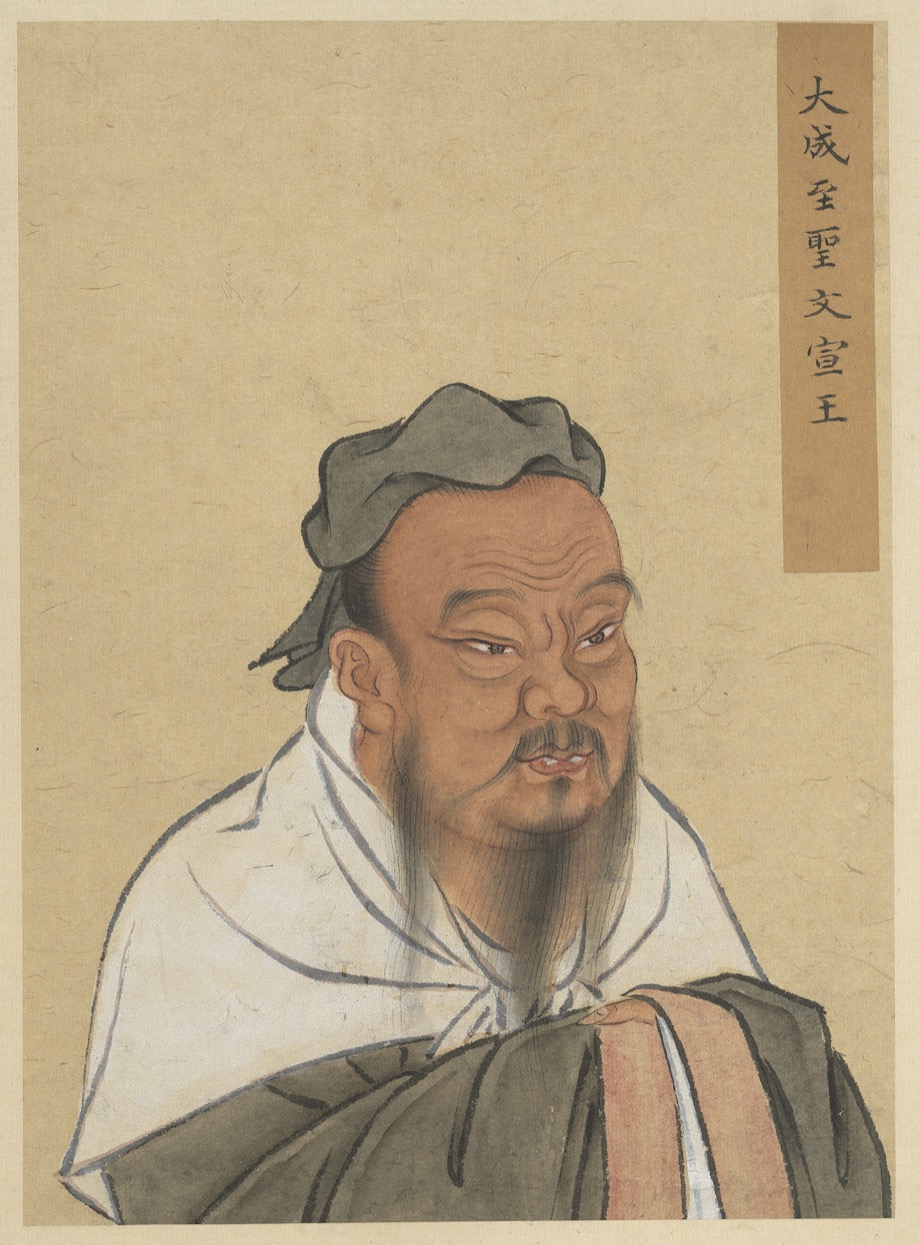
Portrait of Confucius
The Man Who Could Not Get Hired
For roughly fourteen years, an aging scholar from the small state of Lu wandered the roads of a fracturing China with a cart, a handful of students, and a proposal no ruler wanted. He was turned away in Wei. He was nearly killed in Song. He was besieged between Chen and Cai until his followers were too weak from hunger to stand, and when Zilu came to him furious — does even the gentleman endure this? — he answered that the gentleman endures hardship, and only the small man falls apart under it. He was, by every measure his own age recognized, a failure. He died in 479 BCE having never held meaningful power, having converted no state to his program, and having outlived the one student he believed might carry it.
What he had instead was a vision he could not stop seeing: a society held together not by law and punishment but by ritual propriety, li, animated from within by ren — a benevolence so difficult to define that he refused to define it the same way twice. Asked whatren was, he told one student it meant loving others, another that it meant overcoming himself and returning to ritual, another that it was to be cautious in speech. These are not evasions. They are a man circling a single intuition from every angle he can find, because the intuition arrived whole and the words never quite fit it.
Born around 551 BCE to a family with aristocratic lineage but no money — his father died when he was young, and he later said plainly that being poor as a boy was why he was skilled at many menial things — he held only minor posts, then abandoned office for teaching, and took students without regard to rank. Anyone who brought so much as a bundle of dried meat, he said, he had never turned away. That single policy did more to reshape China than any of the ministries he never got.
An INFJ whose dominant Ni saw a whole moral order in a single unbroken image — and who spent his life translating it outward, for anyone who would listen, into duties concrete enough to perform.
The Thread That Runs Through It
The clearest window into Confucius's mind is a short exchange in which he tells Zengzi that his Way has one thread running through the whole of it. He does not explain the thread. He leaves, and the other students ask Zengzi what he meant. This is the signature move of dominant introverted intuition: the conviction that a sprawling body of teaching is not a list at all but a single thing seen from many sides, and the assumption — often mistaken — that others perceive the unity too. He said elsewhere that people took him for someone who had learned a great many things and remembered them, and denied it: no, he said, I have one thing that ties it all together.
He located that vision not in the future but in an idealized past — the early Zhou, and above all the Duke of Zhou, whom he claimed to have stopped dreaming about only in old age, taking the silence as a sign of his own decline. This is worth pausing on. He was not a nostalgist collecting relics; the Zhou he described had never quite existed. It was an image, held with total conviction, of what human society could look like if ritual and virtue were fully realized — and he read the actual historical record backward through it. When he said he transmitted rather than created, he was reporting his felt experience honestly. Ni does not feel like invention from the inside. It feels like recognition.
The vision also gave him a kind of fatalism that never became passivity. Under threat in Kuang he told his terrified followers that if Heaven had not meant this culture to perish, the people of Kuang could do nothing to him. He believed at fifty that he knew the Mandate of Heaven, and he kept walking toward courts that would reject him, because a perception that arrives whole does not negotiate with evidence about its own reception.
Ritual as the Grammar of Feeling
A private mystic would have kept the vision private. Confucius pushed it outward into the most relentlessly social ethic the ancient world produced. Every one of his core relationships is a bond — ruler and subject, father and son, elder and younger brother, friend and friend — and his central practical instruction, the closest thing he offered to a rule, was reciprocity: do not impose on others what you yourself do not want. When Zigong asked for one word to practice for a lifetime, that was the word he got.
Li is the mechanism. Ritual, for Confucius, is not empty form and not mere etiquette; it is the shared external structure through which inner feeling becomes legible and durable. He was fierce about it in both directions. He said that a man without ren had nothing to do with ritual — form without feeling was worthless — but he also refused to let Zigong abolish the sheep sacrificed at the announcement of the new moon: you love the sheep, he said, I love the ritual. Strip the observance and the feeling it carries loses its vessel. That is an Fe argument for institutions, made by a man who understood that a society's emotional life is stored in its practices.
It shows in how he handled people, too. The Analects preserves him giving opposite advice to two students who asked the same question, and answering, when challenged on the inconsistency, that one of them held back and needed pushing while the other rushed and needed restraint. He is recorded weeping past the point of composure at Yan Hui's death, and when reproached for excess, saying that if not for this man, for whom? He read the room, and he read the person, and he calibrated — but he never mistook calibration for the absence of conviction.
The Rectification of Names
Asked what he would do first if given a state to govern, he gave an answer that baffled Zilu: rectify names. If names are not correct, language is not in accord with the truth of things; if language is not in accord, affairs cannot be carried to success; and down the chain to the point where the people do not know where to put hand or foot. It is a piece of pure analytical architecture — a diagnosis that social disorder is at root a definitional failure, that calling a usurper a duke corrupts everything downstream of the word. Duke Jing of Qi asked him about government and got four terms: let the ruler be a ruler, the minister a minister, the father a father, the son a son.
This is tertiary Ti serving the vision rather than competing with it. He built a compact working vocabulary — ren, li, yi, xiao, junzi — and then spent decades stress-testing each term against cases, which is why the Analects reads less like a treatise than like a system under continuous revision. The junzi, the gentleman, was the sharpest of these moves: he took a word that meant a nobleman by birth and redefined it as a nobleman by conduct. An entire hereditary order was quietly detached from its justification by a change of definition.
His intellectual honesty was of the same order. He told Zilu that to know a thing is to know you know it, and to not know a thing is to know you do not — that this is knowledge. He declined questions about spirits and about death on the grounds that he had not yet finished with people and with life. And he insisted on his own method: he had once gone a whole day without eating and a whole night without sleeping in order to think, and gained nothing; it was not as good as study.
Fourteen Years on the Road
The inferior function is where a type strains, and Confucius strained precisely where you would expect: against the physical, political, immediate world. He did not want to be a philosopher. He wanted an appointment. From roughly his mid-fifties he left Lu and spent some fourteen years moving between Wei, Song, Chen, Cai and Chu, presenting his program to one court after another, and the pattern almost never varied — polite interest, no post, or a post without power, then departure. Duke Ling of Wei asked him about military formations, which was the one subject he had no interest in supplying, and he left the next day.
He knew how it looked. A gatekeeper described him as the one who keeps trying though he knows it is hopeless. Recluses he met on the road told him the whole world was a flood and asked why he did not withdraw with them, and he answered that he could not flock with birds and beasts — if the Way already prevailed, there would be nothing for him to change. That is not serenity. It is a man arguing with the evidence of his own senses, which kept telling him the mission was not working.
And yet the striving was never abstract. He compared himself to a fine piece of jade waiting for the right buyer — sell it, he said, sell it, I am waiting for a price. He wanted the theory installed in actual offices, actual courts, actual conduct. He returned to Lu around 484 BCE and did the one thing his hands could still do: taught, and worked on the transmitted texts. The relief of the inferior function, when it finally comes, is usually smaller and more concrete than the ambition that preceded it.
Why INFJ Over INFP
Why not INFP?
The intuition is shared; the direction of travel is not. An INFP holds an idealism inwardly and tends to resist codification — the value is personal, and systematizing it risks falsifying it. Confucius did the opposite at every turn: he built a public vocabulary, defined its terms, ranked its obligations, and aimed the whole apparatus at reforming rulers and institutions. He did not ask what was true for him. He asked what the son owed the father, the minister the ruler, and then argued for the answer in courts. His moral authority is also explicitly external and traditional — the Zhou, the rites, the Mandate — rather than grounded in personal conviction against convention. Fe and Ti, not Fi and Ne.
The test case is li. An Fi-led idealist confronted with a ritual whose feeling has drained out of it abolishes the ritual and keeps the feeling. Confucius kept the sheep. He understood that the shared form is not a shell around the value but the thing that transmits it to people who do not yet have it — which is a claim about society, not about himself. Everything characteristic of him follows from that: teaching anyone who came, refusing to answer the same question the same way twice, and spending fourteen fruitless years trying to hand the vision to someone with the power to enact it.
Connected Figures
Further Reading
- The Analects — Confucius, trans. Simon LeysThe primary source, in a translation whose notes are as valuable as the text.
- The Analects of Confucius — trans. Arthur WaleyThe classic English rendering, still the most readable introduction to the voice.
- Confucius: A Life of Thought and Politics — Annping ChinThe best modern biography, careful about what the sources can and cannot support.
- Records of the Grand Historian (Shiji) — Sima QianThe Han-era biographical chapter that fixed the traditional life story, legends included.
- The Analects: A Norton Critical Edition — ed. Michael NylanTranslation plus scholarly essays on the text's assembly and two millennia of reception.
