 Historical Figure MBTI
#1075 · 8-11-26 · Spring and Autumn China
Zilu
The Blunt Disciple · Warrior Turned Follower
542 – 480 BCE
7 min read
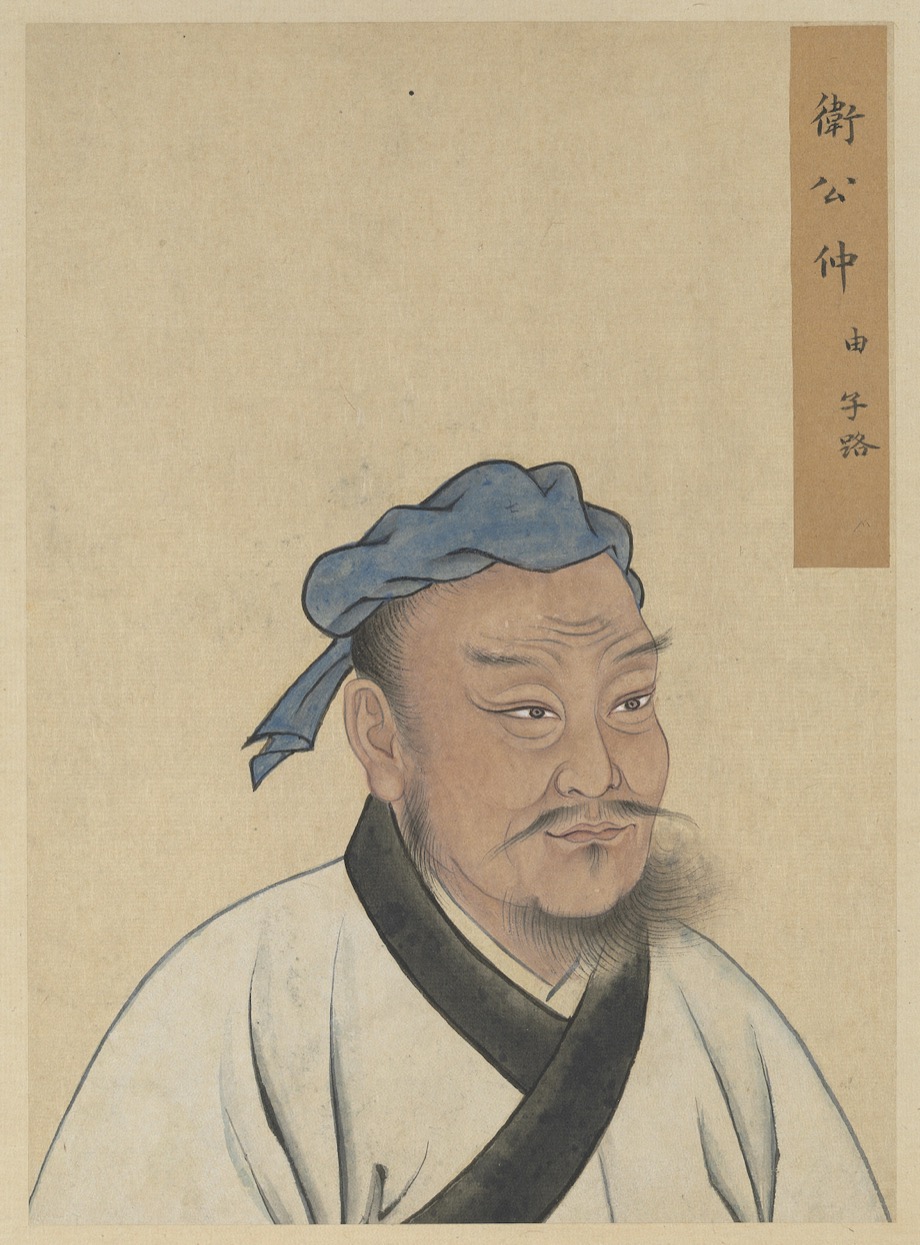
Portrait of Zilu
A Street Tough at the Master's Door
Zhong You came to Confucius the way a fist comes to a face — directly, and without much thought about what came after. Before he was a disciple he was, by the old accounts, a rough character from a poor family, given to swagger and a cock's-feather cap, more comfortable with a blade than a book. He is said to have first approached the sage not to learn but to bully or test him, and to have been talked, more or less on the spot, into staying. That single scene — provocation followed immediately by conversion, with no deliberation in between — is the whole of Zilu's character in miniature.
Everything he did afterward kept that shape. Where other disciples absorbed the Master's sayings and turned them over in silence, Zilu blurted out his objections in the room, on the spot, in front of everyone. He is the disciple of the Analects who says the quiet part loud: he asks whether Confucius would really take an army with him, he needles the Master over an awkward meeting, he wants to know, bluntly, whether a gentleman prizes courage above all. He is not being insolent so much as unable to hold an unresolved question in his chest for even a day. That is a ESTP mind at work — a temperament built for the immediate and the concrete, allergic to sitting on anything.
Zilu was an ESTP built almost entirely on Se — a man who met the world with his hands first and his doctrine second, and who never once managed to change that order.
Confucius loved him for it and dreaded it in equal measure. He said once that if the Way was never to prevail, he would simply take a raft out to sea — and that Zilu alone would go with him. He also said, more soberly, that a man like Zilu was unlikely to die in his bed. Both statements turned out to be true.
The Man Who Argued With His Fists Still Coiled
Zilu's courage was never a metaphor. Sima Qian and the Analects both preserve him as a man of the body first — a former swaggerer who kept, even as a disciple, the reflexes of someone used to settling things physically. Confucius ranked him first among the disciples for sheer bravery, and meant it half as praise and half as warning: asked once who would follow him on campaign, Confucius pointedly did not pick the man who volunteered loudest for the honor of fighting tigers bare-handed and drowning without regret, because raw nerve unchecked by anything else gets a man killed. That is the dominant Se temperament exactly — trust built on what the hands and eyes report right now, not on rehearsal.
It showed in small moments as much as large ones. When Confucius fell seriously ill and the other disciples, in Zilu's judgment, were not treating the crisis with the gravity it deserved, he did not deliberate — he simply organized them as retainers on the spot, staging a funeral-rank household around a man not yet dead, because the immediate problem in front of him seemed to call for immediate action. Confucius was furious at the presumption, but the instinct that produced it — see a gap, fill it, now — never left Zilu for the rest of his life.
Reasoning Out Loud, in Front of Everyone
What kept Zilu from being merely a bruiser in the entourage was a real logical mind, just one that worked in the open rather than in private. He is the disciple who challenges Confucius's statements to his face — questioning why the Master would visit a ruler of doubtful character, pressing him on whether rectifying names is really the first task of government, wanting the syllogism spelled out rather than accepted on authority. Other students wrote down maxims to ponder later; Zilu wanted the argument settled before he left the room.
This is auxiliary Ti in its most recognizable form: not systematic theory-building, but a fast, situational insistence that things add up, tested case by case against the problem directly in front of him. It made him a blunt but genuinely useful check on the school — Confucius corrected him often, sometimes sharply, but rarely dismissed the underlying question. And it made him an effective administrator in Wei, where officials remembered him for cutting straight to a dispute's substance rather than for polish or ceremony.
Loyalty to the Person in the Room, Not the Principle in the Book
Zilu's ethics ran through people, not abstractions. He served Confucius for decades with a devotion that had little patience for doctrine as such — he wanted to know what was owed, to whom, right now, and he paid it. When he took office as steward in the Ji family's territory and later as a minister in Wei, his loyalty attached itself to the concrete household he served, not to some larger theory of statecraft. That is tertiary Fe: duty expressed as fidelity to specific people and specific roles, sharply felt but not projected far past the immediate obligation.
It killed him. During the succession crisis in Wei in 480 BCE, Zilu was outside the city when the coup broke, and everyone urging him to stay clear knew what he would do anyway — he went in, because the lord he served was in danger and that was the whole of the calculation. He was cut down in the fighting, and the detail every source keeps is the one that says everything about the man: mortally wounded, he stopped to retie the cords of his ceremonial cap, saying a gentleman should not be found improperly dressed, and died completing the gesture. It is Fe loyalty to form and role carried all the way to the end, with no weak Ni whispering that the moment called for retreat instead of ceremony. Confucius, told the news, is said to have wept and covered the pickled meat on his table — he had predicted for years that Zilu would not die a natural death, and now he could not bear to eat it.
Why ESTP Over ESTJ
Why not ESTJ?
An ESTJ minister would have built Wei's administration on schedules, precedent, and chains of command — the record shows Zilu doing none of that. He ran toward the crisis in Wei on personal loyalty in the instant, not through any planned defense of an institution, and his signature moments — challenging Confucius outright, staging a funeral around a living man, dying mid-gesture rather than mid-retreat — are all improvised, personal, and immediate. That is dominant Se reading the moment and acting on it, not dominant Te organizing the field in advance.
The distinction matters because Zilu is so often flattened into a stock "loyal soldier" type, as if devotion alone explained him. It does not. What made him singular among Confucius's disciples was the total absence of a gap between perceiving danger and meeting it — no interior committee, no hedge, no exit plan. That is ESTP taken to its most literal extreme, virtue and flaw fused into one irreducible reflex.
Connected Figures
Further Reading
- The Analects — Confucius, trans. Arthur WaleyThe primary source for Zilu's blunt exchanges with Confucius and the Master's mixed verdicts on his courage.
- Shiji (Records of the Grand Historian) — Sima QianContains the fullest narrative account of Zilu's life, career in Wei, and death during the succession crisis.
- Confucius: A Life of Thought and Politics — Annping ChinA modern biography that situates Zilu among the disciples and traces his role in Confucius's inner circle.
