 Historical Figure MBTI
#1077 · 8-11-26 · Spring and Autumn China
Zengzi
Filial Disciple · Keeper of the Teaching
505 – 435 BCE
3 min read
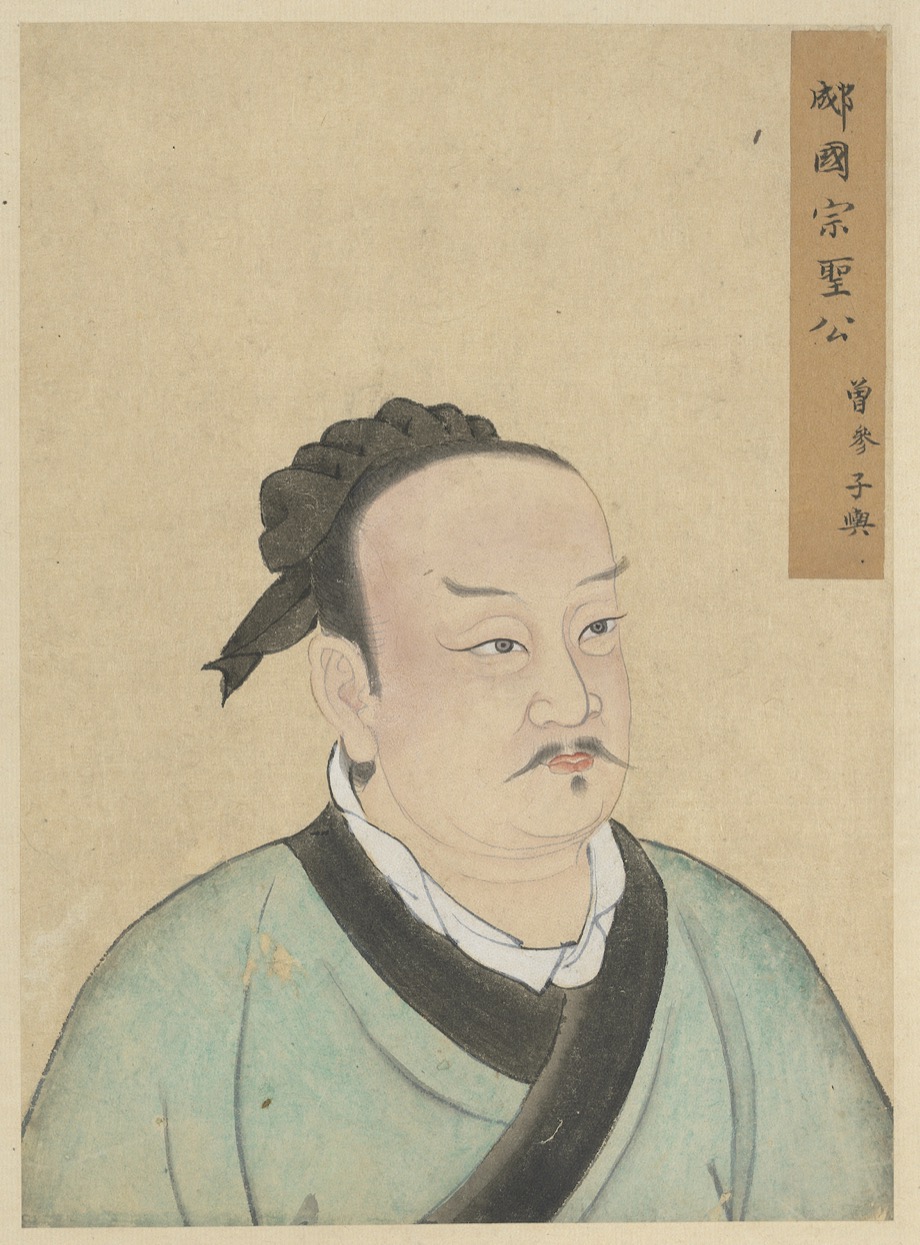
Portrait of Zengzi
Three Times a Day
Among Confucius's later disciples, Zeng Shen — Zengzi, “Master Zeng” — was not the quickest, and he seems to have known it. The Analects preserve a rare moment of a teacher naming a student's slowness aloud: Confucius is said to have called him dull. What Zengzi lacked in speed he supplied in something steadier and, in the end, more durable — a habit of nightly accounting. “Every day I examine myself on three points,” he is remembered as saying: had he been loyal in his dealings for others, trustworthy with friends, and had he practiced what his teacher had passed down to him. It is a discipline with no audience and no reward beyond itself, repeated daily across an entire life.
That same steadiness shows up in the stories told about his devotion to his father — care rendered not as performance but as routine, continued long after it might have won him anything. And it shows up again in the shape of his legacy: rather than founding a school of his own ideas, Zengzi is remembered as the disciple who held the line, transmitting what he had been given intact to Zisi, Confucius's grandson, whose teaching in turn reached Mencius. He is the hinge, not the innovation.
Zengzi is an ISFJ — his psychology is legible less in any single deed than in the pattern of them: daily self-scrutiny turned inward, devoted service turned outward, and a settled refusal to claim more originality than the tradition he was guarding.
Psychological Verdict
The nightly self-examination is the clearest signature of dominant Si: Zengzi does not measure himself against an abstract ideal of what a good disciple should be in the moment, but against a remembered standard, checked and rechecked against yesterday's conduct and the day before that. It is retrospective, procedural, and uncomplaining — the mind of someone who trusts accumulated practice over flashes of insight. Paired with it is a quiet, duty-bound Fe, visible in the filial devotion that later tradition built into legend around him: attentiveness to his father's needs rendered as obligation faithfully met, not as an argument about what filial piety ought to mean.
What makes Zengzi worth typing at all, rather than filing under generic Confucian piety, is what he did not do. He did not reinterpret Confucius for his own age, the way a more independent, systems-building mind might have. He held the material, arranged it, and handed it onward — a role that asks for reliability rather than originality, for a temperament content to be a vessel of continuity rather than a source of new doctrine. That is the ISFJ pattern in miniature: conscientious, tradition-anchored, and quietly indispensable precisely because it does not seek the spotlight it ends up earning anyway.
Connected Figures
Further Reading
- The Analects — Confucius (trans. various)Contains Zengzi's own recorded sayings, including the daily self-examination passage.
- The Classic of Filial Piety (Xiaojing) — Trans. variousThe text traditionally associated with Zengzi's teaching on filial devotion.
- Records of the Grand Historian (Shiji) — Sima QianThe earliest connected biographical account of Confucius's major disciples.
- The Great Learning (Daxue) — Trans. variousTraditionally transmitted through Zengzi as part of the Confucian canon.
