 Historical Figure MBTI
#1076 · 8-11-26 · Spring and Autumn China
Zigong
Merchant Disciple · Diplomat of the School
520 – 456 BCE
7 min read
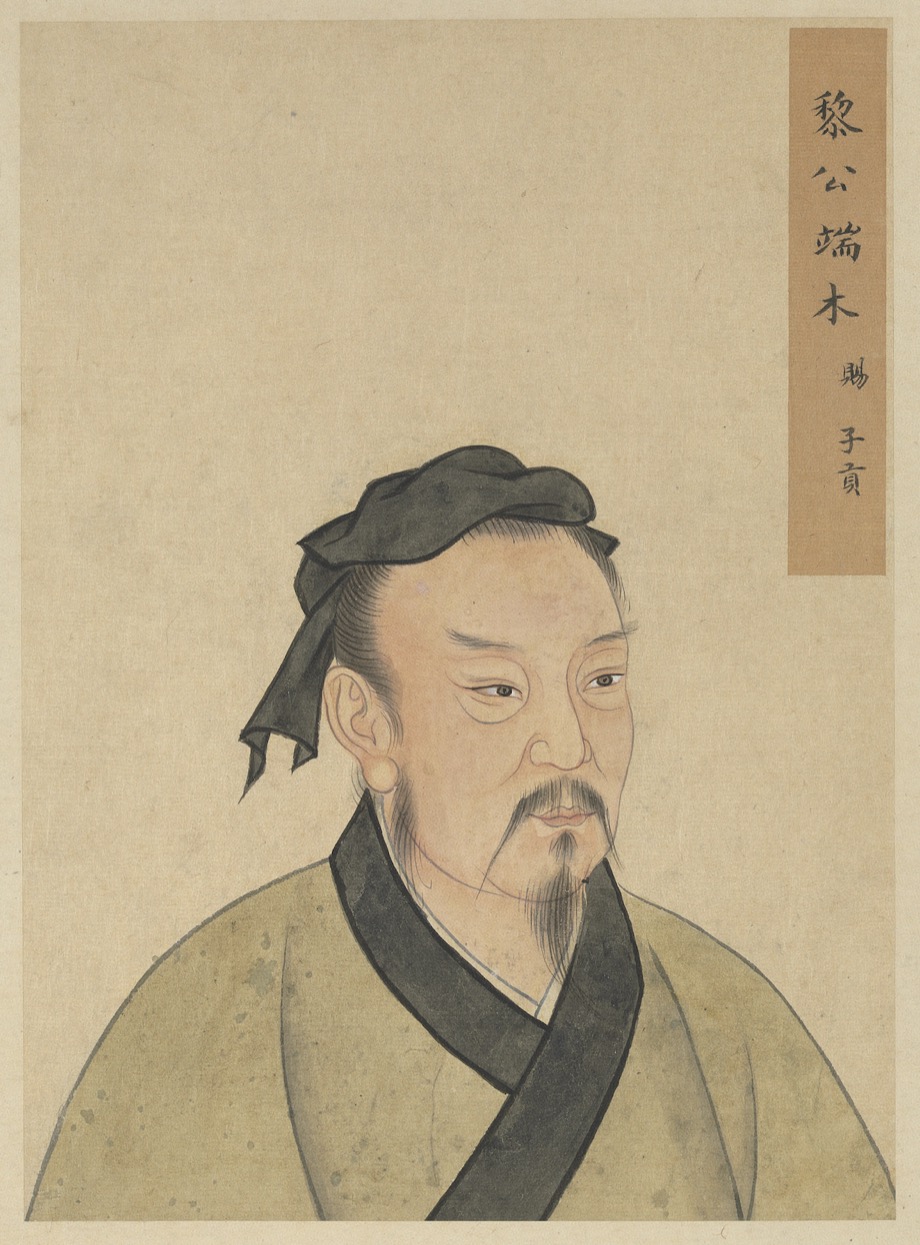
Portrait of Zigong
The Man Who Talked Five Kingdoms Into War
Sima Qian tells the story like a caper. In 484 BCE, the state of Qi prepared to invade Lu — Confucius's home, and Zigong's. The disciples debated who should go plead their case. Zigong volunteered, and what followed, per the Shiji, was not a plea but a demolition derby of persuasion: he talked the Qi minister Tian Chang out of attacking Lu and toward Wu instead, then talked the king of Wu into rescuing Lu by striking Qi, then talked the king of Yue into secretly arming Wu for the campaign, then talked the state of Jin into preparing for the war Wu's ambition would eventually provoke. Five states, one man, one tour, and by the time he came home the invasion of Lu had dissolved into a chain reaction of wars fought everywhere except Lu.
Historians have always treated the tale with suspicion — it reads like a rhetorician's fantasy of what rhetoric can do, and Sima Qian himself collected it centuries after the fact. But even as legend it is diagnostic. Nobody invents that story about a plodding, cautious diplomat. They invent it about a mind that thrived on live improvisation — reading a room, inventing an angle nobody else saw, and trusting the argument to hold together under its own logic. That mind belonged to an ENTP, and Zigong spent his whole life proving it: as a merchant who read markets nobody else could parse, as an ambassador who negotiated as easily as he traded, and as the disciple who bankrolled his teacher's exile and then mourned him for six years after everyone else had gone home.
Zigong was an ENTP built for the open floor — a dominant Ne that treated every court, every market, every argument as raw material to be recombined on the spot.
A Mind That Never Approached a Problem the Same Way Twice
Ne is the function that treats a fixed situation as a field of open possibilities, and Zigong lived by it in two entirely different arenas at once. As a merchant, he was famous — according to the Analects — for guessing market movements before they happened, buying and selling with a timing his fellow disciples found almost unseemly for a follower of Confucius. As a diplomat, he did the same thing to rival courts: each ruler he approached during the Qi-Lu crisis got a different argument, tailored on the spot to that ruler's fear or ambition, not a memorized script repeated five times.
That improvisational range is the tell. A Si-dominant negotiator relies on precedent and prepared position; a Te-dominant one drives toward a predetermined outcome by force of will. Zigong instead generated fresh angles as the situation shifted underneath him — flattering Tian Chang's ambition in one breath, warning the king of Wu about Yue's treachery in the next, each move built for the room he was standing in. Confucius himself noted the gap between Zigong and the more single-minded Yan Hui: asked to compare himself to Yan Hui, Zigong answered that where Yan Hui could grasp ten things from hearing one, he himself could only grasp two — a rare flash of self-deprecation, but also an accurate map of two very different cognitive styles.
The Logic Underneath the Charm
What kept Zigong's improvisation from collapsing into empty cleverness was a hard analytical spine. The five-state chain reaction only works as a story — legendary or not — because each link follows from a cold assessment of interest: Qi's minister wanted a war he could survive; Wu wanted a pretext for expansion; Yue wanted Wu weakened; Jin wanted advance warning. Zigong's persuasion was not charisma dressed up as strategy, it was strategy that happened to be delivered with charisma — he mapped the actual incentive structure connecting five governments and then pulled the threads in order.
The Analects catch the same rigor in miniature. Zigong is the disciple who presses Confucius on definitions — asking what makes a man worthy of the title junzi, testing whether a single word could govern a whole life of conduct — and who gets the famous answer "reciprocity" (shu) in return, an answer precise enough to satisfy a mind that wanted principles, not platitudes. He argued with logical persistence rather than deference, at one point defending the disgraced statesman Guan Zhong against the charge of disloyalty by walking Confucius through the actual consequences of Guan Zhong's choices — a Ti move, testing the moral rule against the case rather than accepting the rule on authority.
The Wealth He Spent on Somebody Else's Legacy
Zigong was, by the standard accounts, the richest of Confucius's disciples — and unusually for an eloquent, socially fluent operator, he never converted that wealth into personal grandeur. He used it to keep the Confucian mission alive: funding the years of wandering exile when Confucius and his followers went from state to state looking for a ruler willing to employ them, smoothing doors open that a poorer entourage would have found shut. Fe reads a room and moves to serve the group's standing in it, and Zigong's money was consistently spent on the school's survival rather than his own comfort.
The clearest evidence came after Confucius died. Tradition held that a disciple should mourn a teacher for three years; every other disciple did exactly that and left. Zigong stayed at the graveside for six — twice the expected term — and by several accounts helped organize the funeral rites and the community of mourners around them. It is not the behavior of a man optimizing for his own next argument. It is the behavior of someone whose sense of obligation ran through the group he belonged to, and who measured his own conduct by what that group, and its founder, deserved from him.
Why ENTP Over ESTP
Why not ESTP?
Zigong operated in the room with rivals and rulers, which invites the guess that he was a sensing-driven tactician reading physical cues and seizing immediate openings. But his actual talent was verbal and conceptual — building arguments, reading the angles between courts that hadn't yet come into contact, forecasting how one persuaded ruler's move would ripple through four others he hadn't spoken to yet. That is abstract pattern-construction, not the concrete, present-tense read of an ESTP working a room by feel. His market instincts were likewise about anticipating trends, not exploiting momentary advantage.
The Qi-Lu campaign is the cleanest evidence: nobody solves a five-state chain reaction by improvising off the immediate scene in front of them. It requires holding an entire abstract map of interlocking interests in mind and generating a novel intervention for each node — the signature of a dominant intuitive type, not a sensing one.
Connected Figures
Further Reading
- The Analects — Confucius, trans. Arthur WaleyThe primary record of Zigong's exchanges with Confucius, including the 'reciprocity' passage and his self-comparison to Yan Hui.
- Shiji (Records of the Grand Historian) — Sima QianSource for the Qi-Lu diplomatic mission and Zigong's biography among Confucius's disciples.
- Confucius: A Life of Thought and Politics — Annping ChinSituates Zigong's wealth, rhetoric, and loyalty within the wider circle of Confucius's students.
