 Historical Figure MBTI
#1074 · 8-11-26 · Spring and Autumn China
Yan Hui
Favorite Disciple · The Sage's Quiet Mirror
c. 521 – c. 481 BCE
5 min read
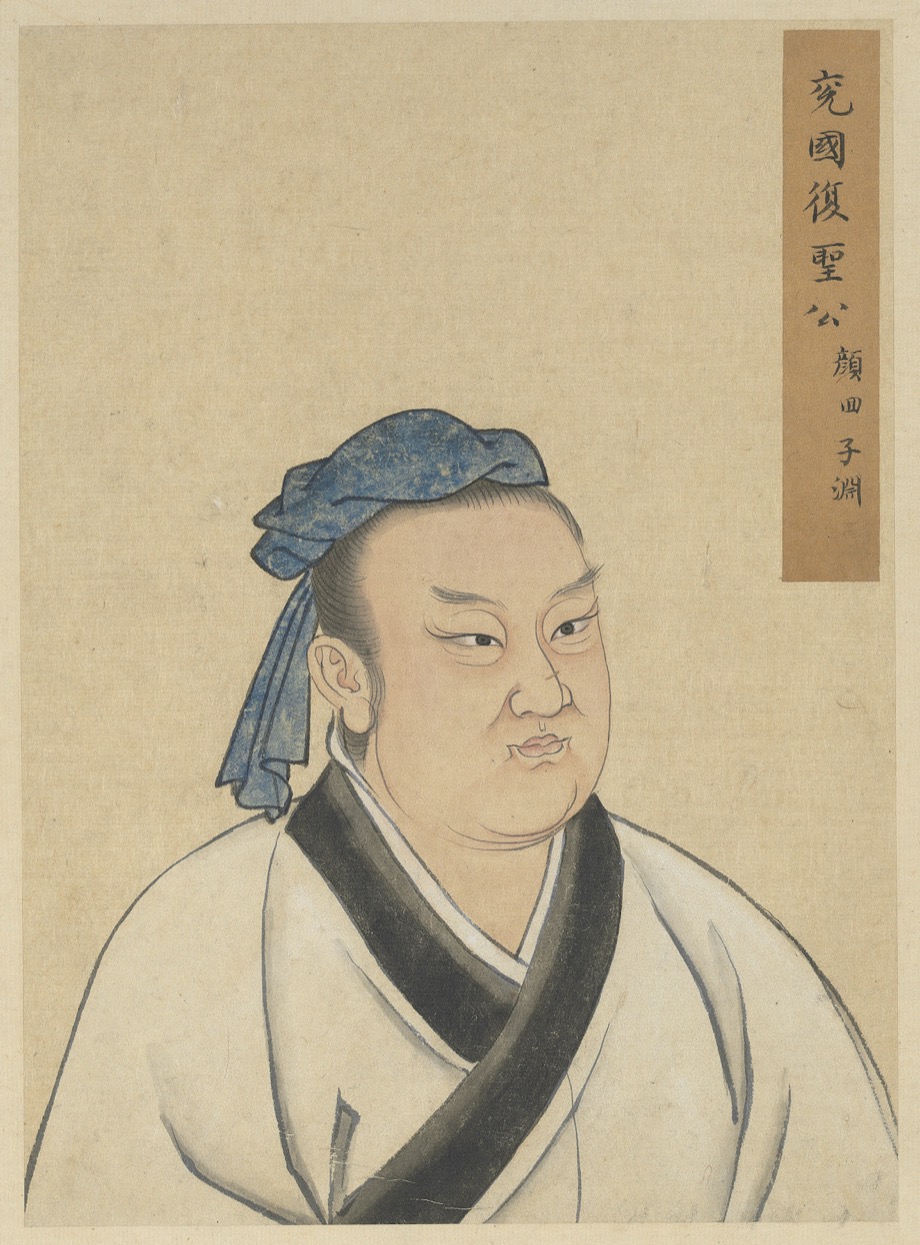
Portrait of Yan Hui
A Bowl of Rice, a Gourd of Water
Of the seventy-odd disciples who passed through Confucius's door, only one earned the unqualified word he never gave to anyone else — that this student "loved learning." Yan Hui left no book, held no office, founded no school of his own, and died before his master did, in his early thirties, having published nothing and argued for nothing. What he did instead was live a conviction so completely that Confucius, watching him make do with one bowl of rice and one gourd of water in a mean alley — misery by any ordinary measure — pronounced him undisturbed, "not sick with worry." That is the whole of Yan Hui's historical record: not what he built, but what he would not be moved from.
This is INFP in its most severe register — a private moral compass (Fi) so absolute that poverty simply failed to register as a problem, paired with a mind that wandered and absorbed rather than argued or administered. Where Confucius taught outward, codifying a program for the state, Yan Hui simply was the teaching, without ever converting it into a doctrine for others to carry.
Yan Hui was an INFP whose dominant Fi needed no audience, no office, and no reward — only the quiet certainty of being right with himself.
Contentment as a Closed Door
The detail the Analects keeps returning to is deliberately small: a single bamboo dish of rice, a single gourd of water, a slum alley most people "could not have endured the distress of." Confucius does not praise Yan Hui for enduring the poverty — he praises him for not experiencing it as distress at all. That distinction is the whole of Fi. An extraverted-feeling type would have needed the community's recognition of his virtue, or would have organized the poverty into a visible protest against the age's corruption. Yan Hui did neither. His judgment of what mattered was settled internally, and the outside world's verdict on his circumstances simply did not reach him.
The same interior stubbornness shows in the one trait Confucius names as unique to him: Yan Hui never repeated a fault. Not that he was faultless — Confucius is explicit that he erred — but that once his private sense of right had registered an error, it did not recur. There was no external enforcement mechanism, no teacher standing over him; the correction happened entirely within, a closed loop between conviction and conduct that needed no witness to hold.
It is telling, too, that Yan Hui never sought a post. Every other major disciple — Zilu, Zigong — eventually took office or angled toward one. Yan Hui alone showed no appetite for it, not from any failure of ambition but because holding a position could not add to what he already possessed inwardly. Fi at its most extreme treats worldly advancement as simply beside the point.
Learning That Never Stopped Moving
Confucius's praise of Yan Hui's "love of learning" is not praise for diligence in the rote sense. The disciple's habit, as the Analects describes it, was almost dreamlike: Confucius would say one thing and Yan Hui would come back having drawn out ten implications from it, chasing associations his teacher had not spelled out. Zigong, asked to compare himself, admitted he could only infer two things from one — a direct acknowledgment that Yan Hui's mind ranged further and faster than any other disciple's.
This is auxiliary Ne serving dominant Fi rather than replacing it: the exploration was never aimless curiosity for its own sake, but a continual testing of ideas against an already-settled inner conviction. Yan Hui absorbed the Way the way an INFP absorbs a subject that has already captured the heart — associatively, restlessly, without needing to systematize it into a transmissible method. That is precisely what he never did with it, and precisely what separated him from the master he loved.
Why INFP Over INFJ
Why not INFJ?
An INFJ's dominant Ni drives toward a vision meant to be carried outward — a doctrine, a following, a program for how others ought to live. Yan Hui built none of that. He gathered no students, argued no position, and left no framework for anyone to inherit; his devotion stayed sealed within his own conduct. That is Fi turned inward rather than Ni turned toward transmission — he embodied the Way instead of systematizing or teaching it, content to be its quietest proof rather than its messenger.
The gap is visible in what each type leaves behind. An INFJ disciple would have written, organized, or converted; Yan Hui left the Analects nothing but reported sayings and one enduring image of a man in an alley, undisturbed. His legacy is not a body of teaching but a demonstration — and demonstrations are what dominant Fi produces when it has no interest in being anything other than itself.
Connected Figures
Further Reading
- The Analects — Confucius, trans. Arthur WaleyThe primary source for Yan Hui's sayings and Confucius's grief at his death.
- The Analects — Confucius, trans. Simon LeysA crisper modern translation with useful notes on the disciple passages.
- Confucius: A Life of Thought and Politics — Annping ChinSituates Yan Hui within Confucius's circle and the politics of the disciples' rivalries.
- Shiji (Records of the Grand Historian) — Sima QianThe earliest biographical accounts of Confucius's leading disciples.
