 Historical Figure MBTI
#1092 · 8-15-26 · The Warring States
Mencius
Second Sage of Confucianism · Voice of the People
372 – 289 BCE
9 min read
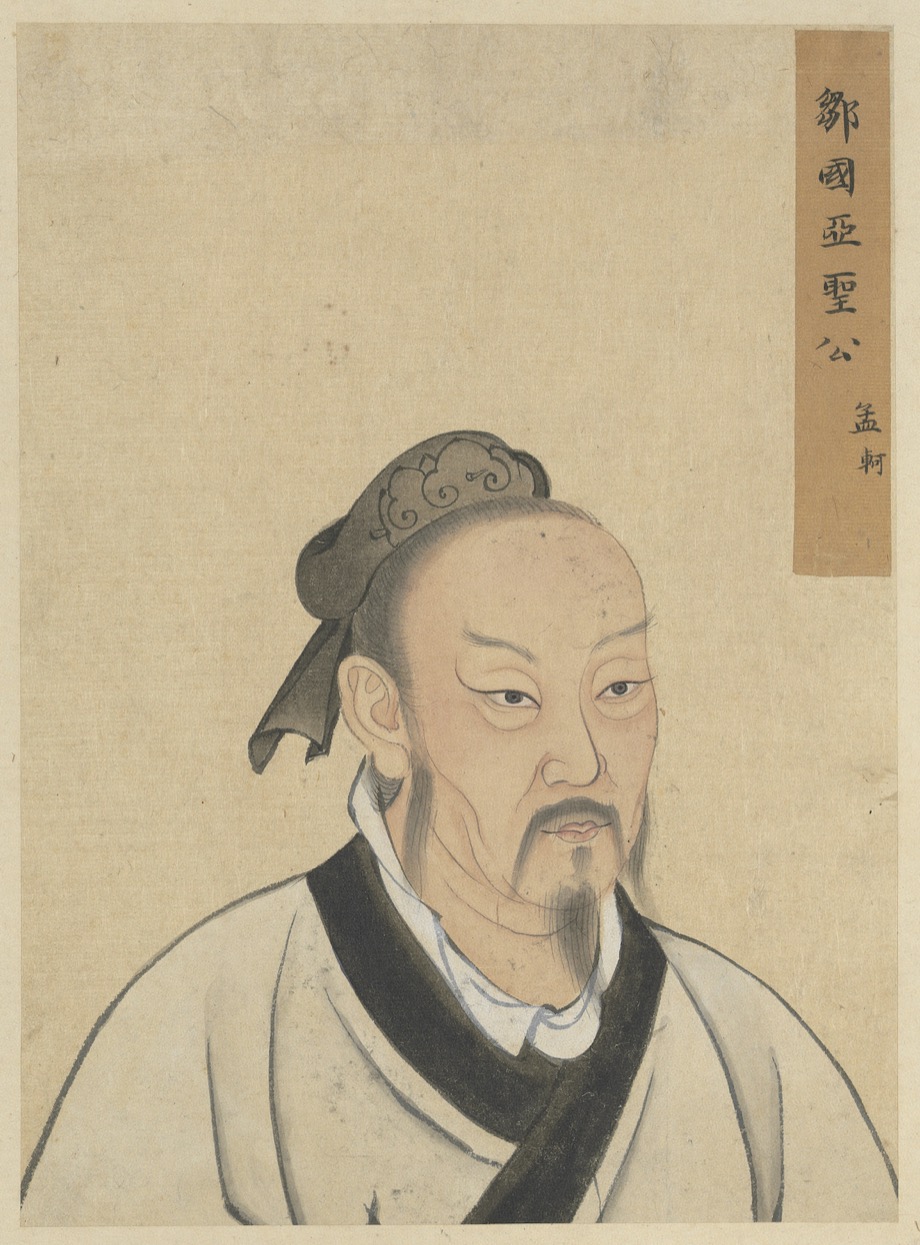
Portrait of Mencius
The Man Who Told Kings They Could Be Killed
He walked into throne rooms during the bloodiest stretch of Chinese history and told the men sitting on the thrones that a ruler who starves his people is not a ruler at all — merely a fellow, and that killing such a fellow is not regicide. King Xuan of Qi asked him whether it was true that subjects had once murdered their sovereigns. Mencius answered that he had heard of the punishment of a thug, not the murder of a king. He did not lower his voice, and he did not leave the room. That was the whole method: to say the unbearable thing directly to the person who most needed to hear it, and then to stay and argue it out.
He was born in Zou around 372 BCE, a century after Confucius died, and reached the Master only at second hand — through the disciples of Zisi, Confucius’s grandson. That distance mattered. Mencius inherited a body of teaching rather than a teacher, and he spent forty years turning it from a set of remembered sayings into a doctrine with an argument underneath it. He travelled from court to court — Qi, Wei, Teng, Song — offering the same prescription everywhere, in an age when every other consultant on the road was selling siege engines, tax schedules, and ways to break an enemy state in three campaigns. He was selling renzheng: benevolent government. Nobody bought it. He kept going.
What survives in the Mencius is not a treatise but a record of confrontations — the philosopher in the room with the powerful, reading their faces, catching them out, moving them. The book became second only to the Analects in the Confucian canon, and the mind visible in it is unmistakably that of an orator who believes moral persuasion is a real force in the world and has staked his life on the proposition.
Mencius is the archive’s clearest ENFJ: a dominant Fe that treats another man’s conscience as a thing you can reach into and work with your hands.
The Conscience of Other Men
Fe in Mencius is not warmth. It is the conviction that moral feeling is public property — that a ruler’s private twinge of pity is a lever, and that the philosopher’s job is to find it and pull. His most famous audience with King Xuan of Qi turns on exactly this. The king had once spared an ox being led to sacrifice because he could not bear its terrified expression. Mencius seized on the moment: you spared an ox you happened to see; your people you have never looked at. The compassion is already in you, he told him — you have simply failed to extend it. He did not construct a new morality for the king. He audited the one the king already had and showed him where it stopped short.
The same instinct produced the most radical political claim of the era. Heaven sees as the people see; a sovereign who lets his subjects starve while his kennels are full of fat dogs has forfeited the Mandate, and the state may be taken from him. Coming from a man with no army and no office, addressed to the man holding both, this was not abstract theory. It was Fe insisting that the collective moral judgment of the governed outranks the person of the ruler — the values of the group as the final court.
And it was aimed outward, always. Mencius rarely reports his own doubts or interior weather. Where a Confucian introvert like Zengzi examined himself three times daily, Mencius examined kings. He is at his most alive in dialogue, taking a rival’s position, softening it, then turning it — the rhythm of someone who thinks by working on another mind in real time.
Where This Road Ends
Every Warring States ruler wanted the same thing: the unification of the realm. Mencius was asked who would achieve it and answered without hedging — one who does not delight in killing men. In an age of mass conscription and annihilating campaigns, that was a forecast, not a platitude. He held that the state which fed its people, kept taxes light, and left the farmer his season would draw the exhausted populations of its neighbours across the border of its own accord, and that the state which conquered by terror would find its foundations hollow. He described the people flowing to a humane ruler the way water runs downhill: inevitable, needing no push.
This is the auxiliary at work — a single, fixed, long-range picture of consequence that no local setback disturbed. Kings told him his advice was impractical; ministers told him war was the medium of the age. He did not adjust the thesis. He had seen where unchecked cruelty takes a kingdom and simply waited for the evidence, warning that rulers who fought over territory and filled the fields with corpses deserved the heaviest punishment the law could name.
History gave him a grim vindication he did not live to see. Qin unified China by exactly the methods he condemned, and the dynasty collapsed within fifteen years of its founder’s death — a fact the Han would spend two centuries explaining, largely in his terms.
The Child at the Well
Mencius argued in pictures, and the pictures are physical. To prove that compassion is native to us, he does not reason from premises: he puts a child at the lip of a well and asks what happens inside you when you see it about to fall. Everyone, he says, feels the same lurch of alarm — not because they want the parents’ friendship or the neighbours’ praise, but because that is what a human being is. The argument works by making you watch something.
The rest of the book runs on the same fuel. A king who retreats fifty paces mocking one who retreats a hundred. The farmer of Song who tugged at his seedlings to help them grow and killed the whole crop. Ox Mountain, stripped bare by axes and grazing cattle until people assume it was never forested — his answer to anyone who points at a cruel man and says human nature must be bad. These are court performances, made to land on a listener in the room, and they are the reason a philosophical text from the fourth century BCE still reads at speed.
Tertiary Se also shows in his bearing. He assessed rulers by looking at them — the pupils of the eyes, he said, cannot conceal what a man is. He refused summonses, walked out of states, took gifts from some kings and returned them to others, and defended each choice on the particulars of the moment. For a moralist he was remarkably attentive to how a thing actually looked.
The Four Sprouts
Beneath the parables sits a genuine system, and Mencius knew he needed one. His claim that human nature is good is supported by an actual structure: four sprouts native to every person — the sense of alarm and pity, of shame, of deference, of right and wrong — which grow, if cultivated, into benevolence, righteousness, ritual propriety, and wisdom. Vice is failed cultivation, not a second nature. That framework is what let his ethics carry political weight: if the capacity is universal, then a bad ruler has no excuse, and a good order is not utopian but merely untended.
The inferior position shows in how he uses it. Against the philosopher Gaozi, who compared nature to willow wood that must be carved into a cup, Mencius answered with force and imagery rather than sustained analysis — you would have to mutilate the willow to make the cup, so do you propose to mutilate men? It is a good reply, and it is not quite a demonstration. Later readers have noted that his most-quoted arguments tend to end where a logician would want them to begin.
The limit is real but the frame held. When Xunzi came a generation later insisting human nature is bad and goodness a deliberate human construction, he was forced to argue on Mencius’s ground, in Mencius’s terms. The fault line between them organised Confucian thought for the next two thousand years.
Why ENFJ Over ENFP
Why not ENFP?
The vivid parables, the moral fire, the willingness to needle a king in his own hall — these read as Ne charisma until you notice that Mencius argued the same thesis for forty years. An ENFP explores; Mencius consolidated. He took a received tradition and built it into a systematic doctrine of government, with a fixed anthropology under it and a fixed prescription on top, and carried that single package unaltered from Qi to Wei to Teng. The imagery changes to suit the listener; the position never does. That is Fe–Ni convergence on one answer, not Ne fanning outward across possibilities — and it is why the Mencius is a doctrine with a canon around it rather than a collection of provocations.
The ENFJ reading also explains his failures better. He never got a state to adopt renzheng, and he never seriously considered that the failure might be the doctrine’s rather than the age’s. A more exploratory mind would have tested variants; a more detached one would have withdrawn, as Zhuangzi did, and laughed at the courts from outside. Mencius did neither. He went to the next king and made the case again, because a mind organised around Fe and Ni cannot really believe that the right appeal, delivered to the right conscience, will fail forever.
Connected Figures
Further Reading
- Mencius — trans. D. C. LauThe standard readable English translation — the court dialogues in full, including the ox, the well, and the mandate.
- Mengzi: With Selections from Traditional Commentaries — Bryan W. Van NordenTranslation plus the classical Chinese commentarial tradition, showing how each argument was read across two millennia.
- Confucian Moral Self Cultivation — Philip J. IvanhoeCompact comparison of the rival models of moral growth, setting Mencius's four sprouts against Xunzi's reshaping of a crooked nature.
- Shiji (Records of the Grand Historian) — Sima QianThe earliest biographical notice, and the Han verdict on why the Warring States courts had no use for him.
