 Historical Figure MBTI
#1094 · 8-15-26 · The Warring States
Xunzi
The Confucian Who Believed Nature Was Selfish
c. 310 – 235 BCE
6 min read
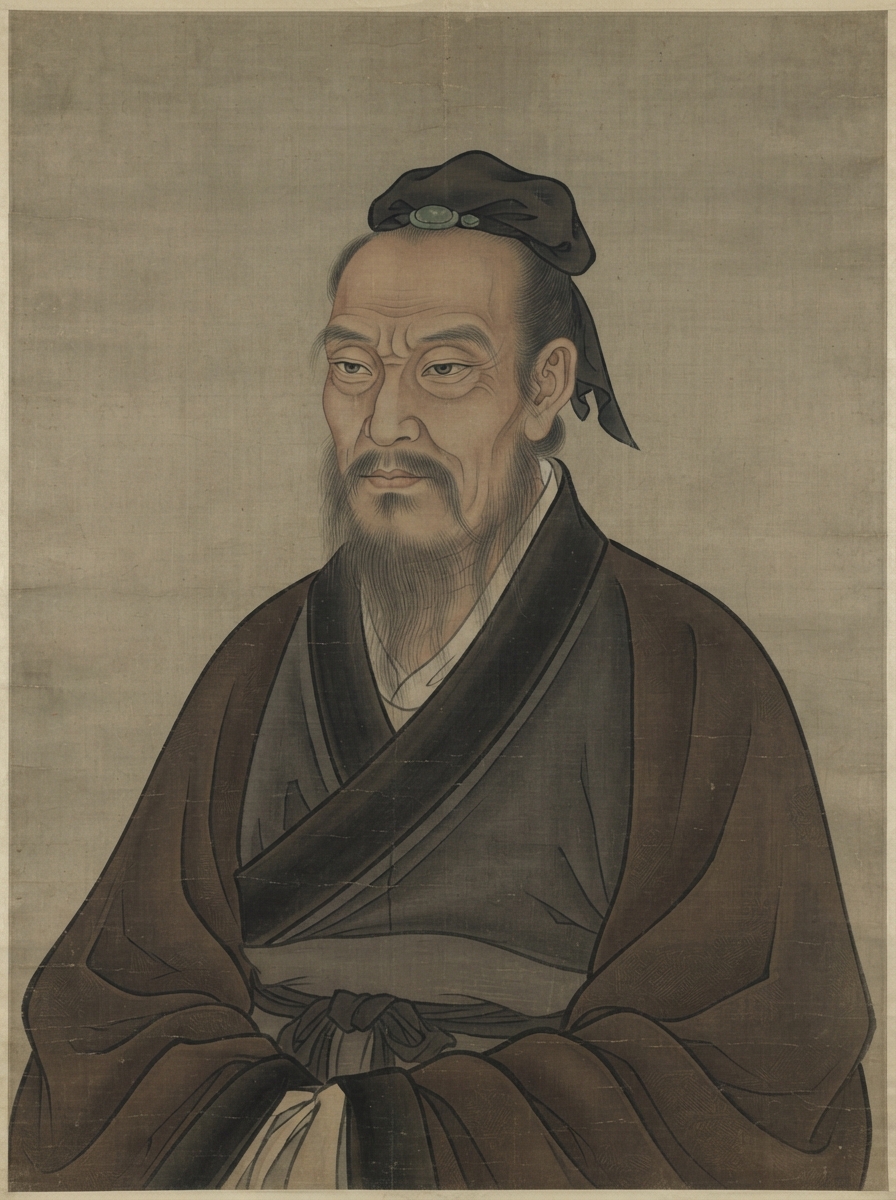
AI-assisted Portrait of Xunzi
The Confucian Who Refused to Trust Human Nature
Mencius had already told everyone what they wanted to hear: that human beings are born with the seeds of goodness already in them, that compassion and shame and courtesy are innate, and that a ruler need only cultivate what nature provides. Xunzi read this, thought about it for a long time, and rejected it flatly. People are born wanting — food, comfort, advantage over their rivals — and left alone they will fight each other for it. Whatever goodness exists in the world was built, deliberately, by sages who invented ritual and law precisely because nature could not be relied on to produce it. This was not a passing provocation. It was the load-bearing premise of a whole intellectual system, worked out across dozens of dense, tightly argued essays, by a man who spent decades directing China's most prestigious academy and who never once let the argument go slack.
That combination — a private, unfashionable conviction about human nature, defended for a lifetime with unusual rigor, and passed downward through a school rather than enacted through office — is the signature of an INTJ. Xunzi held his position not because it flattered anyone, least of all rulers, but because he had traced its logic and found it sound, and he kept building on it long after a more accommodating thinker would have softened the edges.
Xunzi was an INTJ who built an entire architecture of ritual and law on one cold premise his intuition (Ni) would not let him abandon: that human nature, left to itself, is bad.
A System, Not a Sentiment
Confucius left aphorisms; Mencius left dialogues built on a single intuitive appeal to conscience. Xunzi left something closer to a treatise. His writings — on ritual, on the rectification of names, on the nature of Heaven as an impersonal, indifferent order rather than a moral agent watching over human affairs — read like the output of a mind that had already seen the whole structure before it started writing any one part of it, and was now filling in the pieces in the order the architecture demanded.
The clearest proof of that long-range vision is the argument about human nature itself. Xunzi did not merely disagree with Mencius on a point of ethics; he built an entire counter-system from the disagreement — nature is bad, therefore ritual and law are not decorations on an already-good human being but the load-bearing structure that makes civilization possible at all, therefore the sage-kings who invented li were doing something more consequential than any individual act of virtue could be. Each piece implies the next. It is the kind of argument that gets built backward from a conclusion already glimpsed whole.
He also stripped Heaven of its moral machinery — no ancestral spirits rewarding virtue, no cosmic sympathy with the human order — leaving human institutions as the only thing standing between people and their own worst impulses. That is not a comforting picture. It is the picture a mind reaches when it insists on following an internal pattern all the way to its actual end, rather than stopping wherever convention or comfort would prefer it stop.
The Headmaster Who Built the Next Generation
Xunzi did not just theorize education, he ran it. For years he headed the Jixia Academy in the state of Qi, the most prestigious center of scholarly debate in the Warring States world, and later served as a magistrate in Chu. Both posts rewarded exactly the trait Xunzi prized in his own philosophy: the deliberate, effortful shaping of raw material — students, administrators, unruly human impulse — into something ordered. Ritual, in his system, was not mysticism; it was applied social engineering, a technology for producing predictable virtue in people who could not be trusted to generate it on their own.
That engineering instinct shows most starkly in his logic-focused essays, like the "Rectification of Names," where he argues that clear, fixed language is a precondition for a functioning state — confusion about words breeds confusion about duties, and confusion about duties breeds disorder. It is the argument of a man who thought administration was, at bottom, a problem of structure and definition, solvable the way any well-built system is solvable.
His most consequential act of applied Te, though, was pedagogical rather than administrative: he trained Han Fei and Li Si, both of whom absorbed his emphasis on structure, control, and deep skepticism of unaided human virtue — and then carried it somewhere Xunzi himself never fully endorsed.
The Conviction He Would Not Trade Away
Mencius's doctrine of innate goodness was, by Xunzi's era, the comfortable position — flattering to rulers, consoling to ordinary people, and increasingly the mainstream reading of Confucius's legacy. Xunzi held the harder, colder alternative anyway, for decades, against the current of his own tradition. That is not a strategic calculation. A strategist angling for influence would have found it far easier to soften Mencius's optimism at the edges than to build a rival system on the claim that human nature is fundamentally bad.
What kept him there was a private, load-bearing value judgment: that telling people they were already good, when they demonstrably were not, was a kind of moral negligence, and that real respect for human beings meant taking their capacity for selfishness seriously enough to build real structures against it. He never staged this as personal outrage — Xunzi's prose is famously composed, almost clinical — but the conviction underneath it never wavered across a lifetime of writing. That is Fi operating exactly as a tertiary function does in an INTJ: not loud, rarely named directly, but the immovable floor beneath everything the dominant intuition builds.
Why INTJ Over ENTJ
Why not ENTJ?
An ENTJ with Xunzi's convictions would have sought office and bent institutions directly — commanded armies, run a ministry, forced reform through decree. Xunzi's actual mode was reflective and text-based: dense, carefully constructed essays, and a school he directed rather than a state he ruled. His authority was the authority of a teacher whose students went out and did the executing — never his own hand on the lever of power.
That distinction is not incidental to who Xunzi was. Extraverted Thinking, when it is auxiliary rather than dominant, organizes and administers in service of an inward vision; it does not go looking for command in its own right. Xunzi headed an academy and held a minor magistracy, but the record shows a man far more invested in getting the argument right on the page than in accumulating institutional power — which is exactly why it took two of his students, working in the more extraverted, execution-hungry register Xunzi himself never fully inhabited, to turn his ideas into an actual unified empire.
Connected Figures
Further Reading
- Xunzi: The Complete Text — trans. Eric L. HuttonThe standard modern scholarly translation of Xunzi's essays, with an invaluable introduction to his system.
- Shiji (Records of the Grand Historian) — Sima QianThe earliest biographical account of Xunzi, and of his students Han Fei and Li Si.
- Disputers of the Tao — A.C. GrahamSituates Xunzi's rebuttal of Mencius within the broader philosophical ferment of the Warring States.
