 Historical Figure MBTI
#1093 · 8-15-26 · The Warring States
Zhuangzi
The Butterfly Dreamer · Daoism's Great Skeptic
c. 369 – 286 BCE
10 min read
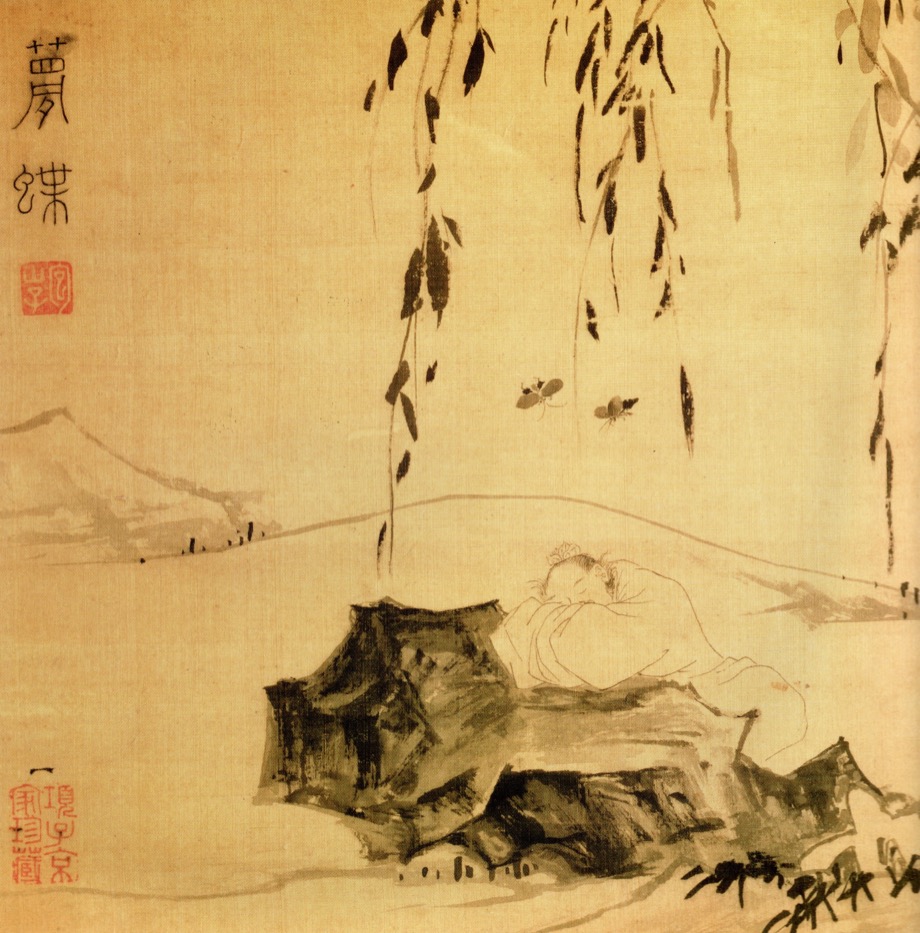
Portrait of Zhuangzi
The Man Who Refused to Be Serious
Envoys from King Wei of Chu found him fishing on the P'u River. They had come with the offer that every scholar of the Warring States was said to want — the administration of a kingdom, a seal of office, the ear of a throne. Zhuangzi did not put down his rod. He asked them about a sacred tortoise the king kept wrapped in silk in a cabinet in his ancestral temple, dead three thousand years and honored daily. Would that tortoise, he wondered, rather be dead and venerated, or alive and dragging its tail in the mud? The envoys conceded the obvious. “Go away,” he told them. “I mean to drag my tail in the mud.”
That is the whole man in one exchange: a question that looks like a joke, a joke that turns out to be an argument, and an argument that leaves the questioner holding a conclusion he never agreed to. Zhuang Zhou was a minor functionary in the small state of Song — by tradition an overseer at a lacquer grove — in an age when philosophers were selling systems to warlords by the cartload. Confucians offered ritual, Mohists offered utility, Legalists offered fear. Zhuangzi offered nothing, and he offered it with a verbal inventiveness no one in early China ever matched.
The text that bears his name is not a treatise. It is a swarm — cooks, cripples, gnarled trees, talking skulls, a fish that becomes a bird so vast its wings darken the sky, a butterfly that may or may not have dreamed a man. The parables do not build on one another toward a doctrine. They come at the same target from thirty directions and dissolve it: the conviction that our categories — useful and useless, life and death, self and other, right and wrong — are carved into reality rather than onto it.
Zhuangzi is the archive's purest ENTP — a dominant Ne that generates possibilities faster than any orthodoxy can absorb them, and uses the surplus to make certainty look ridiculous.
Ne — The Inexhaustible Parable
The opening of the Zhuangzi does not announce a thesis. It describes a fish called Kun, so large no one knows its extent, which transforms into a bird called Peng and beats south across ninety thousand li while a cicada and a dove laugh at it from a bush. Nothing is explained. The image is set down and the text moves on, trusting the reader to feel the scale problem in his own bones. This is Ne in its native mode: thought delivered as possibility rather than proposition, aimed at loosening the mind instead of furnishing it.
The generative fluency is relentless. A butcher whose cleaver has not needed sharpening in nineteen years because he cuts along the emptiness in the joints. A hunchback catching cicadas with a sticky pole as if plucking them from the air. A gnarled, worthless tree that survives precisely because no carpenter wants it. A skull by the roadside that, questioned, declines the offer of resurrection. Each is a different angle on the same insight, and Zhuangzi never seems to run short — he abandons a figure the instant it threatens to harden into a rule.
The Butterfly Dream is the purest specimen. He dreamed he was a butterfly, content and unaware of Zhuang Zhou; waking, he could not say whether he was a man who had dreamed a butterfly or a butterfly now dreaming a man. A systematizer would use that vertigo to launch an epistemology. Zhuangzi calls it the transformation of things and stops. The point was never to settle the question. It was to show that the question can be asked at all — and that once asked, the confident boundary between waking and dreaming, self and other, will not close again.
Ti — The Logic Under the Laughter
The whimsy is load-bearing, and beneath it runs a genuinely rigorous instrument. The second chapter, on the equality of things, is a sustained attack on the machinery of disputation itself: if you and I argue and you win, are you therefore right? Shall we call a third party to judge — and if he agrees with you, or with me, or with neither, by what independent standard is his verdict binding? Every criterion of correctness, Zhuangzi shows, must itself be certified by a criterion, and the regress does not terminate. It is a demolition of foundations executed with complete precision, and it is centuries early.
His sparring partner was Hui Shi, the great logician of the age and the only man in the text treated as a real equal. Crossing a bridge over the Hao, Zhuangzi remarked how the fish were enjoying themselves. Hui Shi objected: you are not a fish, so how do you know what fish enjoy? Zhuangzi answered that Hui Shi was not him, so how did he know that Zhuangzi did not know? Hui Shi pressed the concession — granted, I am not you and cannot know your mind; equally you are not the fish. And Zhuangzi closed the trap on the premise rather than the conclusion: you asked me how I knew, which already grants that I do. I knew it standing above the Hao.
That is Ti serving Ne rather than replacing it. He wins by exposing the structure of his opponent's own question instead of defending a position of his own — the characteristic move of a mind that treats every framework as provisional, including the one it is currently borrowing. When Hui Shi died, Zhuangzi said he had no one left to talk to. Of all the losses in the book, that is the only one he mourns.
Fe — A Philosophy Told Out Loud
For a thinker who praised uselessness and refused office, Zhuangzi is startlingly sociable on the page. The book is built almost entirely of encounters — conversations with Hui Shi, dialogues with Confucius (usually rewritten to say something Confucius would have hated), exchanges with kings, cooks, and hecklers. Even the fables are staged as speech. The philosophy exists in the second person; it needs someone to unsettle.
The timing is performative. Friends came to console him after his wife died and found him drumming on a tub and singing. Scandalized, they said so — and only then did he explain that he had grieved, until he traced her back through form and breath to the undifferentiated, and saw that wailing over the seasons of that transformation showed he had not understood fate. The insight is delivered as a punchline to an audience he deliberately provoked. He wanted the shock first and the reasoning second, because the shock is what does the teaching.
This warmth is real but unpolished — tertiary rather than governing. He reads a room expertly and enjoys it, then cheerfully offends it. Told that Hui Shi feared he had come to Liang to steal his ministerial post, he answered with the story of a phoenix that flies from the South Sea to the North eating only bamboo fruit, and an owl below clutching a rotten rat, shrieking upward in terror that the phoenix wants it. He was calling his closest friend the owl. To his face.
Si — The Rotten Rat on the Altar
Everything the Warring States world stored up — precedent, ritual, rank, the accumulated weight of the past as a guide to the present — Zhuangzi treated as the sickness rather than the cure. The Confucians were reconstructing the Zhou rites from memory and calling it order. Zhuangzi told of a wheelwright who informed a duke that the classics he was reading were the dregs of dead men, since the one thing a craftsman actually knows is exactly the thing he cannot put into words for his own son.
So the tortoise in the temple is not a passing joke. It is his complete verdict on inherited honor: the more perfectly the institution preserves you, the more certainly you are dead. He kept a menial post and stayed poor. He borrowed grain from a marquis and, offered it after the harvest, told him about a fish stranded in a wagon rut asking for a bucket of water and being promised the diverted flow of the West River — better look for me, the fish says, in the dried-fish shop.
The inferior function shows in the totality of the rejection. He cannot simply be indifferent to convention; he is compelled to keep detonating it, and even his own death becomes material. Dying, his disciples proposed a proper burial. He said he would have heaven and earth for his coffin and the stars for his jewels — and when they protested that crows would eat him, he observed that above ground the crows get him and below ground the ants do, so why show such partiality? The one form he could never take seriously was the form he was supposed to be buried in.
Why ENTP Over INTP
Why not INTP?
The relativism and the taste for dissolving categories look introverted-thinking at first glance, and the INTP reading is the serious rival. But Zhuangzi's method is outward and relational: the philosophy arrives almost entirely as dialogue, staged for a listener he intends to unsettle, and its best moments are live improvisations against a real opponent on a bridge. An INTP builds a private system and reports it; Zhuangzi builds nothing and refuses to, generating a new figure each time rather than refining one. The Ti is real, but it audits — it never presides.
The tell is the pleasure. A solitary theorist arrives at radical skepticism and finds it sobering; Zhuangzi arrives and finds it hilarious, then goes looking for someone to try it on. He does not want a doctrine of his own — the text openly mocks the idea that it could be reduced to one — and he shows no interest in the internal consistency an introverted thinker would demand of his own book. What he wants is the moment the other person's certainty gives way. That is Ne first and Ti second, in an extravert who happened to prefer a lacquer grove to a court.
Connected Figures
Further Reading
- The Complete Works of Chuang Tzu — trans. Burton WatsonThe standard English Zhuangzi — fluent, funny, and the version most quoted passages come from.
- Chuang-tzu: The Inner Chapters — A. C. GrahamThe scholar’s translation, with a reconstruction of which layers of the text are plausibly Zhuang Zhou’s own.
- Shiji (Records of the Grand Historian) — Sima QianThe earliest biography: the lacquer grove post, the refused ministership of Chu, and the debt to Laozi.
- Zhuangzi: The Complete Writings — trans. Brook ZiporynThe best recent rendering, with commentary that takes the philosophical argument seriously rather than treating it as mysticism.
- Disputers of the Tao — A. C. GrahamPlaces him in the full Warring States argument alongside the Confucians, Mohists, and Hui Shi’s logicians.
