 Historical Figure MBTI
#1078 · 8-12-26 · Spring and Autumn China
Laozi
Founder of Daoism · The Way and Its Power
c. 6th Century BCE
10 min read
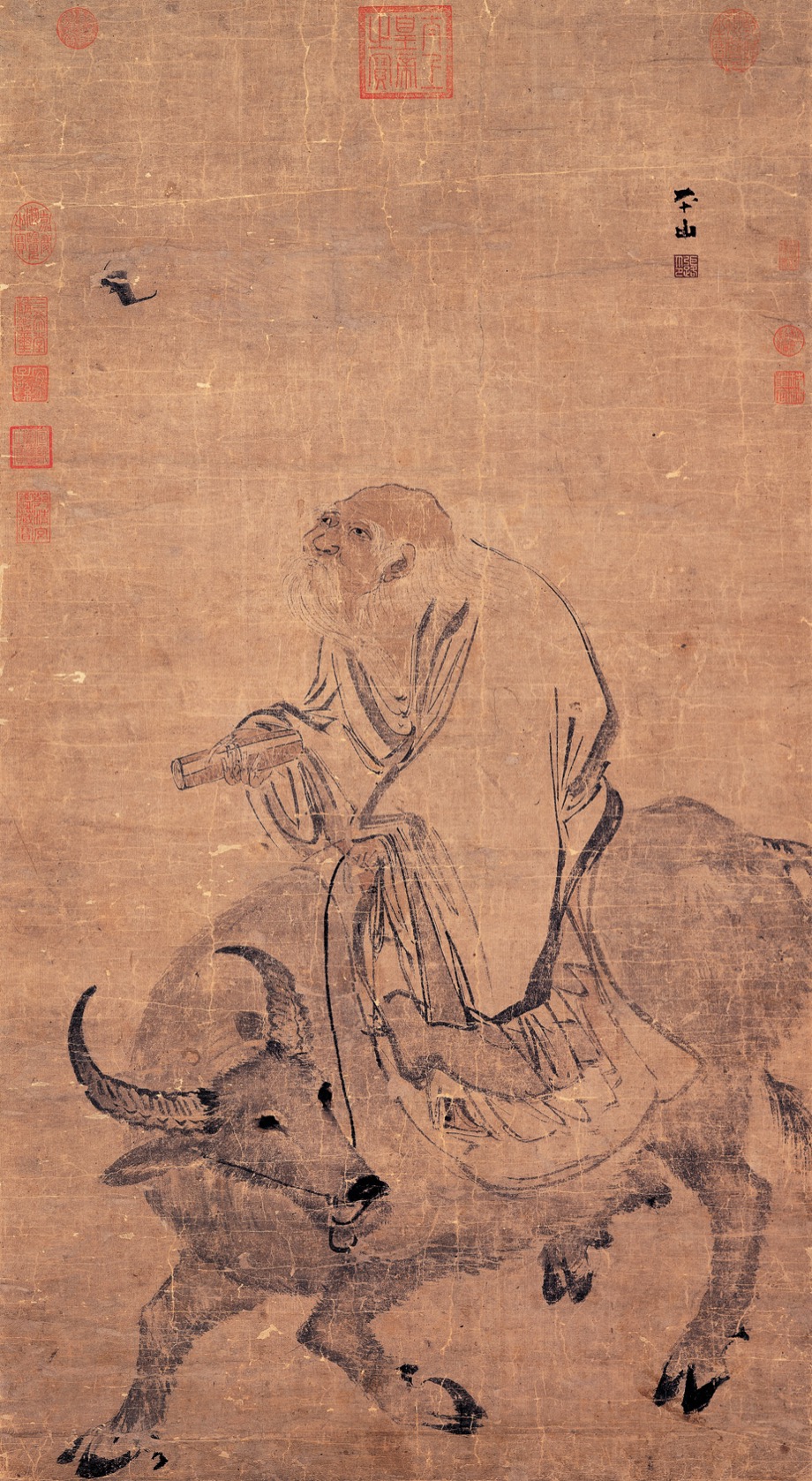
Portrait of Laozi
The Man Who Walked Out
He is the only founder of a world philosophy whose signature act is leaving. The tradition preserved by Sima Qian in the Shiji makes him a keeper of records at the Zhou royal court — an archivist, a man whose profession was the custody of other people’s documents — who watched the dynasty rot from the inside, decided the rot was terminal, and rode west on an ox toward the frontier. At the pass, a gatekeeper recognized him and refused to let him through until he wrote something down. He produced roughly five thousand characters. Then he went through the gate and out of history, fate unrecorded.
Whether any of this happened is genuinely uncertain. Modern scholarship treats “Laozi” — the name means little more than Old Master — as possibly a composite, the text itself a layered accretion rather than one evening’s dictation. But the legend is not arbitrary. It is the shape the tradition gave to a voice, and the voice on the page is startlingly consistent: dry, compressed, allergic to enthusiasm, forever turning a common assumption over to show its underside. Where his near-contemporary Confucius built a program — ritual, hierarchy, the rectification of names, a curriculum for gentlemen — the Dao De Jing offers something closer to an anti-program. It does not tell rulers what to institute. It tells them what to stop doing.
That is the psychological signature. Not a visionary’s blueprint for a reformed society, and not a preacher’s appeal to the heart, but a private, obsessive inquiry into how things actually work — water wearing down stone, the empty hub that makes the wheel useful, the uncarved block that is worth more than anything carved from it — pursued until the inquiry produced a set of conclusions so counterintuitive they could only be stated as paradox. The Dao De Jing reads like the notebook of a man who spent decades testing principles against reality alone, wrote the surviving fragments down under mild duress, and had no particular interest in whether anyone was persuaded.
Laozi is the archive’s clearest INTP: a dominant Ti that trusts only the distinctions it has verified for itself, and refuses to build a system it cannot stand behind.
Ti — The Logic of the Empty Hub
Dominant introverted thinking is not cleverness; it is the refusal to accept a category until you have taken it apart yourself. The Dao De Jing does this to the most basic vocabulary available to it. Chapter after chapter isolates a term everyone uses — strength, fullness, knowledge, achievement, the good — and demonstrates that the term has been drawn in the wrong place. Thirty spokes share a hub, and it is the hole at the center that makes the cart useful. Clay is shaped into a vessel, and the emptiness inside is what you actually wanted. Doors and windows are cut for a room, and the room is the part that is not there. This is not poetry decorating an idea. It is a repeated structural argument that our concepts consistently name the visible component and omit the functional one.
The same instrument turns on morality itself. When the great Way is abandoned, the text observes, benevolence and righteousness appear; when the family falls into discord, filial piety appears. It is a genuinely cold analysis — the virtues everyone praises are read as symptoms of a prior failure, the way a splint is evidence of a break. Confucius wanted to strengthen the splint. Laozi’s Ti asks what condition would make the splint unnecessary, and notices that no amount of splinting produces it. That distinction is the entire disagreement between the two schools, and it was arrived at not by consultation but by one man following a definition until it broke.
Ti also explains the text’s most famous sentence: the Way that can be spoken of is not the constant Way. An introverted thinker’s highest loyalty is to the internal model, and he knows better than anyone how badly language flattens it. Opening a book by warning that the book cannot say the thing it is about is not mysticism for effect. It is intellectual scrupulousness carried past the point where most philosophers would find it convenient to stop.
Ne — Paradox as Method
Auxiliary extraverted intuition is what keeps a Ti user from hardening into dogma: it supplies the counterexample, the inversion, the alternative reading. The Dao De Jing is built almost entirely out of these moves. The soft overcomes the hard. The weak overcomes the strong. To be bent is to remain whole; to be empty is to be filled. He who knows does not speak. The highest good is like water, which benefits all things and contends with none, and settles in the low places everyone else despises. Each is a hinge — take the accepted polarity and rotate it until the underside is facing up.
What makes this Ne rather than mere rhetoric is that the inversions are not decorative and they are not systematized. They accumulate. The text never resolves them into a doctrine with numbered principles; it circles the same intuition from a dozen different entry points, testing whether it holds for governance, for warfare, for craft, for infancy, for water, for valleys, for the female, for the uncarved block. A Ni-driven thinker converges — one vision, elaborated. Laozi diverges, and the convergence is left for the reader to perform.
Wu wei is the practical output of that divergence. Usually rendered non-action, it is better read as the discovery that intervention is frequently the cause of the problem it is meant to solve: the more prohibitions there are, the poorer the people become; the more laws are promulgated, the more thieves there are. Govern a large state, the text says, the way you cook a small fish — do not keep poking it. That is not passivity. It is a Ne-derived hypothesis about complex systems, stated four centuries before anyone had a word for one, and it remains one of the most durable pieces of political psychology ever written down.
Si — The Archivist’s Ear
The tradition gives him a librarian’s job, and the text sounds like one. Tertiary introverted sensing shows up here not as nostalgia for a personal past but as a preference for the compressed, the plain, and the already-worn — the aphorism over the argument. The Dao De Jing is roughly five thousand characters, densely rhymed in places, structured for memory rather than for reading. Much of it appears to draw on older proverbial material, folded in and sharpened. This is a mind that would rather perfect a sentence that already half-exists than construct an original edifice.
Si also colors the content’s persistent primitivism. The ideal state described near the end of the text is a small country with few people, where boats and carts sit unused, where the neighboring village is close enough that its dogs can be heard, and no one ever goes there. Knotted cords instead of writing. Simple food, plain clothes, contentment with the customary. From an archivist charged with the Zhou dynasty’s accumulated records, the recommendation to return to knotted rope is a remarkable judgment on his own profession — the considered opinion of a man who has read the paperwork of a collapsing civilization and concluded that the paperwork was part of the collapse.
Fe — The Gate He Rode Through
Inferior extraverted feeling is the tell that closes the case. Laozi does not persuade. He never addresses a disciple by name, never argues with an opponent, never builds the warm scaffolding of teacher and student that fills the Analects. The Dao De Jing has no interlocutors. It is a voice speaking into a room it does not expect to be occupied — and by the legend’s own account, it was written only because a man at a checkpoint would not open the gate otherwise. The founding scripture of Daoism exists, in its own origin story, under protest.
Where Fe surfaces, it surfaces as principle rather than as warmth. The sage does not accumulate; the more he gives, the more he has. Requite injury with kindness. I have three treasures: compassion, frugality, and not daring to be first in the world. These are real ethical commitments, but they are arrived at deductively — compassion is defended because it works, because the soft outlasts the hard, because contending for status is self-defeating. It is an argument for kindness, not an expression of it. And the recurring insistence on being unknown, on the sage who accomplishes the work and moves on without claiming it, is exactly what an inferior Fe looks like when it is honest: he did not want an audience, and he built a philosophy in which not wanting one is the highest achievement available.
The reported meeting with Confucius, whatever its historicity, was preserved because it dramatizes the same gap. The younger man arrives with questions about ritual and leaves rattled, reportedly comparing the old archivist to a dragon he could not follow into the clouds. Laozi’s recorded advice in the encounter is faintly withering — abandon the arrogant airs and the excessive ambitions. He was not unkind. He was simply not managing the exchange for anyone’s comfort.
Why INTP Over INTJ
Why not INTJ?
The INTJ reading is tempting — a detached mind, a mystical-sounding vocabulary, an ideal society sketched at the end of the book. But Ni-Te converges on a single vision and then engineers toward it, and Laozi does the opposite at every turn. He offers no institutions, no sequence, no mechanism of implementation; his political advice is a list of things to stop. Where an INTJ’s certainty grows as the vision sharpens, the Dao De Jing opens by declaring its own subject unspeakable and warns repeatedly against knowing. And the paradox-stacking — soft over hard, empty over full, low over high, the same intuition tested from a dozen unrelated angles and never resolved into doctrine — is Ne’s divergence, not Ni’s convergence.
The clinching evidence is the ox. An INTJ disillusioned with the Zhou court builds the alternative, or attaches to a state that might implement it, as the Legalists would within two centuries. Laozi left, wrote five thousand characters at a gatekeeper’s insistence, and disappeared. That is not long-range social engineering; it is a Ti-dominant declining to be responsible for a system he did not believe in, having satisfied himself privately about how the world works and feeling no particular obligation to make anyone else agree.
Connected Figures
Further Reading
- Dao De Jing (Tao Te Ching) — Laozi, trans. D.C. LauThe standard scholarly English text — spare, literal, and the best place to meet the aphorisms without a translator's gloss.
- Tao Te Ching — Laozi, trans. Stephen MitchellA loose, widely read rendering: not for close study, but it captures why the book keeps escaping sinology.
- Shiji (Records of the Grand Historian) — Sima QianThe source of nearly everything biographical — the archivist, the meeting with Confucius, the ox, the gatekeeper — and openly uncertain about all of it.
- Tao and Method: A Reasoned Approach to the Tao Te Ching — Michael LaFargueTreats the text as layered oral material rather than one author's essay; the best argument about how it was actually assembled.
- Daoism Handbook — Livia Kohn (ed.)Comprehensive survey of how a five-thousand-character pamphlet became a religion, an alchemy, and a deified Laozi.
