 Historical Figure MBTI
#1079 · 8-12-26 · Spring and Autumn China
Guan Zhong
Chancellor of Qi · Architect of the First Hegemon
c. 720 – 645 BCE
7 min read
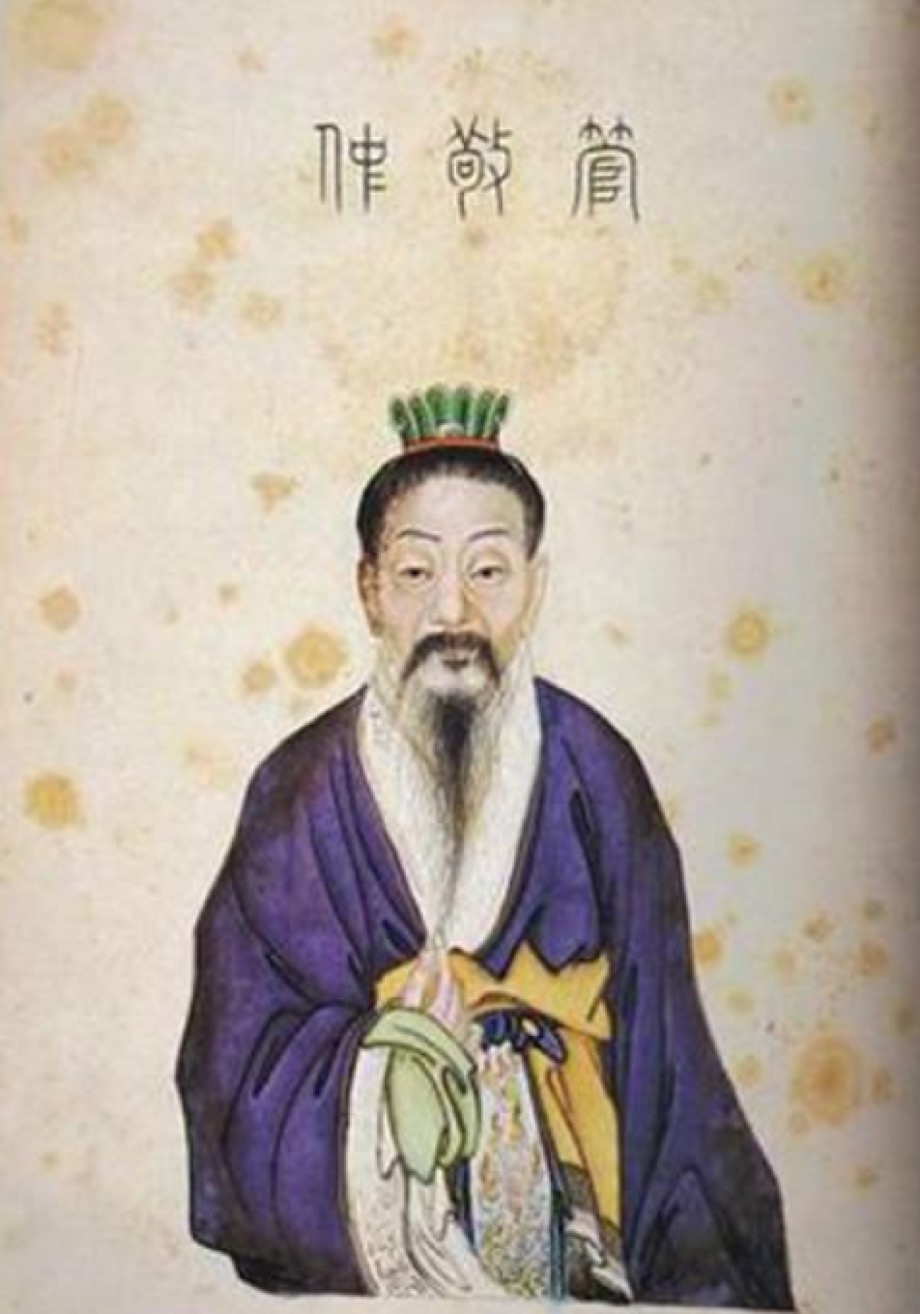
Portrait of Guan Zhong
The Man Who Built a Hegemon Out of a Kingdom
Before he was a chancellor, Guan Zhong was nearly a murderer — or at least tried to be one. In the succession chaos that followed the death of Qi's ruler, he served Prince Jiu, a rival claimant to the throne, and by tradition loosed an arrow at the fleeing Xiaobai that would have ended the future Duke Huan's life had it not lodged in his belt buckle instead of his flesh. Xiaobai won the throne anyway, and by every reasonable expectation Guan Zhong should have died for the attempt. He did not, because his old friend Bao Shuya — now the duke's advisor — argued that the very ruthlessness and competence that had made Guan Zhong dangerous as an enemy would make him indispensable as a minister. Duke Huan, remarkably, agreed.
What followed was not gratitude performed as loyalty, but loyalty performed as institution-building. Over the decades that followed, Guan Zhong rebuilt Qi from the ground up — its taxation, its army, its economy, its bureaucracy — until a mid-sized state on the Shandong peninsula became the first genuine hegemon of the Spring and Autumn period, the power other lords deferred to and the Zhou king leaned on to hold his crumbling authority together. This is the signature of the ENTJ: a mind that does not merely react to a crisis but restructures the system that produced it, and does so with such force of will that the restructuring outlives the man.
Guan Zhong was an ENTJ chancellor whose dominant Te turned a private debt of loyalty into the machinery of a hegemon.
The Machinery of the State
Guan Zhong did not reform Qi with edicts alone; he reformed it with plumbing. He reorganized the population into fixed administrative units tied to military service, so that the army that mustered on campaign was the same body of men, neighbors and kin, who had trained and lived together — a structure that turned social cohesion directly into fighting cohesion. He restructured taxation so that it fell predictably and proportionately rather than arbitrarily, and he placed the state's hand on the two commodities every household needed regardless of harvest or war: salt and iron, brought under monopoly and taxed at the point of sale rather than squeezed from an already-strained peasantry.
He also broke, quietly and consequentially, with the assumption that office belonged to birth. Positions in his administration went to men who could be tested and shown to perform, and he built the apparatus — recommendation, trial appointment, review — to make that testing routine rather than exceptional. None of this was theorized for its own sake; it was engineering, aimed at a visible target: a Qi wealthy and disciplined enough to outlast its rivals. That is Te in its purest form — not commentary on how a state should run, but the sustained, unglamorous work of making it run that way, year after year, for the better part of four decades.
Nominal Fealty, Real Power
What makes Guan Zhong more than an able administrator is the shape of the long game he was playing. The Zhou king's authority was by his lifetime a fiction most lords no longer bothered to maintain even in appearance. Guan Zhong saw, and convinced Duke Huan to see, that the path to real power ran not through discarding that fiction but through occupying it: Qi would not overthrow the Zhou order, it would become its indispensable enforcer. Under the slogan of "honoring the king, expelling the barbarians," Duke Huan convened the other lords, arbitrated their disputes, and organized their defense — all while quietly making Qi the state no coalition could function without.
This was not opportunism improvised crisis by crisis; it was a single strategic architecture applied consistently across a reign, one that let Qi extract the substance of hegemony while leaving its rivals the emptied shell of precedence. Guan Zhong read the entire trajectory of the declining Zhou world at once — where its legitimacy was thinning, where a state could insert itself as guarantor rather than usurper — and then spent his chancellorship building toward that single distant outcome rather than toward any one battle or treaty.
The Debt to Bao Shuya
Underneath four decades of policy and statecraft sits a much smaller, much more private story: a friendship that predates all of it. Guan Zhong and Bao Shuya had been partners in trade and in failed ventures before either served a prince, and later Chinese tradition remembered Guan Zhong's own testimony that Bao Shuya had covered for him again and again — taking a larger share of their profits without resentment, forgiving a poorly timed retreat in battle, never mistaking his friend's bad luck for bad character. When Bao Shuya had every institutional reason to let Duke Huan execute the man who had shot at him, and every rational incentive to claim the chancellorship for himself, he did neither. He recommended his rival.
Guan Zhong rarely wrote or acted in the register of personal sentiment — that was not where his considerable energies went — but the one place his private code surfaces clearly is in how completely he understood what he owed, and to whom. He is said to have remarked that it was not his parents who had given him life, but Bao Shuya who understood him. For a man whose public identity was built almost entirely from Te and Ni — from systems and long horizons — that one unwavering personal loyalty, held quietly beneath the machinery, is exactly where an inferior Fi would be expected to live: undeveloped as a general capacity, but absolute in the one relationship that mattered most.
Why ENTJ Over ENTP
Why not ENTP?
An ENTP chancellor would have kept reinventing Qi's institutions, chasing the next clever mechanism and abandoning the last once its novelty wore off. Guan Zhong did the opposite: he designed his tax structure, his salt-and-iron monopolies, and his military-administrative units once, early, and then spent decades enforcing and refining them rather than replacing them. The reforms outlived not just their initial implementation but his own tenure, still shaping Qi's statecraft generations later — durability, not iteration, is the tell of dominant Te over Ne.
The distinction matters because Guan Zhong's genius was never in generating options — Qi's court had no shortage of advisors proposing schemes. It was in choosing one coherent architecture and building it out with a consistency that made it structural rather than provisional. That is the mark of a Te-dominant mind: execution as the point, not merely the aftermath of insight.
Connected Figures
Further Reading
- Guanzi: Political, Economic, and Philosophical Essays from Early China — trans. W. Allyn RickettThe attributed text bearing Guan Zhong's name, compiled and expanded over centuries but preserving his statecraft philosophy.
- Shiji (Records of the Grand Historian) — Sima QianContains the earliest connected biography of Guan Zhong, including the friendship with Bao Shuya he credited above his own family.
- Zuo Zhuan (The Zuo Tradition) — attributed to Zuo QiumingThe primary chronicle of Spring and Autumn diplomacy, recording Qi's rise under Duke Huan and Guan Zhong's engineered hegemony.
- The Cambridge History of Ancient China — ed. Michael Loewe and Edward L. ShaughnessyScholarly context on Qi's institutional reforms and the Spring and Autumn hegemon system Guan Zhong helped invent.
