 Historical Figure MBTI
#1097 · 8-16-26 · The Qin Dynasty
Li Si
Chancellor Who Built and Broke an Empire
c. 280 – 208 BCE
7 min read
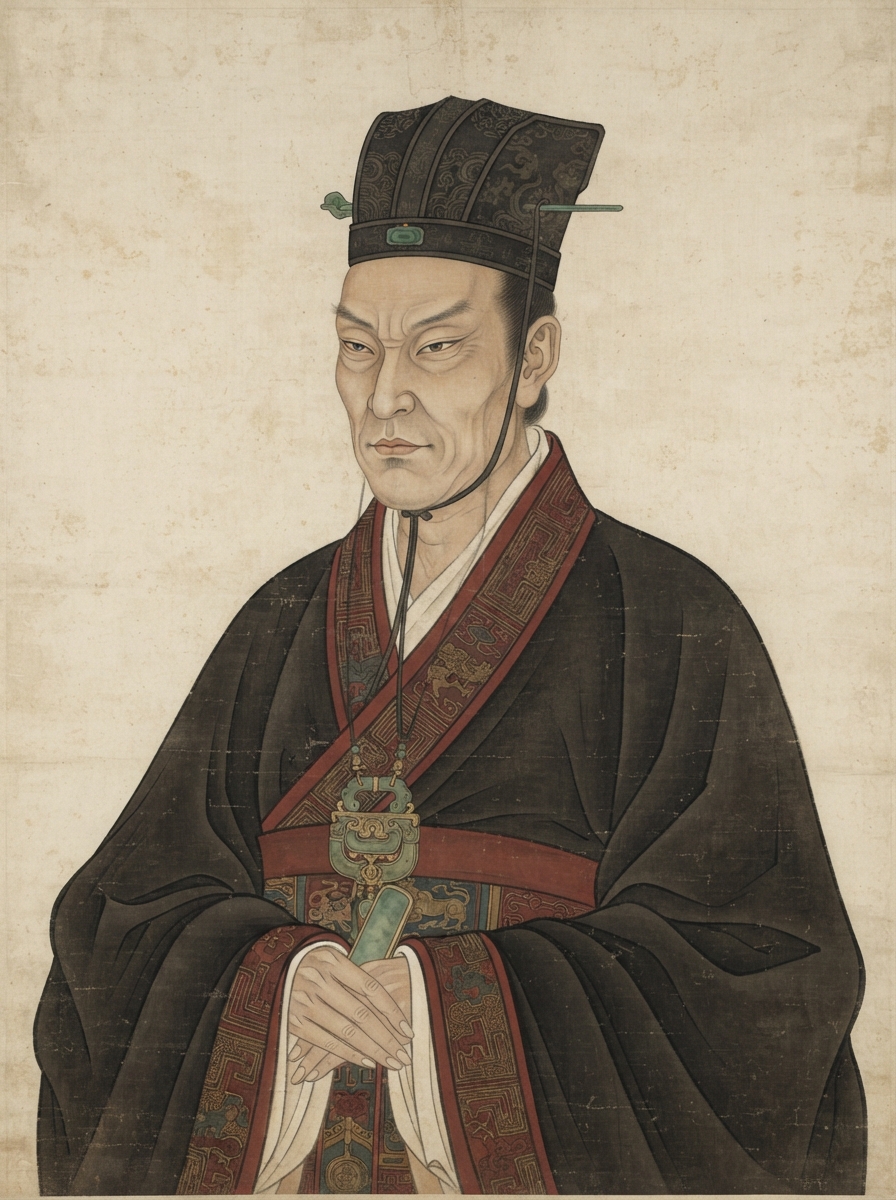
AI-assisted Portrait of Li Si
A Clerk Who Refused to Be a Rat in the Latrine
Li Si began as a minor clerk in the Chu bureaucracy, and the story he told about the moment he changed course has the shape of a founding myth he wrote for himself. He noticed, he said, that the rats living in a latrine were thin and startled, while the rats living in a granary were fat and unafraid — the difference was not the rat, it was where the rat happened to stand. Circumstance, not nature, decided a life. That single observation was enough: he quit his post, studied under the philosopher Xunzi alongside a fellow student named Han Fei, and set out for the state of Qin, then the most ruthlessly ascendant power in a fractured China, because it was the granary and not the latrine.
Everything that followed scaled outward from that decision. Li Si did not dream up Legalism — the doctrine of strict law, uniform code, and merit stripped of sentiment had already been built by Shang Yang a century earlier and sharpened by Han Fei in his own generation. What Li Si supplied was the will and the administrative machinery to run it across a newly unified empire of tens of millions: one script, one currency, one system of weights, one law, applied everywhere without exception. He is the ESTJ case study in what happens when relentless, top-down competence is handed the largest canvas in the ancient world — and in what happens when the same competence, at the very end, turns its tools on the state it built.
Li Si was Te in service of an empire — and, in his final act, Te in service of himself.
One Script, One Law, One Empire
As chancellor under Qin Shi Huang, Li Si had the rare experience of governing a country that, until very recently, had not existed as a single country at all. Six former kingdoms, each with its own script, coinage, axle gauge, and legal code, had just been welded together by conquest. Li Si treated that welding as an administrative problem to be solved, not a cultural wound to be managed. He standardized the written script into a single form usable from the old Chu heartland to the old Yan frontier, unified currency and weights and measures, and extended Qin's Legalist code — impersonal, uniform, indifferent to rank — across the whole empire.
This was Te at its most totalizing: not persuasion, not consensus, but the conviction that a system, correctly specified and enforced, would outperform any patchwork of local custom. When that same logic collided with intellectual dissent, Te showed its harder edge. Li Si argued that competing philosophical and historical traditions were themselves a threat to unity — the burning of books he ordered, and the suppression of scholars associated with it, were the same administrative instinct turned against ideas rather than measures. He also had his old classmate Han Fei imprisoned and driven to suicide in prison, not from personal hatred but because Han Fei's brilliance made him a rival for the emperor's favor — a cold, functional elimination of a variable.
No Exceptions, Anywhere
What separates Li Si's standardization from a merely clever policy is the discipline he applied to enforcing it identically everywhere — the Si that anchored his Te. A single reformed script was not left to spread by imitation; it was mandated and checked. A single set of weights and measures was not a suggestion for merchants; it applied to a granary in the old Qi lands exactly as it applied to a garrison in the old Chu lands. Si is precedent-bound consistency, the insistence that the rule already established governs every new case without renegotiation — and Li Si ran an empire-sized bureaucracy on precisely that premise, generation after local generation of officials trained to apply the same code the same way.
It shows too in how unglamorous his method was. Li Si is not remembered for a single dazzling stroke of statecraft but for years of grinding, procedural follow-through — inspecting weights, standardizing carts, drafting and redrafting law codes — the kind of work a visionary delegates and a Si-auxiliary executive insists on doing, or at least verifying, himself.
The Forged Will
Qin Shi Huang died suddenly in 210 BCE, away from the capital, and the succession he had intended — his capable, principled eldest son as heir — depended entirely on the document reporting his final wishes. Li Si held that document. Under pressure from the eunuch Zhao Gao, he agreed to forge it: the true heir was ordered to suicide, and a weak, pliable younger son was installed as the Second Emperor instead. It is the single most consequential decision of Li Si's life, and it is the one his own system offers no defense of — an unexamined, underdeveloped inferior Fi, personal survival and status dressed up as loyalty, overriding decades of stated devotion to law and order.
The irony finished itself without his help. Zhao Gao, having used Li Si to secure the throne for a puppet, then turned on Li Si himself, engineering his downfall and execution by the "five punishments," his family exterminated with him in 208 BCE. The empire he had spent a lifetime making uniform collapsed within two years. A man who never let a subordinate bend a rule could not, in the one moment that mattered most, hold a line inside himself.
Why ESTJ Over ENTJ
Why not ENTJ?
An ENTJ chancellor would have been the one drawing up Legalism from first principles, restlessly generating new grand strategy as circumstances shifted. Li Si did not design the system he ran — Shang Yang had built its legal architecture, Han Fei had sharpened its philosophy — and Li Si's genius was in scaling and enforcing an already-fixed vision with total procedural consistency, not in reinventing it. His late-life turn was likewise not strategic reinvention but defensive enforcement of one goal, his own survival, pursued with the same rule-bound rigidity he'd applied to an empire. That is Si in service of Te, not Ne driving it.
The distinction matters because it explains both halves of Li Si's life with one mechanism. The same insistence on a single system applied without exception that unified Chinese script and law also, at the end, could not bend to accommodate a moral exception when one was most needed. ESTJ names a mind built for administering an already-decided order — brilliantly, ruthlessly, and, when self-interest intruded, without the introspective brake that might have stopped him.
Connected Figures
Further Reading
- Shiji (Records of the Grand Historian) — "Biography of Li Si" — Sima QianThe foundational, near-contemporary account of Li Si's rise, chancellorship, and fall.
- China's First Unifier: A Study of the Ch'in Dynasty as Seen in the Life of Li Ssu — Derk BoddeThe standard English-language scholarly biography of Li Si and his reforms.
- The First Emperor of China — Jonathan ClementsAn accessible narrative history of Qin Shi Huang's court, with Li Si as its central administrator.
- The Cambridge History of Ancient China — Michael Loewe and Edward L. Shaughnessy (eds.)Scholarly context on Qin Legalism, the burning of the books, and the fall of the dynasty.
