 Historical Figure MBTI
#1098 · 8-16-26 · The Qin Dynasty
Qin Shi Huang
The First Emperor · Unifier of China
259 – 210 BCE
10 min read
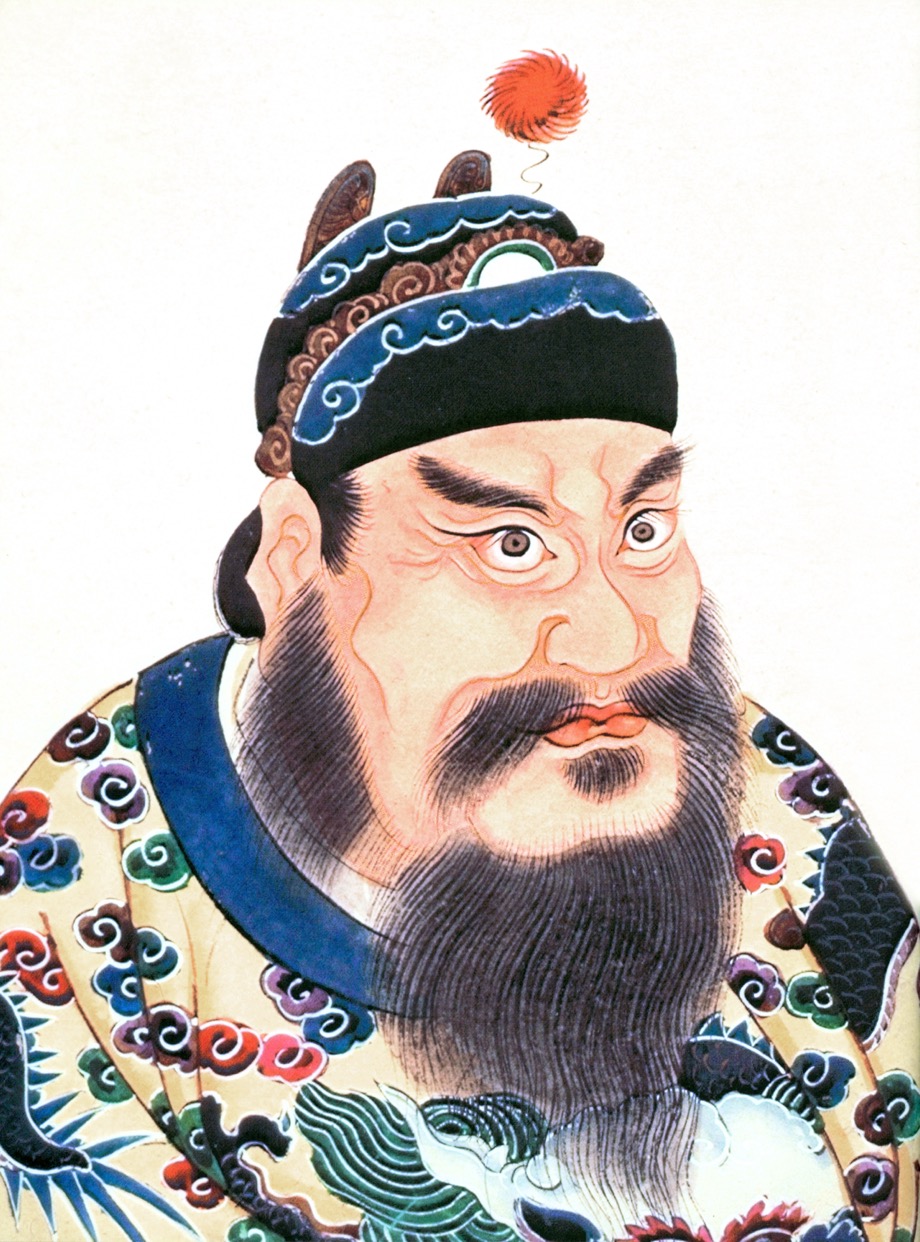
Portrait of Qin Shi Huang
The Man Who Refused to Be a King
When the last of the rival states fell in 221 BCE, the king of Qin decided that the vocabulary of Chinese power was no longer adequate to describe him. There had been kings for eight centuries; there had been, in the fog of legend, the Three Sovereigns and the Five Emperors. He took a syllable from each and made a word that had never existed — huangdi — and then appended a number to it. He would be the First Emperor. His son would be the Second, his grandson the Third, and the line would run, he specified, to ten thousand generations. It is the single most revealing act of his life: confronted with a victory no one had ever won, his instinct was not to celebrate it but to build an administrative container large enough to hold it forever.
Everything else follows from that instinct. Within a decade he abolished the hereditary aristocracy and replaced it with thirty-six commanderies staffed by appointed officials who could be audited and removed. He fixed the width of cart axles so that a single set of ruts would serve every road in the empire. He decreed one script, one coinage, one set of weights and measures, one legal code, and — when scholars persisted in citing older, better arrangements — one permitted body of thought. He melted the confiscated weapons of the conquered into twelve colossal bronze statues and set them in his capital, a public accounting of disarmament cast in metal.
Historians have spent two thousand years arguing whether he was a monster or a builder, largely because the surviving record was written by the Confucian tradition he tried to erase. But the psychological outline is remarkably stable across hostile and sympathetic sources alike: a man of ferocious executive appetite, working from a single unshakable image of the future, impatient to see it standing in stone within his own lifetime — and, at the end, terrified by the one deadline he could not administer.
Qin Shi Huang was an ENTJ whose dominant Extraverted Thinking did not manage a state so much as manufacture one, converting a vision of permanence into statutes, standards, roads and walls at a pace that consumed a generation.
Te — The Empire as a Single Machine
Extraverted Thinking is the drive to impose order on the external world by measurable means, and no ruler in history has ever taken that mandate further. The conquest itself was run as a procurement problem: Qin absorbed the six rival states in ten years by systematically buying, isolating and then annihilating them one at a time, on the advice of ministers who were promoted purely on output. When Ying Zheng found a policy that worked, he generalized it to the entire realm without sentiment. The commandery system, the household registers, the graduated penal code, the merit ranks — these were not innovations he invented so much as instruments he scaled, because scale was the point.
The standardizations are the purest expression of the function. A unified script meant an order written in the capital could be executed on the southern frontier without translation. Unified weights and measures meant tax assessed in one province could be audited against another. Standard axle widths meant a supply cart built anywhere could run the imperial highways anywhere. Each measure looks pedantic in isolation; together they constitute a deliberate re-engineering of an entire civilization for throughput. He was not decorating his reign with reforms. He was removing every source of friction between his will and its execution.
Te is also visible in how he used people. He elevated Li Si, a commoner from Chu, to the chancellorship because Li Si produced results, and let him restructure the state to its foundations. He read the essays of Han Fei and reportedly said he would die content if he could meet their author — then, when Han Fei proved politically inconvenient, permitted his death in prison. He destroyed Lü Buwei, the regent who had made his accession possible, once the man became a liability. Loyalty was not a category he reasoned in; usefulness was, and usefulness was assessed continuously.
Ni — One Law, One Script, Ten Thousand Generations
Behind the machinery sat a single, totalizing image that never varied. The Warring States period had produced dozens of proposals for ending the chaos; almost all of them imagined a restored Zhou order, a hegemon presiding over a family of states. Ying Zheng imagined something no one had seen: not a stronger league but the dissolution of states as such, replaced by one undifferentiated administrative body answering to one throne. When his advisors urged him to enfeoff his sons as regional kings — the arrangement every Chinese ruler had known for eight hundred years — he refused, on the grounds that hereditary fiefs were precisely the mechanism that manufactured civil war. That is Introverted Intuition arguing from a picture of the future against the entire weight of precedent.
The vision was cosmological, not merely political. He adopted the Five Phases doctrine and declared Qin the dynasty of Water, with black as its color, six as its number and severity as its governing virtue — an attempt to locate his regime inside the machinery of the universe itself, so that its authority would look less like conquest than like season. His mausoleum, dug for decades beneath an artificial hill near modern Xi'an, was reportedly a scale model of the empire and the heavens together, with rivers of mercury and a mapped sky overhead. Even in death he intended to keep governing a complete world.
And it is why the burning of the books was, in his mind, a coherent act rather than a fit of temper. Scholars who cited the past to criticize the present were not merely irritating; they held an alternative image of order, and two images could not both be true. Suppressing the philosophical archive, exempting only manuals of medicine, divination and agriculture, was Ni defending the singularity of its own vision. Reasonable men would keep finding older arrangements attractive so long as the older arrangements remained legible.
Se — Build It Now, Out of Whatever Is at Hand
A vision that large could have stayed on paper for a century. It did not, because the First Emperor had no patience for staged construction and an almost physical craving to see the thing standing. Within a few years of unification, hundreds of thousands of conscripts were moved north under General Meng Tian to link the frontier fortifications of the old states into a continuous rampart — the first Great Wall — while other levies cut a straight military highway from the capital toward the steppe, and a canal was dug through the southern mountains to float supplies into the campaigns against the Yue. He did not sequence these projects. He ran them at once.
The tertiary Se shows in the crudeness as much as the speed. His answer to intellectual opposition was to burn the physical objects and, according to Sima Qian, to bury the offending scholars alive — a solution reached for at the level of hands and bodies rather than argument. His answer to a dangerous population was to relocate a hundred and twenty thousand aristocratic households to the capital, where they could be watched. His answer to the frontier was earth and rammed clay. When a mountain's weather delayed his passage, the tradition has him strip the mountain bare and paint it red. These are not the improvisations of a subtle man; they are the reflexes of a decisive one, and they worked with terrible efficiency.
He was also, unusually for a ruler of his security anxieties, constantly in motion — five great inspection tours in eleven years, erecting inscribed stelae on sacred mountains, sailing out to look for the immortal islands, dying at last on the road. He needed to see his empire with his own eyes. And that appetite for direct presence nearly killed him early: when Jing Ke came to court in 227 BCE with a dagger hidden in a rolled map, the king survived by physically outrunning him around a pillar until he could free his own sword.
Fi — The One Thing He Could Not Standardize
The inferior function is where a personality goes strange, and in Qin Shi Huang it went strange in the most literal way imaginable. The man who could weigh grain, measure roads and audit provinces discovered in middle age that he could not audit his own body. What followed was not policy but private obsession: expeditions dispatched east to the legendary isles of Penglai in search of the herb of deathlessness, alchemists retained at court, fortunes spent, and — by the most persuasive reading of his death — cinnabar pills taken daily, mercury swallowed as medicine by a man who had ordered rivers of it poured into his tomb.
It shows in his secrecy too. Late in life he had covered walkways built between his two hundred and seventy palaces so that no one could know which he slept in; courtiers who disclosed his movements were executed. He stopped speaking of himself by name. He is said to have read a fixed weight of documents each night before sleeping. This is inferior Fi at its most characteristic — a whole inner life accessible to no one, protected by procedure, expressing itself only as dread. The emperor who had no use for sentiment in others had by then a fixation more personal and less rational than anything he had ever forbidden his subjects.
The irony is exact and total. He died in 210 BCE at Shaqiu, on tour, far from the capital, probably poisoned by his own remedy. Li Si and the eunuch Zhao Gao concealed the corpse for the journey home, packing carts of salted fish alongside the imperial carriage to mask the smell, forging the succession as they travelled. The man who had legislated the shape of ten thousand generations was smuggled back to his capital as cargo, and the dynasty he numbered to infinity ended at the Second Emperor, four years later.
Why ENTJ Over ESTJ
Why not ESTJ?
The ESTJ reading is tempting because the surface is all administration — registers, statutes, standards, audits. But an ESTJ administers an inherited system well; Qin Shi Huang refused the inherited system outright. He rejected the eight-hundred-year-old enfeoffment order that every precedent recommended, invented a title that had no referent, imposed a new script on people who already had functioning ones, and rebuilt law, currency, roads, frontier and cosmology from first principles in a single reign. Si would have improved the Zhou arrangement; Ni discarded it. The standardizations were not housekeeping but the physical scaffolding of an idea, and the idea came first.
The distinction matters most where he failed. An ESTJ ruler, working from precedent and consensus, would likely have moderated the pace when the conscription levies grew unsustainable, because the feedback was empirical and loud. Qin Shi Huang could not, because the wall, the tomb, the highways and the purge of rival thought were not separable line items to be trimmed — they were one vision, and partial execution would have meant no execution at all. He drove a working state into exhaustion in pursuit of permanence, and the rebellions began within a year of his death. That is the characteristic ENTJ collapse: not incompetence, but a vision pursued past the carrying capacity of the people asked to build it.
Connected Figures
Further Reading
- Shiji: Basic Annals of the First Emperor of Qin — Sima QianThe foundational account, written a century later by a hostile Han historian — every anecdote here, including the mercury and the salted fish, traces back to it.
- The First Emperor of China — Jonathan ClementsThe most readable modern biography, careful about separating Sima Qian's reportage from his moralizing.
- China's First Emperor and His Terracotta Warriors — Frances WoodPairs the archaeology of the mausoleum complex with the textual record; strongest on what the tomb actually reveals about Qin logistics.
- China's First Unifier: A Study of the Ch'in Dynasty as Seen in the Life of Li Ssu — Derk BoddeThe classic scholarly treatment of the machinery of unification, told through the chancellor who built it.
- The Cambridge History of Ancient China — Michael Loewe & Edward Shaughnessy (eds.)Sets the Qin conquest in the long Warring States context and weighs the evidence for the book-burning and the scholar-burial.
