 Historical Figure MBTI
#1099 · 8-16-26 · The Qin Dynasty
Lü Buwei
The Merchant Who Bought a Throne
c. 291 – 235 BCE
6 min read
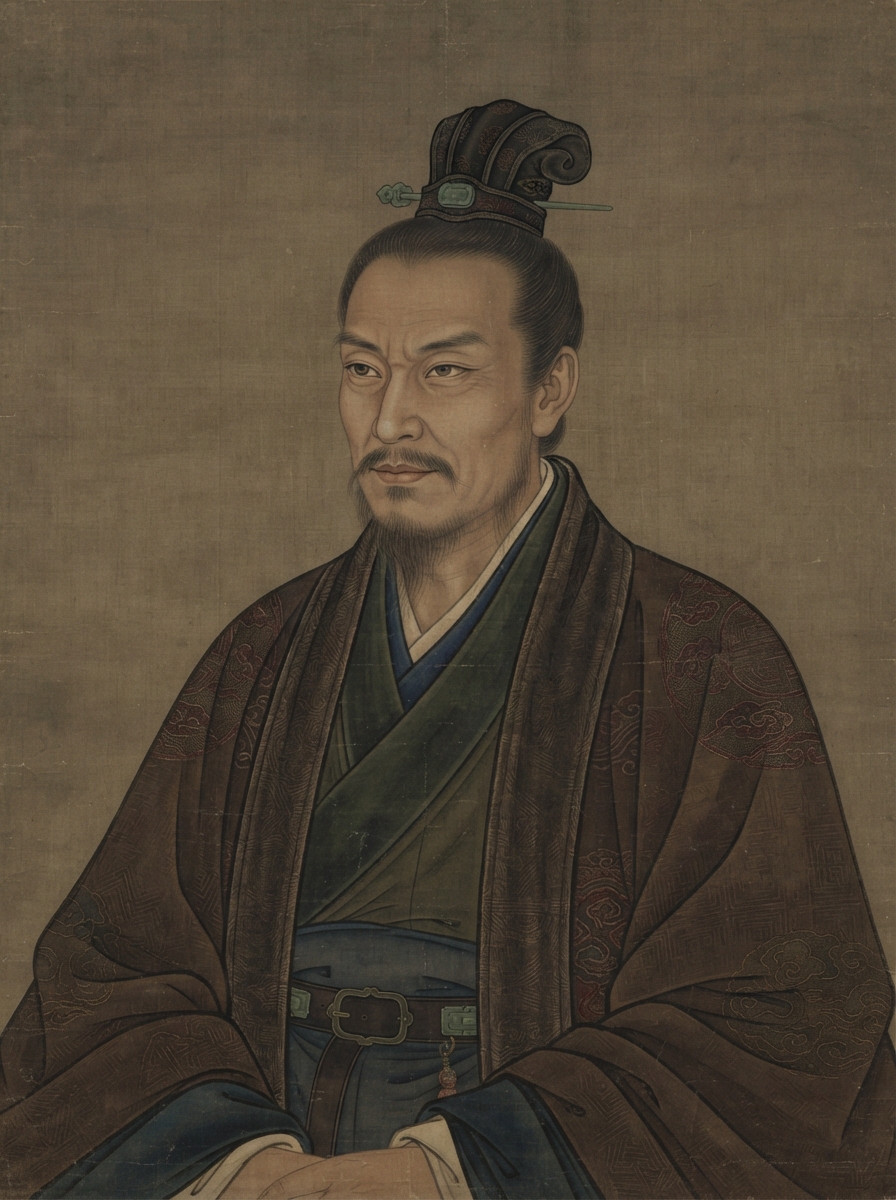
AI-assisted Portrait of Lü Buwei
Rare Merchandise, Worth Hoarding
Lü Buwei made his fortune trading between the cities of the late Warring States, buying cheap and selling dear, and he looked at a person the same way he looked at a jade or a bolt of silk. Sometime around 260 BCE, doing business in the state of Zhao, he came across a minor Qin prince named Yiren, held there as a hostage of low standing, treated shabbily even by his own family back home. Most men would have seen a diplomatic afterthought. Lü Buwei reportedly turned to his father and asked what the profit margin was on farming, on the jewel trade — and then on “setting up a kingdom’s ruler.” He is said to have called Yiren “rare merchandise, worth hoarding.”
It was not a metaphor he let sit idle. Lü Buwei spent his own fortune bribing his way into the Qin court, arranged for the childless favorite consort of the Qin crown prince to adopt Yiren as her heir, and stage-managed the friendless hostage’s return home and eventual accession as King Zhuangxiang. He had purchased, in effect, a king — and cashed the note in as chancellor of Qin, then as the power behind a child sovereign who would grow up to be Qin Shi Huang. It is one of the most audacious speculative trades in Chinese history, and it reads, start to finish, as the work of an ENTP: a mind that scans a field of discarded possibilities for the one nobody else has priced correctly.
Lü Buwei was an ENTP who traded in futures nobody else could see — a merchant’s Ne fixed on a hostage prince as the rarest commodity in the world.
A Trader in Discarded Futures
Dominant Ne does not see a hostage prince and think in terms of his current station; it strips the label off and asks what else the object in front of it could become. Every other actor in the Zhao court treated Yiren as a write-off — a bargaining chip so minor no one bothered updating the terms of his captivity. Lü Buwei alone ran the counterfactual: a childless consort back in Qin, a line of succession with a gap in it, and a friendless prince who would owe his entire existence to whoever filled that gap first. That is Ne’s signature move — treating the present arrangement of the world as provisional, one reshuffle away from a different, better configuration.
The same appetite for open possibility shows later, in power, when Lü Buwei commissioned the Lüshi Chunqiu, the “Spring and Autumn Annals of Lü Buwei.” Rather than declare for one school — Legalism, Confucianism, Daoism — and enforce it, he assembled scholars from every tradition and had them compile a synthesis, betting that no single ideology held the whole truth of government. It is the same mind that once looked at a discarded prince and saw an asset: refusing to accept the going valuation on anything, whether a hostage or a philosophical school.
The Arithmetic Behind the Wager
A pure gambler bets on a hunch. Lü Buwei backed his with structure. The plan for Yiren was not one bribe but a sequence: money to soften Yiren’s standing at the Zhao court, money and persuasion to place him as the adopted heir of the childless consort Lady Huayang, and a calculated exit — buying Yiren’s escape from Zhao at the exact moment war made his hostage status a liability rather than an asset. Each step depended on the one before it holding. That is auxiliary Ti at work: Ne supplies the audacious premise, Ti builds the load-bearing logic that lets the premise survive contact with a hostile court.
The same calculating instinct shaped his account, as Sima Qian records it, of giving a favored concubine to Zhuangxiang while she was reportedly already carrying his own child — a maneuver, if the tradition is accurate, engineered with exact foreknowledge of the odds it would take to plant a chancellor’s bloodline on the Qin throne itself. Whether or not the paternity claim is later Han-dynasty character assassination, the alleged plan has the shape of Lü Buwei’s mind: not a leap of faith but a wager priced down to the month.
A Reward for Anyone Who Could Improve One Word
Once the Lüshi Chunqiu was finished, Lü Buwei reportedly had it hung at the gate of the Qin capital with a thousand pieces of gold suspended beside it — a public offer to anyone who could alter a single character for the better. No one collected. The gesture mattered more than the prize: it was theater aimed at the whole literate world, an argument that his chancellorship rested on persuasive authority rather than merely on the throne he had helped install. Tertiary Fe wants consensus performed in public, wants the room won over rather than merely out-legislated.
But performance is not the same as entrenchment, and this is where Lü Buwei’s weak, inferior Si finally caught up with him. He never built the quiet institutional machinery — the loyal bureaucratic base, the settled precedent, the patient cultivation of the growing king’s trust over years — that might have outlasted a single scandal. When a courtier’s affair with the queen dowager blew up into a court crisis in 238 BCE, the young King Zheng, by then suspicious of the chancellor who had made him, had no deep structural loyalty to fall back on. Lü Buwei was stripped of office in a matter of months. A man who could price a hostage prince to the month had never priced his own exposure.
Why ENTP Over ENTJ
Why not ENTJ?
An ENTJ chancellor builds. He drafts the statute, staffs the ministry, drills the loyal cadre that will still answer to him a decade on — dominant Te converting a vision directly into command structure. Lü Buwei never did any of that. His entire rise ran through wagering on an overlooked person, buying influence rather than commanding it, and trying to win the philosophical argument in public rather than quietly wiring the bureaucracy to make his position irremovable. When the crisis came, he had no machine — only a case he’d been making, and a king who had stopped listening.
The distinction is the whole story. An ENTJ who spots a hostage prince’s potential starts building him a faction. An ENTP spots the same potential, prices the trade, and executes it as a single audacious transaction — then tries to hold the resulting power through persuasion and reputation rather than institutional weight. Lü Buwei won bigger and faster than any Te-dominant strategist would have dared. He also had nothing left to stand on when the argument stopped working.
Connected Figures
Further Reading
- Shiji (Records of the Grand Historian), "Biography of Lü Buwei" — Sima QianThe primary — and heavily moralized — ancient account of the hostage gambit and the paternity scandal.
- The Annals of Lü Buwei — trans. John Knoblock & Jeffrey RiegelFull English translation of the Lüshi Chunqiu, the compendium Lü Buwei commissioned.
- The First Emperor of China — Jonathan ClementsA readable narrative history situating Lü Buwei within Qin Shi Huang's rise.
