 Historical Figure MBTI
#1096 · 8-16-26 · The Qin Dynasty
Han Fei
Legalism's Sharpest Theorist
c. 280 – 233 BCE
7 min read
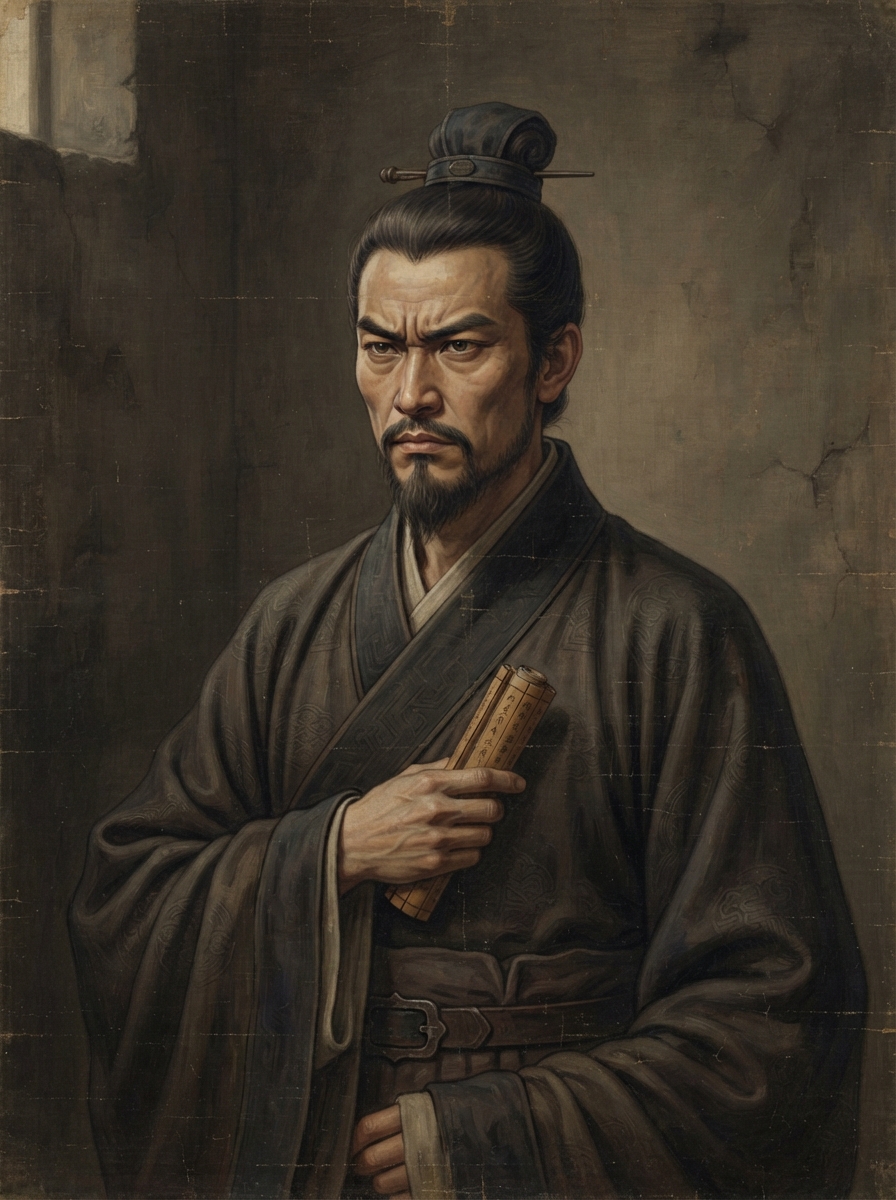
AI-assisted Portrait of Han Fei
The Man Who Could Not Speak, and Would Not Stop Writing
Han Fei was born a prince of Han, the weakest of the seven warring states, at a moment when weak states did not get to keep their princes' illusions. He studied under Xunzi alongside a fellow disciple named Li Si, and by every account he was the sharper mind of the two — except that a severe stutter made him nearly useless in the one arena that mattered most to an ambitious man of his era: the spoken audience with a ruler. Chinese court politics ran on persuasion delivered live, syllable by syllable, in front of a throne that could kill you for a wrong word or ignore you for a right one delivered badly. Han Fei could not compete there. So he did something colder and, it turned out, far more durable — he stopped trying to be heard and started making sure he would be read.
What came out of that redirection was the Han Feizi, the single most complete theoretical structure Chinese Legalism ever produced — a synthesis of Shang Yang's law, Shen Buhai's bureaucratic method, and his own teacher Xunzi's grim verdict on human nature, fused by an INTJ mind that treated governance not as a set of virtues to be modeled but as a system to be engineered. It is a legend, and probably not far from true, that his essays reached the king of Qin — the future First Emperor — and impressed him so much that Qin nearly went to war with Han simply to acquire the man who wrote them.
Han Fei is INTJ dominant Ni at its most severe: a totalizing private architecture of statecraft, built once, in isolation, to be imposed rather than debated.
One System, Built From Three Broken Ones
Before Han Fei, Legalism was a scatter of workable but partial insights. Shang Yang had shown, a century earlier in Qin itself, that impartial law (fa) — applied to nobles and peasants alike, rewards and punishments fixed and public — could turn a backward state into a war machine. Shen Buhai had shown that a ruler needed technique (shu), covert methods for auditing and controlling his own ministers, because a bureaucracy left to itself would hollow out the throne from within. What Han Fei saw, and no one before him had articulated whole, was that neither alone was sufficient — that law without method left the ruler blind to his own officials, and method without law left punishment arbitrary and untrustworthy. He added a third leg, positional power (shi), the argument that a mediocre ruler backed by the right institutional position could out-govern a sage ruling by pure virtue, because virtue is not transferable and position is.
This is dominant Ni doing exactly what it does at its most severe: taking in scattered, partial, historically contingent material and fusing it, alone, into a single closed architecture that did not exist as a whole in anyone else's head. Han Fei did not road-test his synthesis through debate or apprenticeship in office — he built it in withdrawal, on the page, and only afterward did the world come looking for it. The finished theory was not a set of policy suggestions a ruler might adapt; it was offered as a total operating system for the state, internally consistent enough that later dynasties which loudly renounced Legalism as cruelty kept running large parts of it under other names.
A Ministry of One, Conducted in Ink
Te ordinarily looks like an executive running an office, issuing orders, tightening a process in real time. Han Fei's stutter closed that channel to him, and what happened instead is instructive about how a function adapts when its usual outlet is blocked: the efficiency drive did not disappear, it moved entirely into text. The Han Feizi is not a philosophical meditation but an applied manual — chapter after chapter of specific mechanisms a ruler could install: the "two handles" of reward and punishment kept exclusively in the sovereign's grip, the technique of comparing a minister's words against his results (xing-ming) to catch inflated claims, the argument for anonymous and unpredictable royal conduct so that ministers could never game the ruler's habits.
Every one of these is a piece of organizational engineering, not moral exhortation — and that is the tell. Han Fei never once argues that a ruler should be good; he argues, relentlessly, about what will actually work, given what people actually do when unsupervised. His prose is stacked with historical case studies functioning as after-action reports — this minister deceived that duke, this law prevented that rebellion — the register of a mind building an instruction manual, not a sermon.
Sentiment as a Trap, Held as a Private Conviction
Han Fei's contempt for Confucian virtue-talk was not delivered as detached analysis; it reads as something closer to a private, near-obsessive conviction that sentiment was a trapdoor rulers kept falling through. He wrote of fathers and sons calculating each other's usefulness, of a wet nurse and a physician who "love" a child only because it profits them to keep it alive — a bleaker anthropology even than Xunzi's, pushed further than his teacher was willing to push it. That extremity, held with such unwavering internal certainty across an entire body of work, is Fi rather than Te at work underneath the system: a value commitment — that comforting illusions are the most dangerous thing a ruler can permit himself — defended not because it was popular or provable but because Han Fei believed it down to the floor.
It cost him. His own former classmate Li Si, threatened by a rival he knew to be more capable, had him imprisoned in Qin on fabricated charges and, before the king could intervene, either forced or maneuvered him into drinking poison. Han Fei had spent a career arguing that a ruler could not afford to trust in another man's good faith — and he died because he had, for one crucial interval, trusted in his own position instead of anticipating exactly the kind of betrayal his entire philosophy predicted.
Why INTJ Over INTP
Why not INTP?
An INTP theorist explores a system for its own coherence, content to leave its application to someone else. Han Fei never wrote that way. Every mechanism in the Han Feizi — the two handles, the comparison of word to deed, the ruler's studied unpredictability — is pitched directly at an actual sovereign running an actual state, with the explicit goal of being installed and used. His writing courted a throne, and very nearly won one by force of persuasion alone; that is judgment (Te) in service of a settled inner vision, not perception exploring possibility.
The distinction matters because Han Fei is sometimes mistaken for a mere systematizer, cataloguing Legalist thought the way a scholar catalogues a school. But a cataloguer does not risk — and lose — his life delivering the finished product in person to the one court capable of using it. Han Fei built his architecture to be imposed on the world, not admired from a private study, and that directedness is the mark of a dominant intuitive judger, not a perceiver refining a thought experiment.
Connected Figures
Further Reading
- Han Feizi: Basic Writings — trans. Burton WatsonThe standard accessible translation of Han Fei's core essays.
- Shiji (Records of the Grand Historian): Biography of Han Fei — Sima QianThe earliest connected narrative of his life, rivalry with Li Si, and death.
- Disputers of the Tao — A. C. GrahamSituates Han Fei's synthesis within the broader landscape of Warring States philosophy.
