 Historical Figure MBTI
#1070 · 8-10-26 · The Ramesside Age
Nefertari
Abu Simbel’s Queen
fl. c. 1279 – 1255 BCE
8 min read
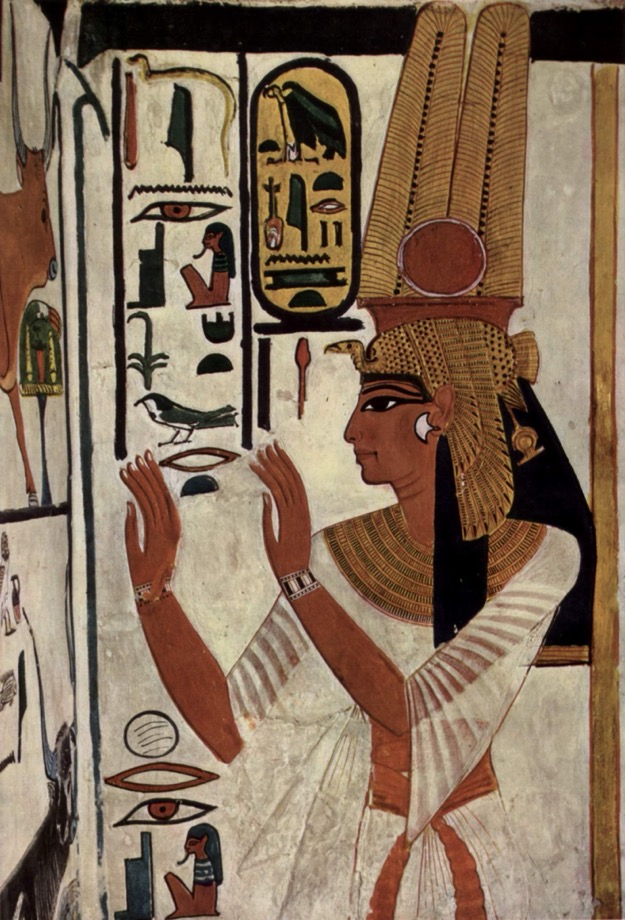
Tomb painting of Nefertari
The One for Whom the Sun Shines
Two temples stand cut into the cliff at Abu Simbel. The larger belongs to Ramesses II, four seated colossi of himself, and it is exactly the monument you would expect from a man who spent sixty-six years telling Egypt how large he was. The smaller, two hundred feet north, is stranger. Its façade carries six standing statues more than thirty feet high — four of Ramesses, two of Nefertari — and hers are cut to the same height as his. In Egyptian royal art a queen is knee-high to her husband. Here, for the only time, she is not.
The dedication inscription is even less usual than the scale: the temple is for Hathor of Ibshek and for Nefertari, and Ramesses states that he made it for her, “for whose sake the very sun does rise.” A queen had never before been given a temple of her own on that scale, and no queen would be again. Whatever else Nefertari was, she was the woman for whom the most self-absorbed pharaoh in Egyptian history stepped, once, out of his own frame.
We know her from three things: that temple, her tomb, and a letter. Together they describe a specific kind of person — someone whose gift was for the atmosphere around her. She appears beside Ramesses at his coronation, at the founding of Pi-Ramesses, at the Abu Simbel dedication; she bore him at least four sons and two daughters; she held the titles God’s Wife and Lady of the Two Lands. And when Egypt made peace with the empire it had fought for a century, it was Nefertari who wrote to the Hittite queen.
Nefertari is an ESFJ whose dominant Fe made her the connective tissue of a reign — warmth deployed as statecraft, holding a household, a court, and finally two empires in working relation.
A Letter to the Queen of the Enemy
After the Battle of Kadesh had settled nothing and sixteen further years had settled nothing either, Egypt and Hatti signed the earliest surviving international peace treaty in history — sworn in Ramesses’s twenty-first year, preserved in both Egyptian hieroglyphs at Karnak and Akkadian cuneiform at Hattusa. What followed the treaty is where Nefertari appears. A tablet from the Hittite archive preserves her letter to Puduhepa, the Hittite queen: she addresses her as sister, wishes peace and brotherhood between their two great lands forever, tells her the sun-god and the storm-god will grant it, and sends gifts — a necklace of pure gold, linen of the finest weave, dyed cloth.
Nothing about this was ceremonial boilerplate. Puduhepa was a formidable figure in her own right, co-signing her husband’s correspondence and conducting negotiations directly, and the two queens maintained a channel that ran in parallel to the kings’ own. It is a second track of diplomacy, conducted in the register of personal relationship rather than terms and guarantees — precisely what a treaty between exhausted enemies needs if it is to become an actual peace rather than a document. That peace held for the rest of both dynasties, and was sealed a few years later by a Hittite princess marrying into the Egyptian royal house.
Dominant extraverted feeling reads a room and then works to make it a better room. Nefertari does it at every scale available to her: standing beside Ramesses at ceremonies where a queen’s presence signalled that the new dynasty was a family and not a junta; shaking sistra before Hathor to place the divine feminine at the centre of the state cult; writing sister to a woman whose army had tried to kill her husband. The instinct is always the same — find the relationship, and warm it.
The Rites Performed Exactly
Auxiliary Si is why her Fe never destabilized anything. Nefertari operated with complete fluency inside the traditional apparatus of Egyptian queenship: God’s Wife of Amun, Mistress of Upper and Lower Egypt, the Hathoric role with its sistrum and menat, the ritual calendar observed year upon year. She was not of royal birth — her origins were probably in the Theban nobility, and a knob from the tomb of Ay found among her possessions has kept scholars speculating for a century — yet she inhabited the role so completely that no one appears to have questioned it.
Her tomb, QV66, is Si given a palette. Every register of it is orthodox: the queen playing senet against an unseen opponent, guided by Isis, adoring the gods, passing the gates of the underworld with the correct text spoken at each. There is not one invented image in the whole chamber. What makes it the most beautiful painted tomb in Egypt is not novelty but the quality of attention — the linen rendered translucent over her body, the yellow-gold of her jewellery, the deep blue of the star ceiling — the tradition executed with a warmth that the tradition alone does not supply.
Room Enough for a Nubian Temple
Tertiary Ne shows up as receptiveness rather than invention. Someone at Abu Simbel decided that a queen could be carved at a king’s scale and identified with a goddess in her own sanctuary — a genuine break with eight centuries of convention — and Nefertari occupied that break without visible strain. She is shown inside the small temple being crowned by Hathor and Isis, and offering to the gods herself, unaccompanied: a queen performing priestly acts that Egyptian art normally reserves for the king.
The same openness is what let her pick up the correspondence with a foreign court and make something of it. Nobody had a protocol for queen-to-queen diplomacy between Egypt and Hatti; the relationship had to be improvised out of gifts and courtesy formulas. She was comfortable in a situation with no precedent, provided the situation was fundamentally about people. That is Ne serving Fe: the imagination gets used on relationships, not on systems.
The Argument She Never Had to Make
For a woman of her prominence, Nefertari left remarkably little that is analytical. Her letter to Puduhepa contains no terms, no conditions, no leverage — it is an expression of goodwill attached to a treaty other people had drafted. She never appears contesting policy, never appears advancing a claim, never appears building a faction. The inferior function is simply absent from the record.
It is also, arguably, why her position was never threatened. Ramesses had a second Great Royal Wife, Isetnofret, whose sons would eventually inherit; a court queen who argued and calculated would have found herself in a succession fight and quite possibly lost it. Nefertari never entered that contest, and Ramesses buried her in the most beautiful tomb in Egypt. Whether that reflects a limitation or an extraordinarily accurate reading of what her role could bear is the open question of her life.
Why ESFJ Over ENFJ
Why not ENFJ?
Both lead with Fe, and a queen who wrote to her husband’s enemies about brotherhood between nations sounds like the visionary version. But ENFJ’s Ni drives toward a future the person has authored themselves, and Nefertari never authored anything. She amplified: Ramesses built the temples, Ramesses and Hattusili made the treaty, the tradition supplied the rites. Her genius was for making an inherited role radiate — Si in the second seat, working from the established form outward, not Ni pulling toward a different one.
That distinction is not a demotion. Ramesses II was an ENTJ engine of self-assertion who would happily have spent seven decades carving his own face into every cliff between Nubia and the Delta, and the thing that made his reign feel like a golden age rather than a monument to one man was that Nefertari was standing in it. She humanized a project she had not designed, and the two most affecting objects left by the most bombastic reign in Egyptian history — a temple where the queen stands at full height, and a tomb painted like a memory of someone loved — are both hers.
Connected Figures
Further Reading
- Ramesses: Egypt's Greatest Pharaoh — Joyce TyldesleyThe most readable account of the reign and of Nefertari's place in the royal household.
- Pharaoh Triumphant: The Life and Times of Ramesses II — Kenneth A. KitchenThe standard scholarly narrative; strongest on Kadesh, the peace treaty, and the queens' correspondence with Hatti.
- House of Eternity: The Tomb of Nefertari — John K. McDonald (Getty Conservation Institute)Full account of QV66 and the conservation campaign that saved its paintings.
- The Egyptian–Hittite Peace Treaty — Karnak hieroglyphic and Hattusa cuneiform versionsThe earliest surviving international peace treaty, and the diplomatic frame for Nefertari's letter to Puduhepa.
