 Historical Figure MBTI
#1060 · 8-8-26 · The Amarna Period
Nefertiti
The Face of the New Religion
fl. c. 1353 – 1336 BCE
10 min read
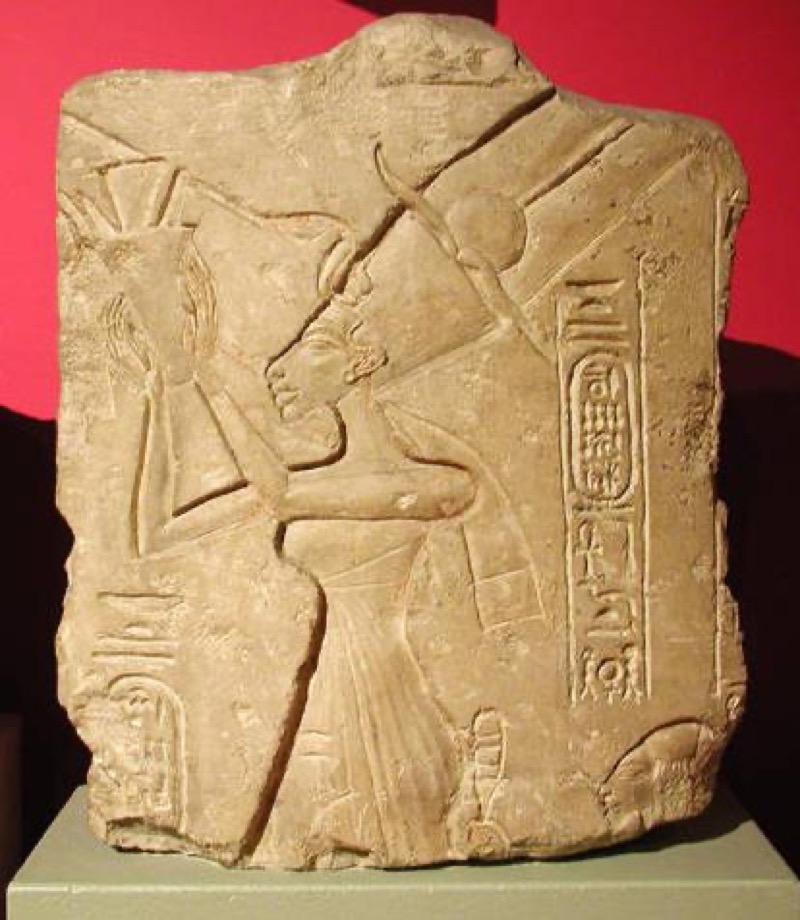
Relief of Nefertiti
A Revolution That Needed a Face
Somewhere in the ruins of a sculptor’s workshop at Amarna, in 1912, a German expedition lifted a painted limestone head out of the sand and found itself holding the most famous woman of the ancient world. The bust was unfinished — one inlaid eye had never been set — and it had been left behind as a working model, a reference object for apprentices copying a face they would have to reproduce a thousand times across a brand-new city. That is the detail worth holding onto. Nefertiti’s face was not preserved because it was beautiful. It was preserved because it was needed: a standard, a template, an image the state had to get right because the image was doing theological work.
Her husband abolished the gods. Around the fifth year of his reign, Amenhotep IV became Akhenaten, closed the temples of Amun, defunded a priesthood that had run Egypt’s spiritual economy for centuries, and moved the court to a raw site in Middle Egypt that no god had ever claimed. In place of the old crowded pantheon he installed a single luminous abstraction: the Aten, the visible disk of the sun, which had no myths, no consort, no animal form, no story anyone could tell a child. It was, by the standards of Bronze Age religion, an almost unbearably cold idea. And it was Nefertiti who made it warm.
The evidence is not decorative. At the Aten temples at Karnak, built before the move to Amarna, her image appears in the reconstructed talatat blocks as often as her husband’s and by some counts more often. She is shown offering directly to the disk — an act of priestly mediation ordinarily reserved to the king. On one structure, the Hwt-Benben, she seems to have officiated essentially alone. And on a ceremonial barque she appears in the smiting pose: the queen with her arm raised over a kneeling foreign captive, the oldest and most exclusively royal image Egyptian art possessed. No Great Royal Wife before her had been drawn doing that.
Nefertiti was an ENFJ — dominant extraverted feeling, a woman whose gift was making a cold new god feel like something a court could love.
The Warmth That Carried the Doctrine
Extraverted feeling is the function that reads a room and then changes its temperature — that senses what a collective needs to feel and supplies it, publicly, as a performance that is nonetheless sincere. Amarna art is the largest surviving artifact of that function in the ancient world. Egyptian royal imagery had been frozen for a millennium into a vocabulary of stiff, forward-facing, emotionally sealed figures. Then, abruptly, the Amarna reliefs show a king and queen kissing their children, a daughter perched on her mother’s lap and reaching for her chin, the royal couple riding a chariot together with the queen leaning in to kiss her husband while the horses run. Family meals. Hands touching. Grief, later, over a dead child.
These scenes are usually called intimate, which is true and misses the point. They were not private. They were carved on the walls of the tombs of the highest officials of the realm, in a city where the old gods had been switched off and the new one had no mythology to love. The Aten gave light; it did not give a face. So the royal family became the face — the doctrine’s emotional interface, the place where an abstraction could be seen behaving tenderly. Nefertiti sits at the center of nearly every one of those compositions. Her role was not ornamental consort. It was the deliberate, sustained public projection of feeling as religious instruction.
Fe also explains the strangest thing about the Berlin bust: how little it tells us and how much it makes us feel. There is no attribute in it, no crook or flail, no narrative. There is a neck held at an impossible angle of composure, a mouth arranged just short of a smile, and a flat-topped blue crown that appears on no other queen. It is charisma rendered as an object — an image engineered to be looked at and believed. Thutmose kept it in his studio because it worked, and three thousand years later it still does. The face that convinced a court is the same face that colonized the modern imagination.
Not a Follower of the Vision — a Second Author of It
The lazy reading makes her a beautiful accessory to her husband’s obsession. The record does not support it. Her full titulary — Neferneferuaten Nefertiti, “Beautiful are the Beauties of the Aten, the Beautiful One has Come” — folds the new theology into her own name, and the epithets attached to her go far past courtesy: she is called the one at whose voice the king rejoices, the one who contents the Aten with a sweet voice. The Hwt-Benben at Karnak, where she officiates without him, was hers. A queen who was merely decorative does not get her own temple building within the first years of a religious revolution.
Introverted intuition in the auxiliary slot does not look like Akhenaten’s Ni — the solitary, monomaniacal conviction that arrives whole and refuses negotiation. In an ENFJ it looks like a firmly held reading of where things are going, held privately and then translated outward into whatever form will move people. That is exactly the division of labor the monuments show. He wrote the Great Hymn; she stood in the Window of Appearances beside him and threw gold collars down to the officials whose loyalty the new order depended on. He supplied the idea. She supplied the reason to want it.
The Ni also shows in her willingness to take the revolution’s logic further than protocol allowed. Depicting herself smiting captives, wearing a crown no queen had worn, offering to the disk with no male intermediary — these are not the moves of someone improvising for attention. They are the moves of someone who has thought through what a religion without a pantheon implies about who may approach the god, and concluded that the answer includes her. Whether or not she later ruled outright, she had already redrawn the boundary of what a Great Royal Wife could be.
Command of the Visible World
Tertiary extraverted sensing is the ENFJ’s instinct for the physical register of persuasion: presence, staging, the moment. Amarna was a city built to be walked through as a piece of theater, and Nefertiti moved through it as its leading player. The royal road ran the length of the site, and the king and queen drove it in chariots, in public, on a schedule the whole city could observe — a daily reenactment of the sun’s own passage across the sky. Barry Kemp’s excavations have shown how much of the city’s plan was organized around those sightlines. The theology was not preached. It was performed at speed, in the open air.
Her aesthetic control extended to her own image with a precision that reads as deliberate branding. The tall flat-topped crown is unique to her and instantly legible at a distance; so is the long, elegantly extended neck that Amarna artists gave her even as they rendered her husband with the drooping belly and heavy jaw of the period’s new style. The style was strange and mannered, but her version of it was tuned to be attractive. Somebody made that decision, repeatedly, across dozens of workshops. The evidence from Thutmose’s studio — plaster study heads, the unfinished bust kept as a reference — shows an image under active management.
And the Se has an edge to it. The smiting scene is not a metaphor; it is the Egyptian state’s single most violent visual formula, and she claimed it. There is a physical confidence in Nefertiti’s record — the chariot, the raised mace, the crowded balcony of the Window of Appearances — that separates her from the cloistered, ceremonial queenship of her predecessors. She liked being seen, and she understood that being seen was the job.
The Blind Spot the Empire Paid For
Inferior introverted thinking is the ENFJ’s weak wall: the capacity for cold, disinterested analysis that asks whether a beloved system actually functions. The Amarna experiment failed that test comprehensively. The Amarna Letters — the diplomatic archive found at the site — record vassals in Syria and Canaan writing again and again for troops that never came, while the court occupied itself with a new capital and a new liturgy. The old temple economy that had fed and employed a large part of the country was dismantled without a functioning replacement. Amarna itself was abandoned within a generation, its stones quarried for other kings’ buildings.
None of this can be laid solely at Nefertiti’s door; she was the second figure in a regime, not its architect. But the type’s characteristic failure is visible in the shape of the disaster. A dominant-Fe partnership excels at generating belief and cohesion inside the room it controls, and is structurally poor at registering the unglamorous arithmetic outside it — garrisons, harvests, the loyalty of provincial priests whose faces you never see. Amarna was superbly convincing to the people standing in front of the Window of Appearances, and almost invisible to everyone else.
If the contested identification is right — if Nefertiti did in fact become the pharaoh Neferneferuaten, or even Smenkhkare, after her husband’s death — then the ending is a study in the same limitation. A letter from a widowed Egyptian queen to the Hittite king Suppiluliuma, asking for one of his sons as a husband because she would not marry a servant, has been attributed by some scholars to her; the prince was sent and murdered en route. Egyptologists remain genuinely divided on every part of this, and the honest position is that we do not know. What is clear is that the regime she embodied had no mechanism for surviving the loss of the feeling that held it together.
Why ENFJ Over ESFJ
Why not ESFJ?
ESFJ is the obvious alternative: the same warm, socially masterful dominant Fe, but paired with introverted sensing — a keeper of established forms, a stabilizer who binds a community by honoring its precedent. Nefertiti did the precise opposite. She helped dismantle a thousand-year-old religious order, adopted a crown no queen had worn, performed rites no queen had performed, and had herself carved smiting a captive in the king’s own iconographic language. Si does not do that; Si defends the temple of Amun. Her charisma was not deployed to conserve a tradition but to make an unprecedented and abstract idea emotionally survivable — Fe in service of a vision, which is the ENFJ signature.
The distinction matters because it decides what kind of historical figure she was. An ESFJ Nefertiti is a gracious consort executing her husband’s program with exceptional charm — the reading that dominated Egyptology for most of the twentieth century. An ENFJ Nefertiti is something harder and more interesting: a partner who understood the new theology well enough to extend it, who saw that a god without myth would need a human face, and who supplied that face knowingly, in temple relief and chariot procession and painted limestone, until the face became the religion’s most persuasive argument. The revolution’s ideas died with Akhenaten. Her image did not.
Connected Figures
Further Reading
- Nefertiti: Egypt's Sun Queen — Joyce TyldesleyThe standard accessible biography, careful about separating evidence from the legend.
- Amarna Sunset: Nefertiti, Tutankhamun, Ay, Horemheb, and the Egyptian Counter-Reformation — Aidan DodsonThe best guide to the tangled succession and the case for a female pharaoh after Akhenaten.
- The City of Akhenaten and Nefertiti: Amarna and Its People — Barry KempDecades of excavation turned into a portrait of how the capital actually worked.
- Pharaohs of the Sun: Akhenaten, Nefertiti, Tutankhamen — Rita E. Freed, Yvonne J. Markowitz and Sue H. D'Auria (eds.)The MFA Boston exhibition catalog — the fullest visual survey of Amarna art in one volume.
