 Historical Figure MBTI
#1063 · 8-8-26 · The Amarna Period
Thutmose (sculptor)
The Workshop and Its Masterpiece
fl. c. 1340 BCE
4 min read
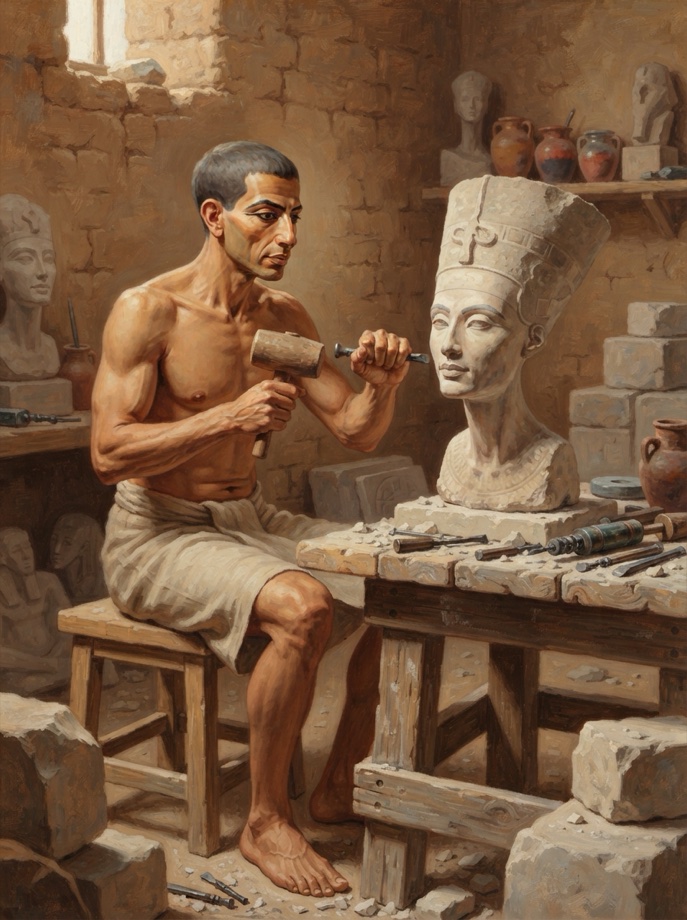
AI-assisted Portrait of Thutmose (sculptor)
The Face Left Behind in a Locked Workshop
Almost nothing survives of Thutmose the man. A single title, painted on an ivory horse blinker found among his ruins — Chief Sculptor, King’s Favorite — is nearly the whole of his documented biography. What survives instead is his workshop: a mudbrick studio at Amarna, discovered intact in 1912, its shelves still holding plaster casts, unfinished busts, and, wrapped and stored as if awaiting further work, the painted limestone bust of Nefertiti now famous around the world.
The bust is not an idealized formula of royal beauty. Its features are individualized and slightly asymmetric, rendered with an attention to a specific human face that stands apart from the standardized, formulaic royal portraiture of most Egyptian art. Many scholars read it as a private modeling study rather than a finished commission — practice for royal features made for its own sake, in the seclusion of a workshop, not for public display.
Thutmose is an ISFP, and the Nefertiti bust — an intimate, unofficial study of one face, crafted with obsessive individual sensitivity — is dominant Fi given physical form.
A Private Study of One Particular Face
Official Egyptian sculpture worked in formula — proportion grids, idealized youth, a stable canon repeated across a thousand statues. The Nefertiti bust breaks from that instinctively. Its asymmetries, its specific cheekbones and mouth, argue for an artist working from close personal observation and internal aesthetic conviction rather than institutional template. That is dominant Fi: an individual, deeply felt standard of what a face should truthfully look like, held to even when convention asked for something more generic.
That the bust was found unfinished — the left eye’s inlay never added — and stored rather than delivered suggests it may never have left Thutmose’s own hands as official product at all. A dominant-Fi artist working in the seclusion of his own workshop, perfecting a private study for reasons that satisfied himself first, is a far more coherent picture than a rushed royal commission.
Nothing else in the ruins of his studio — the plaster life-masks, the trial pieces, the practice busts of unnamed subjects — points toward institutional ambition. It points toward a craftsman absorbed in getting a specific likeness exactly, personally right.
Hands That Trusted What They Saw
Auxiliary Se is the bust’s technical mastery: the exact modeling of a jawline, the precise painted color transitions, the physical, tactile confidence of a sculptor who worked directly from observation rather than abstract rule. Egyptian relief and statuary usually subordinated observed anatomy to symbolic convention; Thutmose’s workshop pieces show an eye trained on the physical world as it actually appeared, translated into stone and plaster with unusual fidelity.
The life-mask casts found in his studio — direct plaster impressions taken from living faces — are Se in its rawest form: an artist who wanted the immediate physical truth of a face in his hands before he trusted his own interpretation of it.
Reworking the Same Face Until It Held
Tertiary Ni surfaces in the workshop’s cache of trial pieces and unfinished studies of the same royal subjects, reworked repeatedly. That points to an artist chasing a single, refined internal image of how a face should ultimately resolve — willing to redo the same study until an inward vision matched the stone, rather than settling for the first competent likeness.
It is a quiet, patient kind of insight, subordinate to the immediate sensory craft of Se and the personal conviction of Fi, but present in every reworked cast: a sculptor who trusted that there was one true, distilled version of a face still to be found.
Why ISFP Over ESFP
Why not ESFP?
An ESFP sculptor at a royal court would likely have courted visibility — signed work, public reputation, performance for an audience. Thutmose left behind a private workshop full of unofficial studies and a masterpiece that was never delivered or displayed in his lifetime. That preference for solitary, internally-driven refinement over public presentation points to introverted Fi leading, with Se in a supporting, observational role rather than an outward, attention-seeking one.
The Nefertiti bust’s obscurity for over three thousand years — hidden in a buried studio rather than displayed in a temple — is itself the argument: this was never work made for an audience.
Connected Figures
Further Reading
- Amarna Sunset — Aidan DodsonCovers the Amarna period's art and workshops, including Thutmose's studio finds.
- A History of Ancient Egypt — Nicolas GrimalGeneral dynastic and artistic context for the Amarna interlude.
- Ancient Egyptian Literature — Miriam LichtheimTranslated Amarna-era hymns illuminating the period's aesthetic sensibility.
