 Historical Figure MBTI
#1061 · 8-8-26 · The Amarna Period
Meritaten
The Eldest Daughter
fl. c. 1340 – 1332 BCE
3 min read
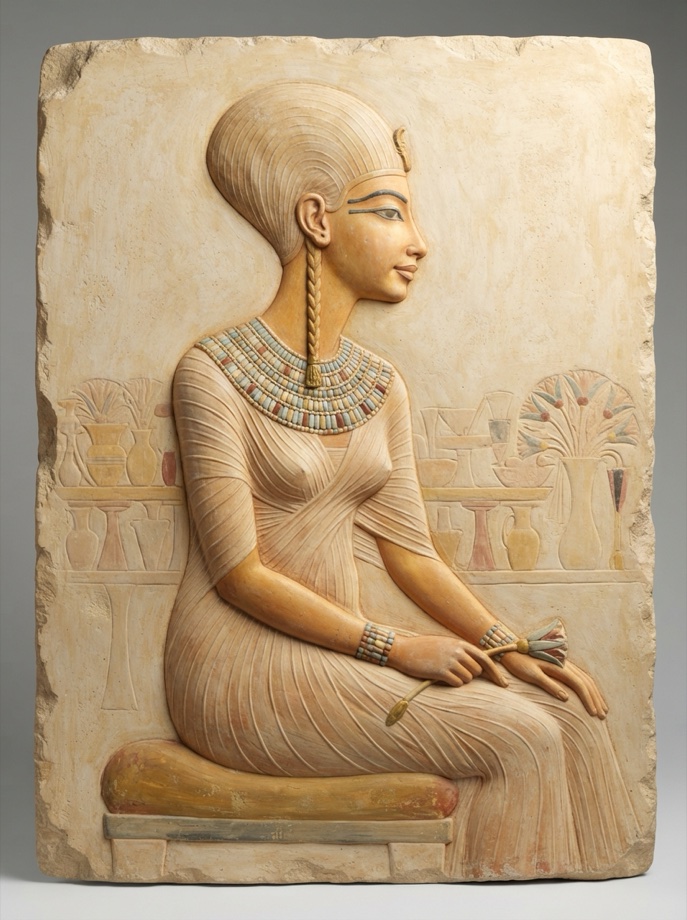
AI-assisted Portrait of Meritaten
The Constant at Amarna's Center
Meritaten grew up in front of the whole court. As the eldest daughter of Akhenaten and Nefertiti, she appears again and again in Amarna art from early childhood — trailing her parents at temple ceremonies, seated at the family table in scenes of startling domestic intimacy, present at nearly every public moment the revolutionary royal family staged for their new capital.
As she grew older, that visibility turned into responsibility. When Nefertiti’s own public role apparently faded — whether through death, disgrace, or simple political eclipse remains debated — Meritaten seems to have stepped forward to fill part of the gap, taking on ceremonial duties and, by some readings of the evidence, even a formal consort’s position beside her father and later beside the shadowy successor Smenkhkare. The exact mechanics of that succession are contested, but Meritaten’s presence throughout it is not.
Where the Amarna court kept reinventing itself, Meritaten was the one figure who simply kept showing up.
Si — The Family's Continuity
Through a reign defined by upheaval — a new religion, a new capital, a mother’s disappearance from the record — Meritaten’s role stayed remarkably consistent: present, dutiful, visible beside whoever needed her there. That steady continuation of an established role, rather than any reinvention of it, points to a grounded, tradition-oriented Si.
Fe — Holding the Court Together
Stepping into ceremonial duties her mother had once held required more than obedience — it required reading exactly what the moment and the court around her needed. That instinct to stabilize a role for the sake of everyone depending on it, quietly and without complaint, is auxiliary Fe at work.
Ti — tertiary
What little agency Meritaten shows in the record is procedural rather than assertive — understanding how a title works, how a role is properly filled — never a bid to redefine the system itself. That is consistent with a background Ti offering quiet structural understanding, never pushed to the foreground.
Ne — inferior
Nothing suggests Meritaten reached for a role beyond the one circumstance handed her, even as the throne itself grew contested around her. That absence of any visible ambition toward new possibilities is exactly what an inferior Ne looks like beneath a dutiful, present-focused core.
Why ISFJ Over ESFJ
Why not ESFJ?
Meritaten’s role, as far as the evidence shows, was reactive rather than socially assertive — filling a vacancy left by her mother rather than actively cultivating her own network of influence at court. An ESFJ would more visibly shape the social world around her; Meritaten instead absorbed whatever position the family's turbulence required of her.
ISFJ captures a life defined by quiet constancy under pressure — a daughter who held her family’s public face together while its center kept shifting beneath her.
Connected Figures
Further Reading
- Amarna Sunset — Aidan DodsonOn the succession crisis and Meritaten's possible role in it.
- Akhenaten: Egypt's False Prophet — Nicholas ReevesCovers the royal family's public image at Amarna.
