 Historical Figure MBTI
#1058 · 8-7-26 · The New Kingdom
Amenhotep son of Hapu
The Sage Deified for His Mind
fl. c. 1390 – 1350 BCE
4 min read
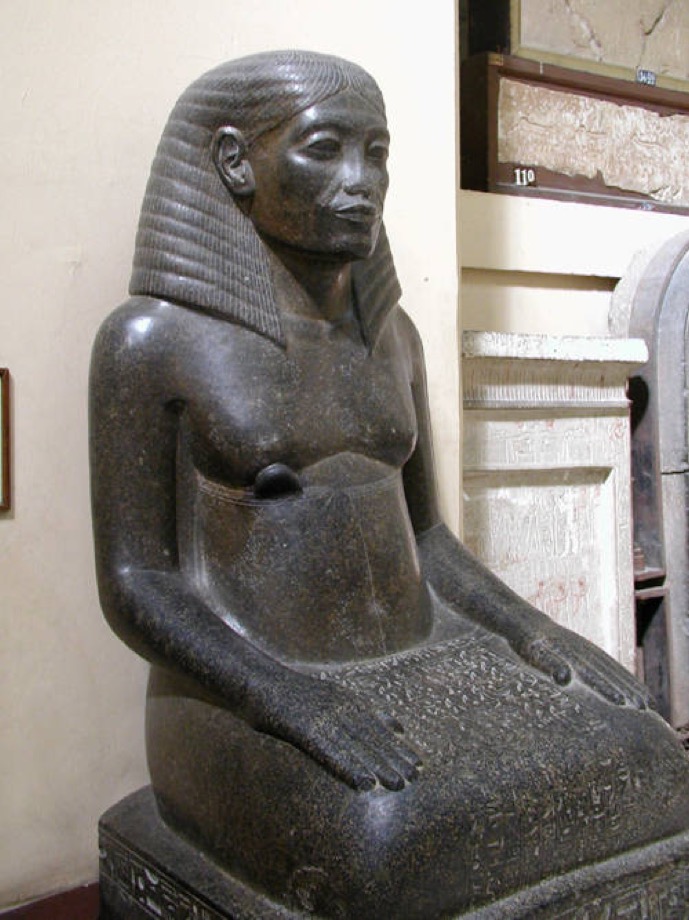
Statue of Amenhotep, son of Hapu
The Commoner Who Earned a King’s Temple
Amenhotep son of Hapu was born a commoner and rose, purely on documented ability, to become the most powerful non-royal official of Amenhotep III’s glittering reign — scribe of army recruits, overseer of all royal works, the man who organized the quarrying and transport of the colossal statues now known as the Colossi of Memnon. He designed the king’s vast mortuary temple at Kom el-Hettan, once the largest religious complex in Egypt. That alone would make him a notable administrator.
What makes him extraordinary is what happened next: Amenhotep III granted him a mortuary temple of his own, built beside the royal temples on the west bank of Thebes — an honor no other commoner in Egyptian history is known to have received. Centuries later, Ptolemaic Egyptians worshipped him as a god of wisdom and healing, paired with the legendary Imhotep. A career built almost entirely on the force of one man’s perceived insight into how the kingdom should be built.
Amenhotep son of Hapu is an INTJ, and the deification his contemporaries granted him — treating his judgment as something close to oracular — is dominant Ni recognized and rewarded in real time, not just by history.
A Vision Others Learned to Trust Blindly
No other Egyptian official of any era received a personal mortuary temple beside the king’s own. That singular honor was not a reward for loyalty — the court was full of loyal men — it was a reward for a specific reputation: that Amenhotep son of Hapu could see the shape of a project, a building, a policy, before anyone else could, and that his foresight was reliable enough to bet an empire’s resources on.
His deification a thousand years later, as a healing and wisdom god invoked by ordinary petitioners at Deir el-Bahari, is Ni’s clearest possible afterlife: not remembered for a single feat, but abstracted into a symbol of penetrating, trustworthy insight itself. People did not pray to him for strength or wealth. They prayed to him for clarity — the exact currency a dominant-Ni mind trades in.
Even his surviving autobiographical inscriptions read as calculated self-positioning rather than boastful résumé-building: precise claims about specific projects, phrased to demonstrate competence rather than charisma. That is Ni speaking through its auxiliary Te — vision translated into verifiable, checkable fact.
Moving Stone the Size of a Small Temple
Vision alone does not quarry, transport, and erect two 700-ton quartzite colossi across hundreds of miles of Nile floodplain. That took auxiliary Te: logistics, labor organization, resource accounting on a scale Egypt had rarely attempted. As overseer of all royal works, Amenhotep son of Hapu managed the largest building program of the New Kingdom’s wealthiest reign and delivered it — the Colossi of Memnon still stand, nearly 3,400 years later, as literal proof of execution matching ambition.
As scribe of recruits, he also built and administered the levy system that staffed Amenhotep III’s army and labor gangs — bureaucratic infrastructure, not glory work, but exactly the kind of unglamorous, exacting system-building that turns a visionary’s plan into a functioning state.
A Reputation He Guarded Himself
Tertiary Fi surfaces in how carefully Amenhotep son of Hapu curated his own commemorative inscriptions — not toward flattery of the king, the safer and more expected move for a commoner favorite, but toward an insistent, personal claim to individual merit. He wanted credit recorded in his own words, attached to his own name, for what he specifically had accomplished.
That quiet insistence on personal legacy, distinct from royal legacy, is unusual for the period and points to an inner value system that mattered to him privately, even while his public role stayed one of scrupulous, formal deference to the throne that had elevated him.
Why INTJ Over ENTJ
Why not ENTJ?
An ENTJ commoner of this ability would likely have pushed for visible command — leading armies, directing court factions outright. Amenhotep son of Hapu instead worked almost entirely through design, planning, and quiet administrative reach, letting his structures and monuments argue his case rather than asserting authority directly. That preference for working behind a king’s authority rather than beside or over it points to introverted Ni leading, with Te in a supporting, executing role rather than driving him outward.
It also explains why deification came only after death: an ENTJ’s influence tends to be felt immediately and personally; Amenhotep’s influence was felt in the durability of what he built, and it took centuries for that durability to calcify into worship.
Connected Figures
Further Reading
- A History of Ancient Egypt — Nicolas GrimalDynastic overview of Amenhotep III's reign and its building programs.
- On the officials of Amenhotep III — Betsy M. BryanScholarship on the court careers surrounding Amenhotep son of Hapu directly.
- Ancient Egyptian Literature — Miriam LichtheimTranslated autobiographical inscriptions from his statues and tomb.
