 Historical Figure MBTI
#500 · 4-18-26 · Plantagenet England
Anne of Bohemia
Queen of England · Richard II's Beloved First Wife
1366 — 1394
7 min read
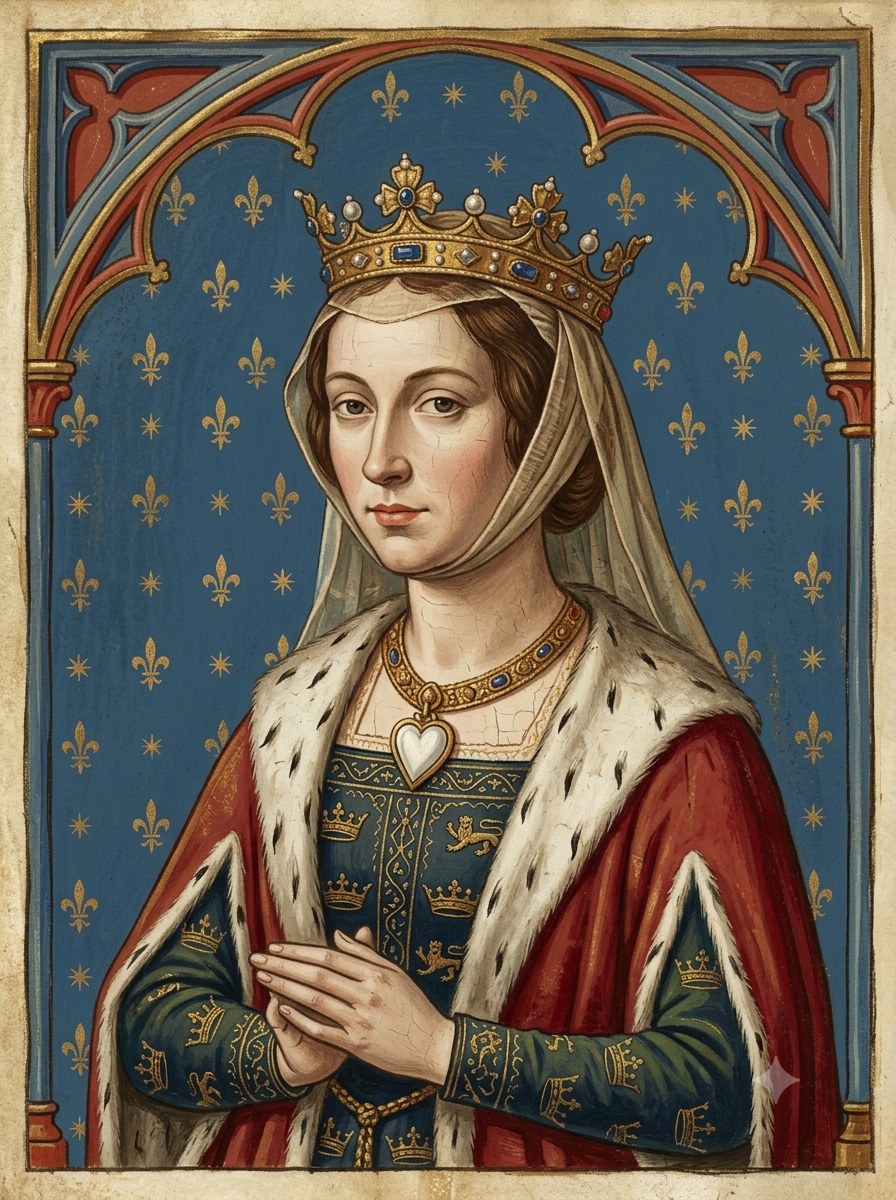
AI-assisted Portrait of Anne of Bohemia
The Gentle Heart of a Brittle Court
When she came to England in 1382 to marry the fifteen-year-old Richard II, Anne of Bohemia brought with her the prestige of the greatest house in Christendom—she was a daughter of the Holy Roman Emperor Charles IV—and something rarer at the Plantagenet court: an instinct for mercy. The marriage had been arranged for diplomacy, and contemporaries grumbled that she had arrived with a large household and no dowry worth the name. Yet within a few years she had become the one person who could reliably soften the proud, volatile young king, and the match had ripened into a genuine love.
Gracious, cultivated, and devout, Anne made herself the conscience of the court rather than its ornament. She was no power broker in her own right; her influence ran entirely through tenderness, persuasion, and the moral weight of her example, used again and again to beg pardon for those who had fallen under Richard's displeasure. When plague took her at the palace of Sheen in 1394, she was barely twenty-eight, and the king's grief was so violent that he ordered the building where she had died torn to the ground.
Anne of Bohemia was the warm, mediating ENFJ at the heart of a hard reign—dominant Fe that read a room and reached for reconciliation, steadied by a quiet Ni idealism that gave her warmth its moral seriousness.
She gentled a king who could not gentle himself—and her loss helped unmake him.
The Queen Who Knelt for Mercy
Fe — dominant
Dominant Fe orients itself by the emotional temperature of the people around it—it feels the strain in a relationship before words are spoken and moves instinctively to repair it. Anne's entire public role was an exercise in this. In a court organized around honour, faction, and the king's easily wounded pride, she made herself the channel through which anger could be talked down into pardon. The medieval queen's recognized prerogative of intercession—pleading publicly for the condemned—was tailor-made for her temperament, and she used it more readily than almost any consort of her century.
The reconciliation with London in 1392 is the defining scene. Richard, in a fury at the city's defiance, had stripped it of its liberties and seized its government. The restoration of peace was staged as a great civic pageant—and at its emotional climax Anne knelt before her husband to beg mercy for the citizens, giving him a way to relent without losing face. That is Fe at full stretch: it does not merely feel for the wronged, it engineers the social ritual through which a proud man can climb down gracefully. She turned her own submission into the instrument of someone else's rescue—and chroniclers who agreed on little else agreed that the warmth was real. The marriage itself was Fe's quiet triumph, a diplomatic arrangement she turned, through patience and affection, into the one secure attachment of Richard's life.
The Devout Idealist Beneath the Warmth
Ni — auxiliary
If Fe explains Anne's manner, auxiliary Ni explains its weight. Beneath the graciousness ran a current of genuine moral and religious seriousness—a settled inner conviction about how people ought to be treated that her kindness expressed rather than invented. Ni gives the ENFJ a private north star, an idealism that keeps the warmth from collapsing into mere people-pleasing, and Anne's piety supplied exactly that ballast.
Her religious and intellectual interests point the same way. Raised in the cultivated court of her father's Bohemia, she appears to have brought continental books and devotional habits to England, and her household has been loosely linked by later writers to the reformist currents that fed the Lollards—the movement around vernacular Scripture and the questioning of clerical wealth. The connection is tenuous and much disputed, and it would be wrong to make her a proto-reformer. But the temperament it gestures at is real: a queen who read seriously, prayed seriously, and located the source of her conduct in something deeper than court custom. That inwardness is why her interventions never read as calculation—the mercy flowed from a coherent picture of the good she carried quietly, and applied to whoever stood in front of her.
The Splendour of a Shared Court
Se — tertiary
Tertiary Se in an ENFJ surfaces as a real pleasure in the textures of the present—in ceremony, beauty, dress, and the sensory life of the court—harnessed to the dominant function's social aims. Anne and Richard presided over a famously cultivated, image-conscious court, and she was a full partner in its display. The pageantry of intercession itself depended on this: mercy had to be seen, staged in the right setting with the right gestures, to do its work. The continental fashions that arrived in her train and the visibility of her public devotion are Se in the service of Fe—the present moment dressed to carry a feeling. It is a lighter function than her warmth or her idealism, but it gave her kindness a stage.
The Logic She Never Needed to Wield
Ti — inferior
Inferior Ti is the ENFJ's least trusted faculty—cold, impersonal analysis, the weighing of a position purely on whether it is internally consistent, regardless of whom it helps or hurts. It is precisely the register in which Anne never operated: she did not argue London's legal rights, she knelt.
Where inferior Ti shows is in the limits of that gift. Her power was entirely relational, and it left almost no detachable record—no policy, no system, no doctrine. When the warm presence was gone, nothing impersonal remained to do its work, which is part of why her death created such a vacuum. The strength that made her indispensable was inseparable from the person; it could not be codified, only felt, and then mourned.
Why ENFJ Over ESFJ
Why not ESFJ?
The ESFJ shares Anne's dominant Fe—the warmth, the care for harmony, the attentiveness to others' needs—and on the surface the fit looks close. But the ESFJ's second function is Si: it keeps the social order by honouring custom, precedent, and the established way of doing things. Anne's warmth had a different flavour. It was joined to a quiet idealism—an Ni conviction about how people ought to be treated—that made her a gentle reformer of her court's moral temperature rather than its faithful upholder. A pure ESFJ consort would have kept the forms beautifully; Anne kept reaching past them toward mercy.
The distinction is Si versus Ni beneath a shared Fe. The ESFJ steadies a court by embodying its traditions; the ENFJ steadies it by holding a vision of what it could be. Anne was the second kind—a devout idealist who used her kindness not to preserve the status quo but to bend a hard reign, however briefly, toward grace.
Connected Figures
Further Reading
- Richard II — Nigel SaulThe standard modern biography of the king — authoritative on the marriage, the London reconciliation, and the collapse that followed Anne's death.
- Three Medieval Queens: Queenship and the Crown in Fourteenth-Century England — Lisa Benz St. JohnSituates Anne within the political and ceremonial role of the English queen, including the practice of intercession.
- Anne's Bohemia: Czech Literature and Society, 1310–1420 — Alfred ThomasOn the cultivated Bohemian world Anne came from and the books and devotional currents she may have carried to England.
