 Historical Figure MBTI
#495 · 4-18-26 · Plantagenet England
Richard II
King of England · The Aesthete-King Deposed at Pontefract
1367 — 1400
11 min read
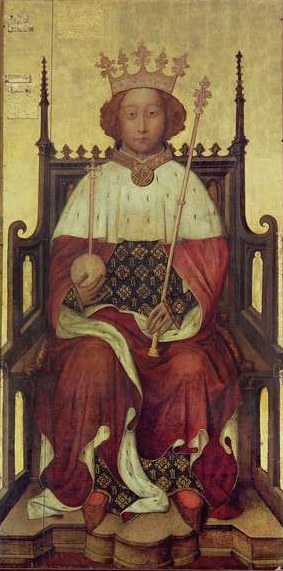
AI-assisted Portrait of Richard II
The King Who Mistook a Vision for a Crown
He believed he was half-divine, and he very nearly persuaded England to believe it with him. Richard II came to the throne in 1377 as a boy of ten, the son of the most celebrated warrior in Christendom — Edward the Black Prince, who had captured a French king at Poitiers and then died before he could inherit — and the grandson of Edward III. From that inheritance Richard took none of the soldiering and all of the majesty. He grew into an aesthete-king who sat enthroned in silent state, expecting men to kneel before a gaze he held on them in deliberate, theatrical silence; who demanded to be addressed as “your Majesty” and “your Highness” where his predecessors had settled for “my lord”; and who commissioned a painting — the Wilton Diptych — in which he kneels and is commended to the Virgin by a host of angels wearing his own badge. No English king before him had imagined kingship in quite these terms.
The reign curdled around that conception. Richard had one heroic hour at fourteen, riding out to the rebels of the Peasants' Revolt at Smithfield in 1381 and, when their leader was struck down before him, calling out that the crowd should follow him instead. After that the record is one of grievance nursed in private and vengeance taken cold: the humiliation by the Lords Appellant who purged his friends, the long patient wait, the tyranny of his final years, and the catastrophic overreach of 1399 that handed his cousin a crown and handed Richard a slow death at Pontefract. He was the INFJ on a throne — a man governed by a single interior image of what the world ought to be, who could not tell the difference between that image and the realm he was actually given to rule.
Richard II was an Ni vision wearing a crown — an INFJ who conceived of kingship as a sacred, almost mystical idea, externalized it in gold and ceremony, and then broke himself against the brute fact that England was not a painting and his subjects were not angels.
The Idea of the Sacred King
Ni — dominant
Dominant Ni lives inside a single, totalizing image of how things truly are beneath their surface, and it bends everything toward that image. For Richard the image was kingship itself — not the practical business of governing barons and raising armies, but the metaphysical idea of the king as a being set apart, anointed, standing at the apex of a divinely ordered hierarchy. Where his grandfather and father had understood the crown as something you won and defended with a sword, Richard understood it as something you were: a sacred essence to which the only fitting response was veneration. This is the abstraction-first, symbol-saturated cognition of Ni, and Richard pursued it with the single-mindedness of a man who has seen something the people around him cannot.
He externalized the vision relentlessly. The Wilton Diptych is the clearest statement of it — a private devotional panel in which Richard is presented to the Virgin and Child by saints, and a company of angels wears his personal emblem of the white hart, as though heaven itself had been enrolled in his livery. He rebuilt the great hall at Westminster and crowned it with a hammerbeam roof that seems to float without support, a vault of carved angels hovering over the king who sat beneath it. He introduced elaborate, almost liturgical ceremony into his court, and on certain high days would sit crowned and motionless from morning to evening, and any man on whom his eye fell was expected to bend the knee. None of this was idle vanity. It was the projection of an inner certainty — Ni's conviction that there is one true pattern — onto the visible, public surface of the realm.
The trouble with dominant Ni is that the vision feels more real than the facts, and Richard governed accordingly. He came to believe that the laws of England were in his own mouth and his own breast — that his will, as the anointed king, simply was the law. This was not the conclusion of an argument; it was the felt logic of the idea taken to its end. A man who sees kingship as sacred essence rather than negotiated power will, in the end, treat any check on his will as something close to blasphemy — which is precisely what Richard came to do.
The Theatre of Majesty
Fe — auxiliary
If Ni gave Richard the idea, auxiliary Fe gave him the instrument for projecting it into the social world. Fe is attunement to the emotional and symbolic atmosphere of a room, an instinct for ceremony, image, and the orchestration of how a gathering feels. Richard was, before anything else, a man of the staged occasion. His court became the most refined in Europe — he is sometimes credited with introducing the handkerchief and a new vocabulary of courtly manners — and he understood, in the marrow, that majesty is something performed. The silent enthronements, the white-hart badges distributed to followers like a uniform of devotion, the cultivation of poets and painters and goldsmiths: this is Fe pressed into the service of Ni's vision, building an entire aesthetic environment designed to make people feel the sacredness their king already knew to be true.
But Fe in the grip of a dominant Ni vision is a brittle thing. Healthy Fe seeks harmony and shared feeling; it reads the room in order to belong to it. Richard's Fe was bent entirely inward, toward the maintenance of his own image, and so it curdled. What began as a longing to be loved and revered hardened, under the pressure of humiliation, into a tyrant's demand for devotion — loyalty enforced rather than earned, the white hart worn not out of affection but out of fear. In his last years he extracted blank charters from whole counties, forcing communities to seal documents acknowledging their guilt against him, so that he might hold their submission in writing. The same faculty that had built the most beautiful court in Christendom was now policing the realm for insufficient reverence.
His Fe began as a hunger to be adored and ended as a tyrant's ledger of enforced loyalty — the difference between a king who wins devotion and a king who audits it.
The Cold Logic of Revenge
Ti — tertiary
The most chilling thing about Richard is his patience, and it is here that tertiary Ti shows itself. Ti is the impulse toward internal consistency — the private, impersonal working-out of how a system fits together and where it can be turned to advantage. In a young king it surfaced as a gift for legal and procedural manoeuvre, and Richard used it to plot a revenge he was willing to wait a decade to complete. In 1388 the Lords Appellant — a faction of magnates led by his uncle Thomas of Woodstock — had broken his power, hauled his friends before what came to be called the Merciless Parliament, and had them condemned and killed, driving his closest favourite into exile. Richard, barely twenty, submitted. He bided his time for nine years.
Then, in 1397, he struck with a precision that was almost legalistic in its cruelty. He moved against the three senior Appellants in a single coordinated sweep, had his uncle Woodstock taken to Calais and quietly murdered — smothered, it was said, under a feather mattress — and then staged a packed Parliament that reversed the earlier judgments, reproduced their procedures in mirror image, and condemned his old enemies by their own machinery. He revived ancient, half-forgotten royal rights to squeeze money from his subjects and to entrap the men he distrusted. This is Ti as a weapon: not hot rage but a cold, systematic construction in which every move is fitted to the last, the law itself reverse-engineered to deliver the outcome the king had envisioned years before.
But tertiary Ti is a servant, not a master, and in Richard it served the vision rather than disciplining it. A dominant thinker might have asked whether the whole edifice could hold; Richard's logic was brilliant in its parts and catastrophic in its whole, a machine built with great ingenuity to demolish the very consent on which his throne depended.
Blind to the World of Force
Se — inferior
Inferior Se is the blind spot of the INFJ: a chronic difficulty reading the concrete, physical, present-tense world of force and fact, of who actually holds the swords and what they will do next. Richard's reign is, in the end, the story of that blind spot destroying him. His father had been a soldier who understood the brute arithmetic of war; Richard had no taste for it and no feel for it. He preferred peace with France, preferred his court and his commissions and his idea of sacred kingship, and seems never to have grasped that a crown rested, in the last analysis, not on liturgy but on the loyalty of armed men.
The fatal proof came in 1399. When his uncle John of Gaunt died, Richard seized the vast Lancastrian inheritance for the crown and extended the exile of Gaunt's son, Henry Bolingbroke — disinheriting the most powerful magnate in England at a stroke. Then, with the kingdom thus inflamed, he sailed off to campaign in Ireland, leaving England all but undefended behind him. Bolingbroke landed, the realm rose to him almost without a blow, and by the time Richard returned the war was already lost. He had not seen it coming because he had been living inside the vision, where he was the anointed king and such things could not happen, rather than in the world, where they manifestly could.
Cornered, the Se-blind idealist collapsed into the grandiose despair that is the inferior function's other face — alternating, the chroniclers report, between defiant invocations of his sacred majesty and abject helplessness. He was deposed, imprisoned at Pontefract Castle, and there, early in 1400, he died — most likely starved to death — the end of the direct Plantagenet line. The world of force he had refused to see had come for him at last.
Why INFJ Over INFP or ENFJ
Why not INFP?
It is a tempting reading — Shakespeare's Richard, lyrical and self-pitying, weeping over his own deposition, is practically an INFP on stage. But the INFP's core is Fi: an inward landscape of deeply held personal values and authentic feeling, an aesthete of the self. Richard's core was not a private value system but an abstract, symbolic, almost theological idea of sacred kingship that he tried to impose on the external world — the white hart, the angels in his livery, the law in his own breast. That is Ni building an objective vision of how reality should be ordered, not Fi cultivating a private moral interior.
Why not ENFJ?
An ENFJ shares the Ni–Fe pairing but leads with Fe: warm, outward, people-reading, gifted at harmonizing a group around a shared purpose. Richard was the inversion of that — his vision faced inward and upward, not toward his subjects, and his Fe served the projection of his own majesty rather than the cohesion of his court. A true ENFJ king binds people to him; Richard demanded that people bind themselves to his idea, and was baffled and enraged when they would not. The grandiosity is dominant-Ni introverted vision, not auxiliary-Fe outward warmth.
The whole tragedy turns on the difference. An INFP would have given England a king who ruled by conscience and felt every wound as a personal betrayal — which is the Richard the playwrights gave us, but not quite the Richard the chroniclers describe. An ENFJ would have given England a king who could rally and charm. What England actually got was an INFJ: a man possessed by a singular, abstract vision of sacred majesty, convinced he could see the true order of things, who externalized that vision in breathtaking art and then enforced it with cold and patient cruelty — and who never once understood that the realm he was ruling was not the realm he saw.
Connected Figures
Further Reading
- Richard II — Nigel SaulThe definitive modern biography — magisterial on Richard's exalted theory of kingship and the politics of his fall.
- Richard II: Manhood, Youth, and Politics, 1377–99 — Christopher FletcherA revisionist study reading the reign through contemporary ideas of kingly manhood and the king's contested adolescence.
- Richard II: A Brittle Glory — Laura AsheA concise, literary portrait of the aesthete-king and the culture of his court — strong on the Wilton Diptych and his patronage.
- Richard II — William ShakespeareThe play that made the deposition immortal — the hollow-crown king who unkings himself in language of unbearable beauty.
