 Historical Figure MBTI
#490 · 4-17-26 · The Hundred Years' War
John of Gaunt
Duke of Lancaster · Ancestor of Kings
1340 — 1399
9 min read
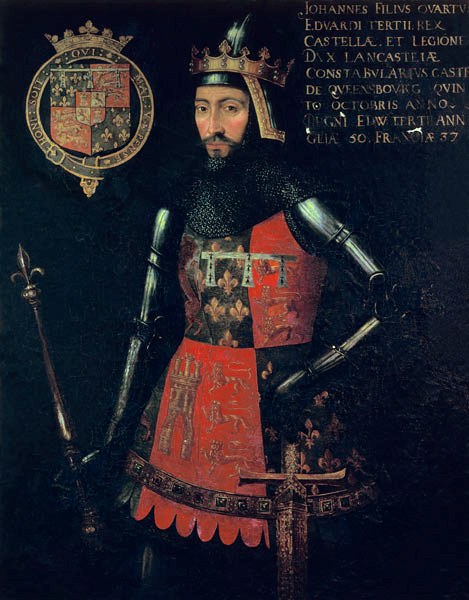
AI-assisted Portrait of John of Gaunt
The Richest Man Who Was Never King
He held more land, more castles, and more men than anyone in England except the crown itself, and for a stretch of years he wielded that power as if the crown were merely a piece on a board he already controlled. John of Gaunt — third surviving son of Edward III and Duke of Lancaster — spent his life within touching distance of the throne and never sat on it. In his father's senile final years he effectively ran the kingdom, and through the long minority of his nephew Richard II he was the most powerful man in the realm, the de facto regent in all but name. He was loathed for it. To the Commons he was the face of misgovernment; to the London mob he was the architect of every grievance. When the Peasants' Revolt erupted in 1381, the rebels singled out his magnificent Savoy Palace on the Strand and burned it to the ground.
None of it bent him. Gaunt was an empire-builder by temperament, and a throne he could not have in England he simply pursued elsewhere: through his second marriage to Constance of Castile he claimed that kingdom's crown and styled himself King of Castile and León, chasing the title across the Iberian peninsula with armies that never delivered it. He was a patron on the same outsized scale — protecting the proto-reformer John Wycliffe when the bishops moved against him, and advancing the poet Geoffrey Chaucer, who became his brother-in-law through Katherine Swynford, the mistress of decades whom Gaunt would finally make his third wife. He is the ENTJ rendered in the idiom of the fourteenth century: a man who organized power the way other men organize a household, and who measured a life by what it could be made to build.
Gaunt was the ENTJ as dynast — Te marshalling the greatest private power in England into armies, offices, and estates, and Ni holding fast to a vision that reached past his own lifetime to the crowns his blood would one day wear.
The Machinery of Power
Te — dominant
Dominant Te organizes the world into systems that can be administered, and Gaunt administered England. The Duchy of Lancaster was not merely an inheritance; under his hand it became a state within the state — a network of estates, retainers, receivers, and fortresses run with the discipline of a treasury. He marshalled armies for the French wars, sat at the center of the royal council, and through the drift of his father's last years and the childhood of Richard II became the indispensable manager of the realm. Te does not crave the symbol of authority so much as the working of it: Gaunt never needed to be called king to behave as the man whose decisions actually moved the kingdom.
The same instinct made him resented. Te run at full power looks, from below, like cold machinery — and the Commons in the Good Parliament of 1376 attacked his circle for corruption and misrule precisely because he had organized so much of the government around his own people. He answered not by softening but by reorganizing, gutting the Parliament's reforms the following year and reasserting control. When the mob came for the Savoy in 1381 and reduced the grandest private residence in England to ash, Gaunt — safely in the north negotiating with the Scots — absorbed the loss as an operational fact and rebuilt his position rather than his palace. The Te dominant treats catastrophe as a problem of reconstruction, not a wound to be nursed.
What separates Gaunt from a mere administrator is the sheer scale of the apparatus he preferred to wield directly. He did not delegate his ambition. He raised his own expeditionary force to enforce the Castilian claim, financed it from his own colossal revenues, and ran a quasi-royal court at the Savoy with its own diplomacy. Te here is not the steward of an office handed down but the builder of an instrument large enough to chase a foreign crown — power assembled, capitalized, and aimed.
The Long Game of Blood
Ni — auxiliary
If Te built the machine, auxiliary Ni decided what it was for. Gaunt's ambition was never merely to be powerful in the present; it was dynastic, oriented toward a future he would not live to see. The Castilian crown is the clearest case. By any near-term accounting the claim was a fantasy — expensive, militarily doomed, pursued across years of fruitless campaigning. But Ni does not reason in near-term accounting. Gaunt held the vision of his line seated on a foreign throne and bent enormous resources toward it; and when the crown itself proved unattainable, he converted the campaign into a marriage, wedding his daughter Catherine to the heir of Castile so that his blood, if not his body, would wear it. The objective survived the failure of the means.
The deeper proof of his Ni is what his bloodline became — and the strong suggestion that he planned for it. His legitimate son, Henry Bolingbroke, would seize the throne as Henry IV and found the Lancastrian dynasty. His children by Katherine Swynford, born outside marriage and later legitimized as the Beauforts, became the ancestors of the Tudors. Gaunt took deliberate, patient steps toward that future: marrying Katherine after decades, securing papal and royal legitimization for their children, building a position from which a Lancastrian king became thinkable. He was arranging pieces whose payoff lay generations downstream.
One half of the bloodline that would tear England apart in the Wars of the Roses ran through John of Gaunt — and the patience with which he laid that line is Ni at its most far-sighted, an ambition measured not in reigns but in dynasties.
The Soldier and the Splendor
Se — tertiary
Tertiary Se in an ENTJ shows up as a taste for command in the physical world — the campaign, the chevauchée, the display of magnificence — and Gaunt lived a thoroughly martial, thoroughly splendid life. He campaigned in France beside his elder brother Edward the Black Prince, led his own grinding march across France in 1373, and carried the Castilian war into Iberia in person. War for Gaunt was an extension of policy, but it was also something he was simply willing to do with his own body, on the ground, at scale.
The Savoy Palace was the same function turned to splendor. It was the most lavish noble residence in England, a statement of presence as much as wealth — the tangible, visible projection of what Lancaster was. Se wants the world to register power through the senses, and the Savoy made Gaunt's power impossible to miss. That it became the precise target of the rebels' fury in 1381 was no accident: he had built a monument to himself so conspicuous that it served as the obvious altar for a kingdom's resentment.
The One Loyalty He Could Not Govern
Fi — inferior
Inferior Fi is the ENTJ's hidden country — a private set of attachments that the dominant Te neither advertises nor easily controls, surfacing in a stubborn personal loyalty that runs against expedience. Gaunt's lay in Katherine Swynford. The relationship endured for decades through two strategic marriages and a public scandal that cost him real political capital; the chroniclers condemned it, and he persisted anyway. When his second wife died and the dynastic logic had largely played out, he did the thing a pure political calculator would never have bothered to do: he married his mistress, an extraordinary act for a prince of the blood, and went to the considerable trouble of legitimizing their Beaufort children. That was not Te arithmetic. It was the inferior function, late and unguarded, insisting on something the strategist in him could not quite explain away.
The same buried Fi shows in his protection of John Wycliffe. Gaunt's motives were partly political — Wycliffe's attacks on Church wealth were useful against clerical rivals — but he shielded the reformer past the point of mere utility, when the alliance had become a liability. Inferior Fi gives the ENTJ a few convictions he will defend stubbornly and somewhat inarticulately, out of proportion to their usefulness. For Gaunt those convictions were a woman the world told him not to marry and a heretic the Church told him not to keep — and on both he held the line.
Why ENTJ Over ESTJ
Why not ESTJ?
The ESTJ is the consummate administrator of an inherited office — dutiful, concrete, devoted to running well the institution that was handed to him. Gaunt could administer with the best of them, but his eye was never on the office in front of him; it was on a larger board entirely. He poured a fortune into a Castilian crown that no dutiful steward of Lancaster would have chased, and he laid the patient groundwork for a bloodline that would seat two royal houses generations after his death. That is Te yoked to Ni — strategic, dynastic, reaching past the present — not the present-tense, tradition-anchored competence (Te–Si) of the ESTJ.
The distinction is ambition's horizon. An ESTJ asks how to govern well the realm he has; Gaunt asked what crowns his line might wear and how to position the pieces to win them. He treated England not as an estate to be kept in good order but as a base from which to project power outward and forward — toward Castile, toward the throne his son would seize, toward the dynasties his Beaufort grandchildren would found. The longer line and the larger map are the signature of the auxiliary Ni, and they are why Gaunt reads as the strategist-dynast, not the steward.
Connected Figures
Further Reading
- John of Gaunt: The Exercise of Princely Power in Fourteenth-Century Europe — Anthony GoodmanThe standard scholarly biography — exhaustive on Gaunt's estates, retinue, and political machinery.
- The Red Prince: The Life of John of Gaunt — Helen CarrA vivid, accessible modern life that foregrounds the man and his relationship with Katherine Swynford.
- John of Gaunt — Sydney Armitage-SmithThe classic early-twentieth-century study; dated but still valued for its grasp of the documentary record.
