 Historical Figure MBTI
#489 · 4-17-26 · The Hundred Years' War
Philippa of Hainault
Queen of England · Who Spared the Burghers of Calais
c. 1314 — 1369
7 min read
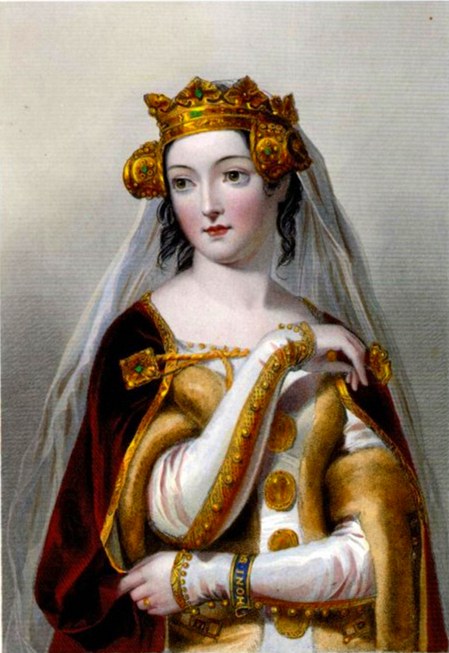
AI-assisted Portrait of Philippa of Hainault
The Queen Who Knelt
In 1347, after eleven months of siege, the starving town of Calais finally surrendered to Edward III, and the king meant to make an example of it. Six of its leading citizens were to walk out bareheaded, ropes around their necks and the keys of the town in their hands, and be put to death. The story, as the chronicler Froissart tells it, turns on what happened next: Edward's own queen — heavily pregnant, in front of the whole army — went down on her knees before her husband and begged him to spare the men. And he did. “You have asked for so much,” he is said to have told her, “that I cannot refuse you.”
That moment made the legend of Philippa of Hainault, but the legend only crystallized what she already was. Married to Edward at fourteen and his queen for more than forty years, she was something rare in a royal marriage: a genuine love-match, and the warm, steadying center of one of medieval England's most glittering courts. She bore him some thirteen children — among them the soldier-prince Edward and the dynast John of Gaunt, whose descendants would one day tear the realm apart in the Wars of the Roses. She founded Queen's College, Oxford. She was so widely loved that her death in 1369 is often read as the moment Edward's long reign began its slow, sad decline.
Philippa was the ESFJ on a throne — warmth as a public act, mercy performed in front of an army, duty held steady across four decades. She did not rule, and never tried to. She did something medieval queenship valued more: she made a hard king bearable.
Mercy as Public Performance
Fe — dominant
The kneeling at Calais is the perfect dominant-Fe image. A queen could have whispered a plea in private and let her husband keep his dignity; Philippa did the opposite. She made her intercession in the open, before the assembled army, in a posture of public supplication that gave Edward the gift of being seen to be merciful. Fe reads a room and acts on it: it understands that mercy granted in front of a crowd is worth more than mercy granted in private, because it does something to everyone watching. The scene was about the burghers' lives, but also about restoring the moral temperature of a court that had nearly committed an atrocity — and Philippa was its thermostat.
Her whole reputation was built this way, out of warmth made visible. Contemporaries describe her as gracious, generous, and kind — not as a private virtue kept for intimates but as a public manner that radiated across the realm. She brought Hainault weavers into England and is credited with helping seed its cloth trade; she founded Queen's College, Oxford, an institution meant to outlast her. None of this is the work of a woman pursuing power. It is the work of one whose deepest instinct is to tend the human fabric around her, and to be loved, reliably, for doing it.
The Constant Companion of a Restless King
Si — auxiliary
Edward III was a warrior-king — ambitious, theatrical, perpetually at war, forever chasing the crown of France. A man like that needs a fixed point, and for forty-one years Philippa was his. Auxiliary Si is the faculty of constancy: it keeps faith with what is established and provides the stable ground from which a restless partner can launch. Where Edward roamed and reinvented his court with chivalric pageantry, Philippa remained — the durable hearth of a marriage that, through thirteen pregnancies and four decades, never curdled into the cold dynastic arrangement most royal unions became.
The same steadiness marked how she did the job. She did not intrigue, build a faction, or reach for the levers of state a more power-hungry consort might have grasped; she understood queen-consort as a settled tradition with settled obligations, and met them so consistently, for so long, that her constancy became the emotional infrastructure of the reign — invisible until, in 1369, it was gone.
A Patron's Imagination
Ne — tertiary
Tertiary Ne in an ESFJ is the quiet engine behind the warmth: not restless idea-spinning, but a real openness to people, possibilities, and projects beyond the household. It shows in Philippa's patronage. She did not simply administer the queen's estates; she saw what could be made of them — bringing Flemish weavers into England, endowing a new Oxford college, keeping the chronicler Froissart in her household, whose history is the only reason we have the Calais story at all. Sitting third in the stack, that openness served the warmth rather than competing with it: always anchored to Fe and Si, aimed at people and institutions she could nurture. It is the difference between a patron and a schemer — the patron sees possibility and feeds it; the schemer exploits it. Philippa was unmistakably the former, and left the strategic gambits to her husband.
The Heart Over the Ledger
Ti — inferior
Inferior Ti is the blind spot of the warm, harmonizing type: cold, impersonal logic, the calculus of strategic advantage, the willingness to let a principle override a feeling. It is precisely the faculty Philippa did not lead with — and Calais shows why. The brutal logic of the siege was Edward's. Six lives offered up as a lesson in the cost of resistance is a coherent, ruthless piece of statecraft; it has its own grim internal sense. Philippa's answer was not a counter-argument; she did not dispute the strategic value of an execution. She knelt. Where a Ti-led mind reasons, an Fe-led one appeals to the bond between two people — and at Calais the appeal won out over the logic. That is the inferior function in its proper place, subordinated to the warmth that defined her. The cost is that Philippa never played, and could not have played, the game of cold power: she built no faction and pursued no agenda of her own. A more calculating queen might have left a stronger political mark. Philippa left something the chroniclers found harder to forget — the memory of mercy.
Why ESFJ Over ISFJ
Why not ISFJ?
ISFJ and ESFJ share the same warm, dutiful Si–Fe heart; the question is which way it faces. The ISFJ is the quieter, more retiring version — devoted, steady, but most comfortable serving from behind the scenes. Philippa was the opposite of retiring. She knelt before an entire army, presided over a famously brilliant court, and was beloved across the whole realm — warmth that worked outward, on others, through presence rather than in private. Her defining act was public by design; an ISFJ would more likely have made the same plea in the king's tent, not in front of his soldiers.
The distinction is the orientation of the dominant function. For the ISFJ, Fe is the auxiliary and the warmth stays close and personal; for Philippa, Fe leads. Her care for people was a public, outward-facing force that shaped the emotional weather of a kingdom — grace radiated across a court and a realm, and loved for it on a national scale. That is extraverted feeling in the dominant seat, and it is what makes her an ESFJ.
Connected Figures
Further Reading
- The Perfect King: The Life of Edward III — Ian MortimerThe fullest modern life of Edward, vivid on Philippa's place as the warm center of his court and reign.
- Edward III — W. M. OrmrodThe authoritative scholarly biography — measured and exhaustive on the reign, its queen, and its dynastic aftermath.
- The Hundred Years War — Jonathan SumptionThe definitive multi-volume narrative; the indispensable account of Calais and the war that framed Philippa's life.
