 Historical Figure MBTI
#487 · 4-17-26 · The Hundred Years' War
Edward III
King of England · The Warrior Who Began the Hundred Years' War
1312 — 1377
11 min read
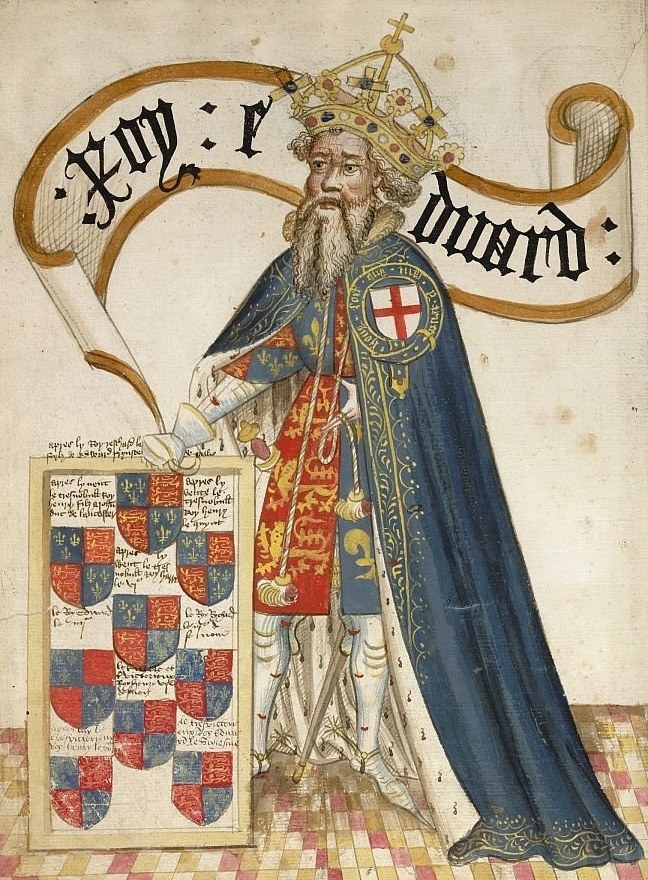
AI-assisted Portrait of Edward III
The Boy Who Took His Kingdom by Night
He was fourteen when they put the crown on him, and it was not really his. His mother, Isabella of France, and her lover Roger Mortimer had landed with an army, deposed his father Edward II, and within months had that broken king dead in a castle cell. The teenage Edward III was a figurehead, the legal cover for a regency that ruled in his name and helped itself to the kingdom. Most boys in that position would have waited, or schemed for years, or simply grown into a puppet. Edward waited three. Then, on an October night in 1330, he and a handful of armed companions came up a secret passage into Nottingham Castle, burst into Mortimer's chamber, and seized the man who had run England since he was a child. Mortimer hanged within the month. Edward was seventeen, and from that night the throne was unambiguously his.
What followed was fifty years of the most glamorous kingship medieval England ever saw. He claimed the crown of France through his mother's blood and, in 1337, opened the long struggle that history would call the Hundred Years' War. The first phase was almost pure English triumph: the sea-fight at Sluys in 1340, then Crécy in 1346, where his outnumbered longbowmen scythed down the flower of French chivalry, then the year-long siege and capture of Calais, a port England would hold for two centuries. He founded the Order of the Garter, ran tournaments that were the talk of Europe, and turned his court into a theater of chivalry with himself at the center. When his eldest son captured the King of France himself at Poitiers in 1356 and the Treaty of Brétigny crowned the whole enterprise in 1360, Edward III stood as the most admired warrior-king in Christendom.
He is the ESTP on a throne — the charismatic man of action who lived for the bold stroke, the open field, the magnificent show, and let those gifts carry him from a stolen boyhood to the height of European glory.
Edward III was the warrior at the center of the spectacle: the seventeen-year-old who took his own kingdom in a midnight raid, and the king who made battle, tournament, and brotherhood into the dazzling public face of medieval power.
The Warrior in the Open Field
Se — dominant
Dominant Se reads the physical present and acts on it — immediately, decisively, with the whole body in the moment. Edward III had it in the purest medieval form: he was a soldier before he was a statesman, most himself with a sword in his hand and an enemy in front of him. The Nottingham coup is the founding image. Faced with a regent who controlled the council, the treasury, and his own mother, the seventeen-year-old did not out-maneuver Mortimer through years of patient politics. He went up a tunnel in the dark with armed friends and took him by the throat. The problem was physical, so the answer was physical. That instinct — close the distance, strike now, settle it in the flesh — never left him.
It is why he was so dangerous on campaign. At Sluys he packed his ships with archers and men-at-arms and fought a land battle on the water, annihilating the French fleet at close quarters. At Crécy he chose his ground, dismounted his knights, and let the longbow do its terrible work, then held the line through wave after wave of French cavalry — and when his own son was hard-pressed in the press, the king famously refused to send help, telling the messenger to “let the boy win his spurs.” That is Se confidence: the situation is being handled, the field is being read, and the right response is to stay in it rather than panic. Calais he simply refused to leave, sitting down before the walls for eleven months until the city starved. Where a more abstract king might have negotiated, Edward applied direct, physical, unrelenting pressure and won.
And the same hunger for the vivid present that made him a warrior made him a showman. Edward loved tournaments the way he loved war — for the spectacle, the danger, the crowd, the sheer sensory magnificence of it. He jousted in disguise, staged Round Table festivals in conscious imitation of Arthur, dressed his court in cloth of gold, and turned every victory into a pageant. This was not idle vanity. For an Se king, the show and the substance are the same gesture: power that cannot be seen, felt, and admired is barely power at all. He governed by being magnificent in public, and he was very good at it.
Whether the field was a battlefield or a tournament ground, Edward's answer to any challenge was the same: close the distance and dominate the physical moment — gloriously, visibly, and in person.
The Tactician's Cold Eye
Ti — auxiliary
Se without judgment is just a brawler. What made Edward a commander rather than a thug was auxiliary Ti — the cool, analytical logic that took his appetite for action and gave it aim. Crécy is the proof. The conventional move for a king who fancied himself the flower of chivalry would have been to charge: meet the French knight to knight, lance to lance, in the glorious mounted clash both sides were raised to revere. Edward did the opposite. He read the actual mechanics of the battlefield — the killing range of the longbow, the vulnerability of horses, the chaos a charging line would meet on broken ground — dismounted his own knights to stiffen the infantry, and let the archers turn French chivalry into a slaughter. It was a coldly practical solution that violated the etiquette of his class, and it worked because he cared more about what was true on the ground than about what was supposed to be done.
That same impersonal pragmatism ran through his statecraft. Wars cost money, and Edward needed staggering sums, so he made a deal that more jealous kings would never have stomached: he went to Parliament again and again, granted the Commons real influence over taxation and grievance, and in effect traded a slice of royal power for the cash to keep fighting. He saw the system clearly — you cannot run a long foreign war on the crown's own purse — and he adjusted to the logic of it rather than fighting it on principle. The institutional growth of the English Parliament is, in no small part, a byproduct of an ESTP king coolly calculating what he had to give to get what he wanted.
Ti in an Se-dominant is a tool, not a temple. Edward did not build grand theories of kingship or brood over abstract systems of governance; his logic was always harnessed to the next concrete objective — this campaign, this siege, this grant of tax. But within that frame it was sharp, flexible, and ruthlessly effective, and it is the quiet reason his bold strokes so often landed.
The Brotherhood of the Garter
Fe — tertiary
Tertiary Fe in an ESTP is not deep emotional attunement; it is a genius for the group mood, for loyalty and morale and the bonds that make men follow you into a hail of arrows. Edward understood, almost without thinking about it, that an army is held together by feeling, and that a king who can make his fighting men love him and one another has a weapon no enemy can buy. His masterpiece in this register is the Order of the Garter, founded in 1348: a tight fellowship of the realm's finest knights, the king first among equals, bound by a shared cult of honor and a motto — Honi soit qui mal y pense — that dared anyone to think ill of it. It was chivalric brotherhood engineered into an institution, and it bound the great men of England to Edward's person and Edward's wars.
You can see the same instinct in the smaller gestures the chroniclers loved. The famous tale of the burghers of Calais — the king ready to hang six citizens, then relenting when Queen Philippa of Hainault knelt and pleaded for mercy — reads, true or embroidered, as a perfectly staged moment of public feeling: the warrior who can also perform magnanimity for the watching world. “Let the boy win his spurs” works the same way, a line crafted to make a son's valor into legend. Edward knew how to give his men a story to belong to.
As a tertiary function, though, Fe served the show more than the soul. Edward's warmth was real enough on the battlefield and at the feast, but it was the warmth of a leader managing a brotherhood, not the tender private empathy of a feeling-dominant. The bonds he forged were instruments of glory and cohesion — magnificent, genuine in their way, and always pointed outward at the next campaign.
The Long Game He Could Not Win
Ni — inferior
The inferior function is the blind spot, and for an Se-dominant it is Ni — the long, slow, strategic vision that asks not “how do I win this battle?” but “where does all of this actually end?” Edward was a sublime tactician and a poor grand strategist, and the gap defined the second half of his reign. He could take Calais and shatter an army at Crécy, but he had no real answer to the deeper question of how a King of England was ever going to digest and hold the crown of France. He won spectacular moments. He never assembled them into a durable end.
The Black Death, which swept England from 1348 and killed perhaps a third of the population, was the kind of vast, structural force that an Ni-blind mind struggles even to see, let alone master — it could not be charged, besieged, or out-jousted, and Edward largely carried on as though the world of cheap labor and crowded fields he had been born into still existed. Then came the slow reversal abroad. France found, in Charles V, exactly the king Edward was not: a cautious, far-sighted, profoundly strategic ruler who refused open battle, avoided the great set-piece clashes Edward craved, and patiently clawed back nearly everything the English had won. Against a man playing the long game, Edward's genius for the brilliant moment slowly went bankrupt, and the gains of Brétigny bled away.
His own end made the pattern cruelly personal. His beloved Philippa died in 1369. His magnificent heir, the Black Prince, sickened and died in 1376, before his father. And the great warrior, now old and senile, slid under the influence of his grasping mistress Alice Perrers and let the kingdom drift while the war turned sour. The man who had lived entirely in the vivid present had never been good at imagining the future, and the future, when it came, belonged to other men. He died in 1377, the throne passing to his young grandson, Richard II — the inferior function's final lesson, that no amount of dazzle in the moment secures what comes after.
Why ESTP Over ESTJ
Why not ESTJ?
The ESTJ is the great administrator-king — the methodical system-builder who governs through order, procedure, and patient institutional machinery, the type that would have spent Edward's reign rationalizing the exchequer and codifying the law. Edward built where he had to, but it was never the point. His defining gift was charismatic action and spectacle, not administration: the midnight coup, the chosen battlefield, the tournament, the cult of the Garter. He governed by being dazzling in person, not by perfecting a system — and he reached instinctively for the bold physical stroke (Se) where the ESTJ reaches for the established structure (Te). The institutional growth under him was a means to his wars, not a monument he set out to raise.
The distinction is the whole of him. The ESTJ accumulates and orders; the ESTP performs and strikes. Edward III was a magnetic showman-warrior who turned kingship into a spectacle of courage, brotherhood, and glory and let that magnificence carry him from a stolen throne to the summit of European fame. He was the dazzle of medieval kingship in a single man — and when the dazzle finally faded, against a patient enemy and a transformed world, there was no quiet administrator underneath to hold the ground he had so brilliantly won.
Connected Figures
Further Reading
- The Perfect King: The Life of Edward III, Father of the English Nation — Ian MortimerThe most vivid modern biography — a spirited, narrative-driven case for Edward as the maker of English national identity.
- Edward III — W. M. OrmrodThe authoritative scholarly life in the Yale English Monarchs series; comprehensive on the reign, the war, and the government.
- The Hundred Years War — Jonathan SumptionThe monumental multi-volume history of the whole conflict; the definitive account of Crécy, Calais, Poitiers, and Brétigny in their full context.
- Edward III and the Triumph of England — Richard BarberA focused study of the Garter, the chivalric court, and the cult of Arthur that Edward built around his kingship.
