 Historical Figure MBTI
#462 · 4-13-26 · Capetian France
Isabella of France
Queen of England · The She-Wolf Who Deposed a King
1295 — 1358
8 min read
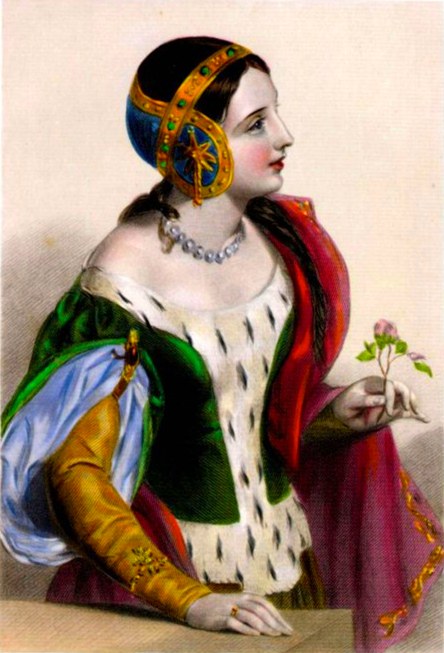
AI-assisted Portrait of Isabella of France
The She-Wolf Who Took a Throne
History remembers her as the She-Wolf of France—a phrase coined for its menace, later borrowed by Shakespeare for an entirely different queen. The original was Isabella, daughter of Philip IV, the Iron King of France, and married at twelve to Edward II of England in 1308. She arrived a child bride and was expected to remain ornamental. Instead she became one of the few medieval queens to depose a reigning king—her own husband—raise an army, and rule a kingdom in her son's name.
The marriage was a humiliation almost from the start. Edward lavished honors, lands, and affection on a succession of favorites—first the Gascon knight Piers Gaveston, then the rapacious Despenser family, who stripped Isabella of her estates and her income and left her, by the early 1320s, a queen in name with nothing of her own. She did not rage in public. She waited. In 1325 she was sent to France on a diplomatic errand and simply refused to return. There she took the exiled English baron Roger Mortimer as her lover and her instrument, and in 1326 the two landed an invasion force on English soil. Edward's regime collapsed without a real fight. The king was deposed, imprisoned, and within a year dead—murdered, almost certainly on her watch. For four years Isabella and Mortimer ruled England as sovereigns in all but title, during the minority of her son, Edward III.
What undid her was not weakness but overreach. She and Mortimer grasped lands, titles, and money with the same greed that had damned the Despensers, and in 1330 the seventeen-year-old Edward III answered with a midnight coup of his own—seizing Mortimer at Nottingham Castle, hanging him as a traitor, and retiring his mother to a long, comfortable, powerless captivity. Through her, Edward III would later claim the crown of France itself, lighting the fuse of the Hundred Years' War.
Isabella was the ENTJ in its coldest register: a strategist who read the board for years before she moved a piece, then took a throne with the unsentimental efficiency of a general—Te welded to Ni, patience in the service of command.
The Commander Who Built a War
Te — dominant
Dominant Te organizes the external world toward an objective and measures everything by whether it works. Isabella did not merely resent her enemies; she assembled the apparatus to destroy them. From the French court in 1325–26 she conducted what was, in substance, a campaign of statecraft: she secured the tacit backing of her brother, the French king; she negotiated the marriage of her son to Philippa of Hainault and used the dowry and the Hainault connection to fund and crew an invasion fleet; she gathered the English exiles who had fled the Despensers into a government-in-waiting. The deposition of a crowned king was, at the time, almost unthinkable—and she engineered it as a logistics problem with a sequence of solvable steps.
Once Edward II fell, the Te did not soften into ceremony. Isabella took control of the treasury, the great seal, and the machinery of patronage, and ran England through the regency council as the effective head of state. She understood that power resides in institutions and revenue, not in titles, and she seized the institutions. The same competence that toppled a king now administered a kingdom: appointments, grants, the renewal of the war with Scotland and then its hard-nosed settlement at Northampton. This was not a queen presiding; it was an operator governing.
Te's shadow is its appetite. Having denounced the Despensers for stripping the crown bare, Isabella and Mortimer proceeded to do the same—hoarding lands, granting themselves enormous incomes, behaving as though the realm were a resource to be optimized for their own account. It was the dominant function with the brakes off: ruthless efficiency that, freed of any check, mistook the kingdom for a balance sheet and spent down the legitimacy that had carried her to power.
The Long Game in the Dark
Ni — auxiliary
Auxiliary Ni gives Te its timing. It is the function of the single converging line—the strategist's sense that events are moving toward one outcome, and the patience to wait until the moment is ripe rather than strike when merely provoked. Isabella endured nearly fifteen years of humiliation without an open break. She watched Gaveston rise and fall; she watched the Despensers take her lands; she absorbed insult after insult while quietly reading the kingdom's discontent and the king's isolation. A reactive temperament would have detonated years earlier and been crushed. Isabella waited until the board was set—an exiled baronage, a hostile France, a regime universally loathed—and only then moved.
The diplomatic mission of 1325 is the clearest tell. On its face it was a routine errand to negotiate over Gascony; in Isabella's hands it became the pivot of a long-laid design. She had seen, perhaps before anyone, that the path back to power ran not through reconciliation with Edward but through her son. Get the heir to France, bind him to her cause, marry him advantageously, and the invasion acquires both an army and a legitimating purpose: not a coup against the crown, but a rescue of it for the next king. That is Ni—working backward from an envisioned endpoint and arranging the present to produce it.
Her one catastrophic misreading was of her son himself. Ni fixes on a vision and can be blind to the data that contradict it, and Isabella seems to have assumed Edward III would remain the pliable boy she had installed. She did not see the king he was becoming until he had her lover dragged from her chambers at Nottingham. The strategist who had read everyone else for fifteen years failed to update on the one person who mattered most.
The Sense of the Theatrical Moment
Se — tertiary
Tertiary Se in an ENTJ surfaces as a feel for spectacle and physical presence—an awareness that power must be seen to be believed. Isabella understood image. Chroniclers remarked on her beauty, and she used it; she dressed the part of the wronged queen and the rightful regent, and when she landed in England in 1326 she did so as a public restorer of order, not a furtive plotter. The widow's mourning she adopted for the rest of her life—the pointed performance of grief for a husband she had helped destroy—was its own kind of staging, a tableau calibrated for the eyes of the realm.
Se is also nerve in the decisive instant: the willingness to act in the physical world when the moment opens. Crossing the Channel with an invasion force, gambling everything on a single landing, was an act of bodily daring as much as strategy. The same boldness, less disciplined, ran through her affair with Mortimer—conducted openly, scandalously, without much regard for appearances once she held the upper hand. Tertiary functions tend to be indulged rather than governed, and in Isabella the Se appetite for seizing what was in front of her—lands, lovers, the visible trappings of dominance—ran ahead of her strategic caution and helped tip her into the overreach that destroyed her.
The Wound She Would Not Name
Fi — inferior
Inferior Fi is the ENTJ's buried interior—a private register of personal value and grievance that the dominant Te neither examines nor expresses, but which can drive behavior with disproportionate force. Isabella spent years processing her humiliation not as articulated feeling but as accumulated debt, and when she finally moved, the campaign carried an unmistakable charge of personal vengeance beneath its strategic logic. The Despensers were not merely political obstacles to be removed; the elder was hanged, the younger gruesomely executed, with a thoroughness that exceeded statecraft. This was the inferior function erupting—decades of swallowed injury discharged at last.
Where Fi failed her was in restraint and in reading the loyalties of the heart. A healthier inner compass might have stayed the appetite that turned a popular liberator into a grasping co-tyrant within a few years, or recognized that her son would not forgive a murdered father indefinitely. Isabella governed everyone's interests but her own emotional reality, and the unexamined feeling broke surface at the worst moments—the vengeful excess, the reckless attachment to Mortimer, the blind spot toward Edward III. The coldest strategist of her age was undone, in the end, by the one faculty she had never learned to manage.
Why ENTJ Over ESTP
Why not ESTP?
The ESTP reading is tempting—Isabella was bold, physically daring, and seized her opening with audacity. But the ESTP excels at improvised, in-the-moment opportunism, and Isabella's coup was the opposite: a planned, multi-year strategic campaign. She endured nearly fifteen years before striking, built a French alliance, secured funding through her son's marriage, assembled a government-in-exile, and only then invaded. An ESTP would have improvised; Isabella architected. She played the long game and took a throne with it.
The distinction is between tactics and strategy—and Isabella lived on the strategic plane. Where the ESTP reads the present field and acts on what is live right now, the ENTJ works backward from an endgame, subordinating the present to a vision of the outcome (Te–Ni). The invasion, the regency, the patient marriage diplomacy, and even the eventual claim to the French crown were moves in a long campaign, not seized chances. Her daring was real, but it served a design. That is what makes her an ENTJ rather than a gambler: she did not catch a wave—she spent years making one, and rode it all the way to a deposed king and a kingdom in her hands.
Connected Figures
Further Reading
- Isabella: She-Wolf of France, Queen of England — Alison WeirThe definitive popular biography — a sympathetic but clear-eyed reconstruction of the invasion, the regency, and the fall.
- Isabella and the Strange Death of Edward II — Paul DohertyFocuses on the deposition and the still-debated fate of Edward II, weighing the evidence for his murder.
- Isabella of France: The Rebel Queen — Kathryn WarnerA scholarly, source-driven account that pushes back on legend and reassesses Isabella on the documentary record.
