 Historical Figure MBTI
#488 · 4-17-26 · The Hundred Years' War
Edward the Black Prince
Prince of Wales · The Hero of Crécy and Poitiers
1330 — 1376
9 min read
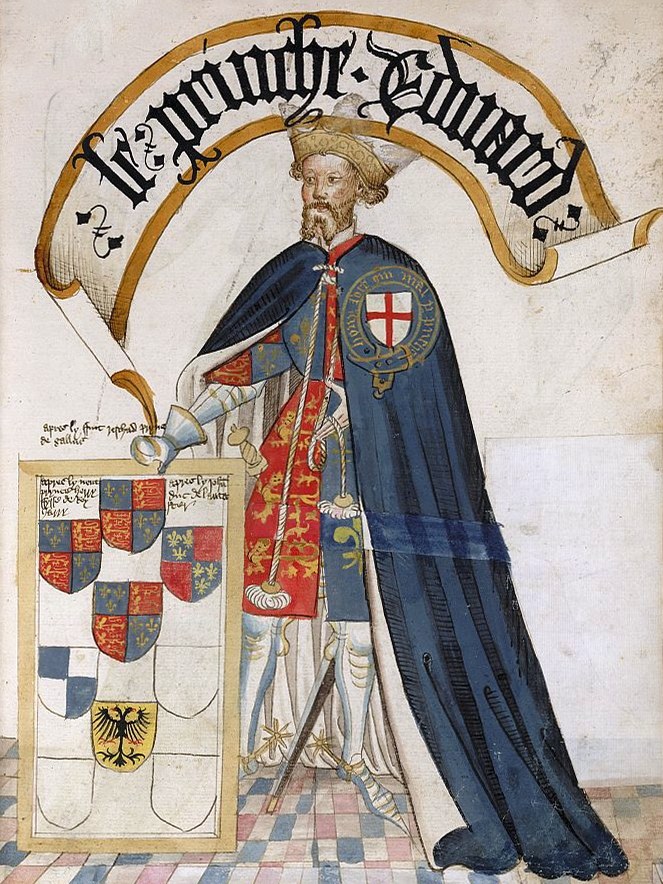
AI-assisted Portrait of Edward the Black Prince
The Prince Who Burned Brightest
He was the superstar of the Hundred Years' War — the eldest son of Edward III, Prince of Wales, heir to the English throne, and the most glamorous soldier of his age. At sixteen he won his spurs at Crécy in 1346, holding the right wing while his father, watching from a windmill, reputedly refused to send relief so that “the boy may win his spurs.” Ten years later, at Poitiers, he gambled everything on a single afternoon and won a victory so complete that he captured the King of France himself. For a generation, his name was a synonym for the chivalric ideal at full pitch: bold, brilliant, generous to the defeated, and utterly without fear.
And yet he never wore the crown. He took a wasting illness — probably dysentery — on campaign in Spain, declined slowly over years, and died in 1376, a year before his father. The throne passed over him to his young son, who became Richard II. What survives is the legend of a warrior-prince who blazed across the battlefield and was gone before he could become a king — and underneath the legend, a man whose gifts were all for the fight in front of him, and whose record as a ruler tells a quieter, harder story.
He is, almost diagrammatically, the ESTP: the man of action and the present moment, supreme where the situation was physical, immediate, and concrete, and far less sure-footed when it asked for patience, administration, and the long view.
The Black Prince was the ESTP as warrior incarnate — Se's appetite for the charge wedded to Ti's cold eye for terrain and timing. He read a battlefield the way other men read a face, and he never met a fight he did not want.
The Appetite for the Charge
Se — dominant
Dominant Se lives in the body and the immediate world — it craves engagement, trusts what it can see and touch, and comes most alive under physical pressure. The Black Prince was its purest medieval expression. At Crécy, a boy of sixteen commanded the hard-pressed vanguard against the full weight of the French chivalry and would not yield; the story that his father let him fight on unaided is, whatever its truth, a measure of how completely contemporaries believed in his nerve. He did not direct the battle from safety. He stood in it.
Se is also an appetite, and Edward had it for war itself. He raided, he campaigned, he sought the decisive clash rather than the cautious maneuver. At Poitiers in 1356, badly outnumbered and with his lines of supply failing, the safe course was to withdraw or negotiate. He chose instead to stand and fight on ground of his own choosing — and when the moment turned, he ordered the charge that broke the French army. The same instinct carried him to Nájera in Spain in 1367, where he crossed the Pyrenees to restore Pedro the Cruel and shattered the enemy in a single morning, taking even the great French soldier Bertrand du Guesclin prisoner. Wherever the question was a battlefield, the answer was Edward.
This is the gift and the limit of dominant Se together. It is unbeatable in the concrete present and indifferent to what comes after. Edward could win any field he stood on; what he could not do, as his years in Aquitaine would show, was administer the peace that victory was supposed to secure.
The Cold Eye for Ground and Timing
Ti — auxiliary
Reckless courage alone does not win battles against the odds; it loses them. What separated Edward from a merely brave knight was auxiliary Ti — an internal, impersonal logic that analyzed a situation for its working parts and found the lever that would move it. His Se supplied the appetite for the fight; his Ti told him exactly how to win it.
Poitiers is the proof. Edward did not simply hurl his outnumbered army at the French. He posted his men behind hedges and in broken, vine-laced ground that funneled the enemy and blunted their numbers, screened his archers to where they could rake the advancing columns, and held his own cavalry in reserve for the decisive instant. He read the terrain like a problem to be solved and timed his counterstroke to the precise moment the French attack lost its shape. The victory was not luck or fury — it was a tactician's cool reading of how a battle actually works, executed under pressure that would have scattered a lesser mind.
This is Ti in the service of Se: not the strategist's decade-long campaign plan, but the field commander's instant, ruthless calculation of the engagement in front of him. Edward's genius was tactical and immediate — the right move now, on this ground, in this hour. It was a genius for the battle, not for the war.
The Theatre of Chivalry
Fe — tertiary
Tertiary Fe in an ESTP shows up as a finely tuned feel for the gesture — an instinct for the public performance that wins admiration and reads the mood of an audience. Edward had it, and he had it in the grand chivalric register of his century. The most famous scene of his life is not a battle but a banquet: on the evening of Poitiers, having captured John II of France, he insisted on serving the defeated king at table with his own hands, standing bareheaded before him and praising his courage, refusing to sit as his equal. It was a magnificent piece of theatre — magnanimity staged for maximum effect — and it sealed his reputation across Europe as the model of the courteous knight.
This was Fe deployed, not Fe felt to the depths. It was the social performance of honor: a man who understood, almost theatrically, what the code of chivalry required and how to embody it so that everyone watching would remember. The captivity of John II was conducted with lavish courtesy precisely because courtesy was the currency of glory, and Edward spent it like a master.
But tertiary Fe is shallow soil, and it could collapse hard. The same prince who served a king at table ordered the sack of Limoges in 1370, when the city had gone over to the French: the chroniclers describe a brutal reprisal, the streets given over to slaughter. The chivalrous host and the man who punished a town without mercy were the same person. Fe in the tertiary slot governs the performance of honor among one's own kind; it does not reliably extend mercy to those outside the circle, and under the pressure of his failing health and a war turning against him, it gave way to something colder.
The Blind Spot Beyond the Battle
Ni — inferior
Inferior Ni is the ESTP's weakest faculty: the long view, the slow-ripening plan, the sense of where a course of action leads years out. Edward's career is a study in its absence. He could win any battle put before him and could not convert those victories into a durable settlement. As Prince of Aquitaine, ruling the vast territory his father's wars had won, he proved an indifferent administrator. His expensive Spanish adventure on behalf of Pedro the Cruel brought a glittering victory at Nájera and almost nothing else — Pedro never paid what he owed, the campaign drained the principality, and to recover the cost Edward levied taxes that drove his Gascon subjects to appeal to the King of France.
That appeal reopened the war on terms that favored the patient enemy waiting in Paris. While Edward had been chasing decisive battles, Charles V of France had been doing the opposite: avoiding pitched fights, wearing the English down with caution and attrition, playing the long game the Black Prince could not see. The great soldier won every field and steadily lost the war.
And then his own body betrayed the man whose whole life had been the body in action. The dysentery he contracted in Spain never left him; he spent his last years a sick man carried in a litter, his Se starved of the physical world it lived for. Inferior Ni offers no consolation in the form of meaning or perspective; it only deepens the sense that the future is closing in. He died in 1376, the heir who never reigned — brilliant to the last on any ground he could stand on, and undone by the one campaign no charge could win.
Why ESTP Over ENTJ
Why not ENTJ?
The ENTJ is the strategic commander — the type that wins wars by building structures, marshaling resources, and executing a plan that unfolds over years. The Black Prince did none of that. His genius was the fight in front of him: read the ground, time the charge, break the enemy today. When the task turned strategic and administrative — governing Aquitaine, financing a campaign, securing a peace — he faltered, and the patient INTJ Charles V outlasted him. His own brother, the ENTJ John of Gaunt, was the family's true long-game operator; Edward was its sword.
The distinction is between the warrior and the strategist. An ENTJ's dominant drive is to impose a long-range plan on reality; the Black Prince's was to win the present engagement with overwhelming tactical brilliance. He lived for the charge, not the campaign map — supreme on the field and lost off it. That is Se leading, Ti aiming, and inferior Ni leaving him blind to the slow war he was actually losing. He was the greatest soldier of his age and never a great ruler, and the gap between those two facts is the whole of the ESTP verdict.
Connected Figures
Further Reading
- Edward, Prince of Wales and Aquitaine: A Biography of the Black Prince — Richard BarberThe standard scholarly life — meticulous on the campaigns, the rule of Aquitaine, and the sources behind the legend.
- The Black Prince — David GreenA modern, accessible biography that weighs the chivalric reputation against the harder record, including Limoges and the failures of governance.
- The Hundred Years War — Jonathan SumptionThe definitive multi-volume narrative of the war; indispensable for Crécy, Poitiers, the Spanish campaign, and the French recovery under Charles V.
