 Historical Figure MBTI
#491 · 4-17-26 · The Hundred Years' War
Alice Perrers
The Grasping Mistress of Edward III's Dotage
c. 1348 — 1400
6 min read
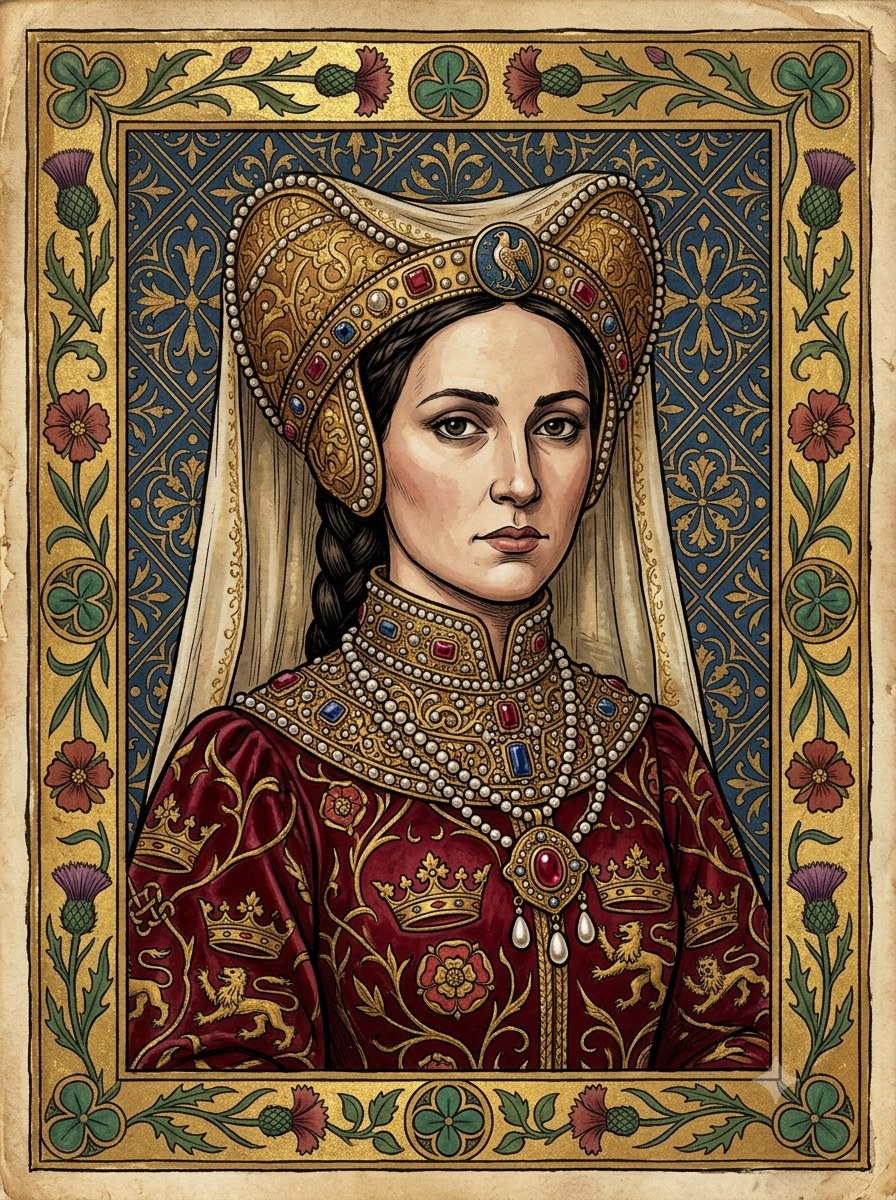
AI-assisted Portrait of Alice Perrers
The Woman Who Fed on a Dying Lion
She came from nowhere — a woman of low, obscure birth whose origins were murky enough that her enemies could never agree who her parents had been. By the late 1360s she had become the mistress of Edward III, the once-glorious warrior-king of England, and as that aging lion sank into senility she made herself one of the most powerful, and most hated, figures at his court. Jewels, manors, ready cash: she gathered them on a scale that astonished even a court inured to favoritism, and at a speed that betrayed a single governing instinct — take it now, while the taking is good.
What set her apart was not greed alone but the nerve of operating in the open — seating herself beside the royal judges to sway their verdicts, riding through London as the “Lady of the Sun” in a great public pageant. She read the situation cold and moved fast: an aging king, a power vacuum, an open hand. That is the ESTP in its rawest form — the bold opportunist seizing the main chance.
Alice Perrers was the ESTP as predator of the moment — Se lunging for the opening, Ti calculating how far the law could be bent, and an inferior Ni that never asked what would happen on the day the lion died.
The Opportunist Who Seized the Hour
Se — dominant
Dominant Se lives in the present tense. It does not wait, does not hedge, does not lay slow foundations for some distant payoff — it sees what is in front of it and takes it. Alice arrived at court as a damsel to the queen, an unremarkable position, and within a few years had converted proximity to a fading king into an empire of property: manors across more than a dozen counties, the wardships and rents that came with them, and chests of jewels said to include gems that had once belonged to the dead queen herself. This was no patient estate-building; it was a smash-and-grab in plain sight, against the clock of Edward's declining health.
The same instinct drove her appetite for spectacle. To ride through London as the “Lady of the Sun” — gilded, adorned, surrounded by knights — was a profoundly Se act: a craving to be seen, to convert position into something dazzling and immediate. Where a guarded operator would have hoarded influence quietly, Alice spent hers on display, with the gambler's nerve to put her whole improbable rise on show. And for a decade, the gamble paid.
The Cold Logic of Every Loophole
Ti — auxiliary
Se supplied the appetite; auxiliary Ti supplied the method. Alice was no reckless spendthrift grabbing at random — she understood systems and exactly where they could be levered. The most notorious example was her interference in the royal courts: she is reported to have sat beside the justices as cases were heard, intimidating them into rulings that favored her or her clients, turning the machinery of the law into a private instrument. The same calculating intelligence ran through her property dealings, with trusted intermediaries holding lands to blur the trail of ownership. None of it required deep feeling or long vision, only a clear, unsentimental grasp of the gap between what the rules said and what they could be made to allow. Ti does not ask whether a thing is seemly. It asks whether it works.
The Charm That Held a King
Fe — tertiary
Tertiary Fe in an ESTP is not warmth so much as a working instinct for what moves the one person who matters. Whatever Alice was — and the chroniclers, who loathed her, granted her no beauty — she held the affection of Edward III through years of his decline, when others were abandoning a king who no longer remembered or rewarded them. That is a real social skill: reading a man's moods, making herself indispensable, being the comfort the failing king reached for. But this Fe is narrow and self-serving. Alice could charm the one person whose favor was her whole fortune, yet made no effort to win the wider court, the Commons, or the city — the very people whose resentment would destroy her. She read the king and ignored everyone else: a transactional warmth, aimed where it paid and absent everywhere it did not.
No Thought for the Reckoning
Ni — inferior
Here is where the whole edifice was always going to crack. Inferior Ni means blindness to where things are heading — an inability to feel the future as vividly as the present. Alice was magnificent at seizing the moment and hopeless at imagining the day it would end. She built her entire fortune on the life of one aging, dying man, with no exit strategy and no hedge against the reckoning everyone else could see coming.
When it came, it came fast. In 1376 the assembly history calls the “Good Parliament” turned on the court's corruption, singled her out by name, and banished her from the king's side. She clawed her way back — the Se operator never stops fighting for the opening — but it was a reprieve, not a rescue. When Edward died in 1377 the protection that was her whole world died with him: stripped of lands and treasure, driven from court, left to grind after scraps of what she had lost. The predator of the moment had no answer for the moment's end.
Why ESTP Over ENTJ
Why not ENTJ?
An ENTJ is a long-range strategic builder — the type that lays durable foundations and secures the position against future threats. John of Gaunt, who shielded Alice, was that type, playing a long game for dynasty and power. Alice did the opposite: she grasped what was in front of her and built nothing meant to outlast the king who supplied it — no faction loyal to her, no fortune secured against his death, no plan for the morning after. That is opportunism, not strategy.
The distinction is the whole story of her fall. An ENTJ accumulating power would have spent the king's final years fortifying it; Alice spent them grabbing, all Se appetite and Ti cunning with no architecture beneath the hoard. While the lion lived she was untouchable; the instant it died, there was nothing holding the structure up — the ESTP at the extreme of its gift and its blindness both.
Connected Figures
Further Reading
- The Perfect King: The Life of Edward III — Ian MortimerThe standard modern biography of the king — vivid on the decline of his final years and the rise of Alice Perrers within it.
- Edward III — W. M. OrmrodThe definitive scholarly life in the Yale English Monarchs series — authoritative on the politics of the reign and the Good Parliament.
- The Uncrowned Queen: Alice Perrers and Related Scholarship — Laura TompkinsTompkins's articles recover the documentary record of Perrers's life, untangling the myth from what the sources actually show.
