 Historical Figure MBTI
#501 · 4-18-26 · Plantagenet England
Robert de Vere
Earl of Oxford · Richard II's Favorite
1362 — 1392
7 min read
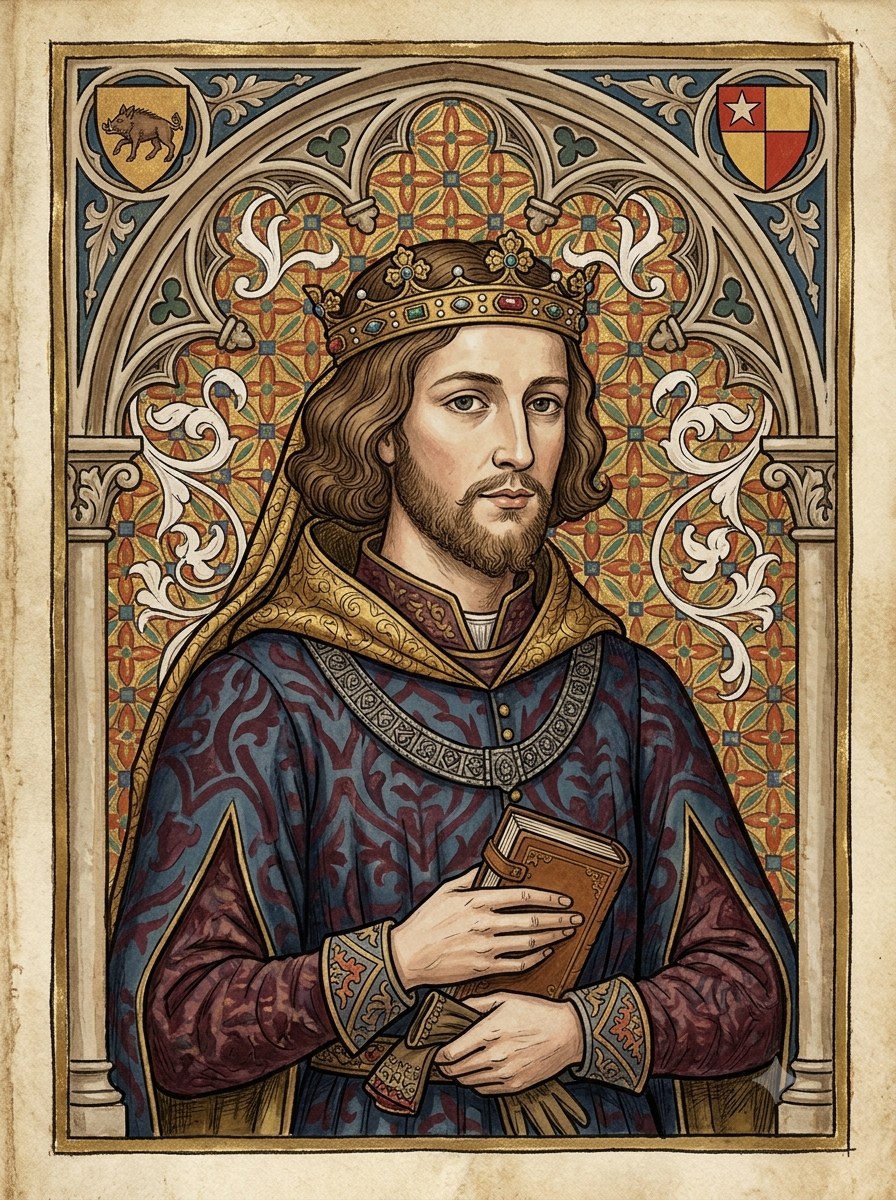
AI-assisted Portrait of Robert de Vere
The Favorite Who Soared on a King's Love
Every king who loves too freely seems eventually to find his Gaveston, and Richard II found his in Robert de Vere, ninth Earl of Oxford. Young, charming, and gloriously frivolous, de Vere was the companion on whom the boy-king lavished honors so far beyond his station that the oldest blood in England recoiled. He was made Marquess of Dublin—a rank never before seen in the realm—and then, in an unprecedented stroke, Duke of Ireland, a princely dignity for a man whose earldom, however ancient, hardly warranted it. The court watched a sovereign pour out love and title on a single dazzling courtier, and it did not forgive him.
What made de Vere so beloved is also what made him so resented: he was delightful and he knew it. He dressed splendidly, jousted gallantly, and moved through the king's presence with the easy grace of a man who has never doubted his welcome. He flaunted his hold over Richard, and then compounded the scandal by casting off his own wife—the king's cousin Philippa de Coucy—for one of Queen Anne's Bohemian ladies-in-waiting, a desertion that insulted the royal family even as the favor of its head shielded him. He had everything charm could win and nothing that charm could not.
Robert de Vere was the ESFP at the summit of fortune—all charm, spectacle, and present pleasure, alive to every glittering surface of court life and blind to the catastrophe his own elevation was inviting.
The Gallant in the Glittering Present
Se — dominant
Dominant Se lives in the immediate, sensory now, and de Vere was its perfect courtier. He was attuned to spectacle, fashion, the carriage of a horse and the cut of a sleeve—to everything bright and tangible that made Richard's court a theater of pleasure. He did not scheme so much as shine. His gift was presence: the ability to fill a room, to charm a king at supper, to be the most delightful person in any company. That is Se in its courtly form—magnetism that needs no strategy because the moment itself is the whole of its concern.
It is telling that contemporaries remembered de Vere not for any policy or cause but for how he carried himself—gracious, vain, gallant, perpetually at the center of the king's amusements. He rose not by counsel or arms but by being a pleasure to be near, and Richard, lonely and loving, could not get enough of him. The Se favorite trades in charm because charm is what the present rewards, and for a glorious decade the present rewarded de Vere with everything.
The Heart That Followed Itself
Fi — auxiliary
Beneath the dazzle ran an auxiliary Fi that answered to nothing but its own feeling. De Vere's most reckless act was not political but personal: he abandoned his wife, Richard's cousin, for a Bohemian attendant of the queen—a desertion that served no ambition and risked a great deal, undertaken purely because his desire pointed that way. A coldly calculating man would have kept the royal marriage and taken a mistress quietly. De Vere instead followed his heart into the open, heedless of how it looked or whom it wounded.
That is Fi in its impulsive register: a private compass of want and feeling that overrides prudence and consequence alike. It made de Vere capable of genuine devotion—his bond with Richard was no mere transaction—but it also made him incapable of the self-discipline his position demanded. He did what he felt like doing, and trusted, as the favored always do, that love would cover the cost. For a while it did. It would not cover everything.
Command Without the Gift for It
Te — tertiary
When the crisis came, de Vere reached for tertiary Te—the executive instinct to organize, levy, and act—and found it unequal to the moment. In 1387, as the Lords Appellant moved against Richard, the king turned to his favorite to raise an army, and de Vere did raise one, marching out of Cheshire to defend his master. The will to act was there; the competence was not. He was a charming courtier asked to be a general, and the two are not the same office.
Tertiary Te can mimic decisiveness without mastering it. De Vere could muster men, but he could not maneuver them—could not read the field, hold his nerve, or out-think opponents who had spent their lives in the harder schools of war and faction. His authority had always rested on the king's affection, not on any demonstrated capacity to lead. Stripped of charm and set on a battlefield, the favorite had only an under-developed gift for command, and it failed him at the one hour it mattered.
The Blindness at Radcot Bridge
Ni — inferior
Inferior Ni is the missing faculty of foresight, and its absence wrote de Vere's ruin. He could not see, as he accumulated honors and titles, that every gift from Richard deepened the enmity of men more powerful than himself—that an unprecedented dukedom was not a triumph but a target. The future was opaque to him. He lived inside the warm present of the king's favor and never reckoned with where it was leading, until it led to a river crossing in December 1387.
At Radcot Bridge his army was outmaneuvered and scattered almost without a fight. De Vere fled, plunging into the Thames to escape, and got away abroad into an exile from which he never returned. He died a few years later in the Low Countries—gored by a wild boar while hunting, an end as careless and physical as the life had been. The man who could charm a king could not foresee a trap, and inferior Ni, the function that might have warned him, simply was not there to see it coming.
Why ESFP Over ESTP
Why not ESTP?
The ESTP shares de Vere's Se love of the immediate and the bold, but pairs it with a tactical, operator's edge—cool nerve, a feel for leverage, a readiness to fight and fight well. De Vere had none of that hardness. His gift was warmth: a gracious, pleasure-and-people-loving charm that won a king's heart, not a gambler's instinct for advantage. And when charm gave way to command at Radcot Bridge, he collapsed. An ESTP would at least have given battle competently; de Vere simply fled.
The decisive split is the auxiliary. De Vere was governed by Fi—a personal, feeling-led compass that abandoned a royal marriage for desire and bound him to Richard by affection rather than calculation—not the ESTP's Ti, which weighs angles and keeps its own counsel. He was a creature of the heart and the moment, gallant and gracious and fatally unstrategic. That is the ESFP favorite: he rose on charm, and he had nothing else to fall back on when charm ran out.
Connected Figures
Further Reading
- Richard II — Nigel SaulThe definitive modern biography of the king — authoritative on de Vere's rise, the Appellant crisis, and the politics of royal favor.
- The Loyal Conspiracy: The Lords Appellant under Richard II — Anthony GoodmanThe fullest study of the magnates who destroyed de Vere — essential for understanding the forces that routed him at Radcot Bridge.
- Richard II and the English Royal Treasure — Jenny StratfordOn the splendor and spectacle of Richard's court — the glittering material world in which de Vere's Se charm flourished.
