 Historical Figure MBTI
#1292 · 9-25-26 · Heian Japan
Ariwara no Narihira
Courtier · Poet · Figure Behind the Tales of Ise
825–880
6 min read
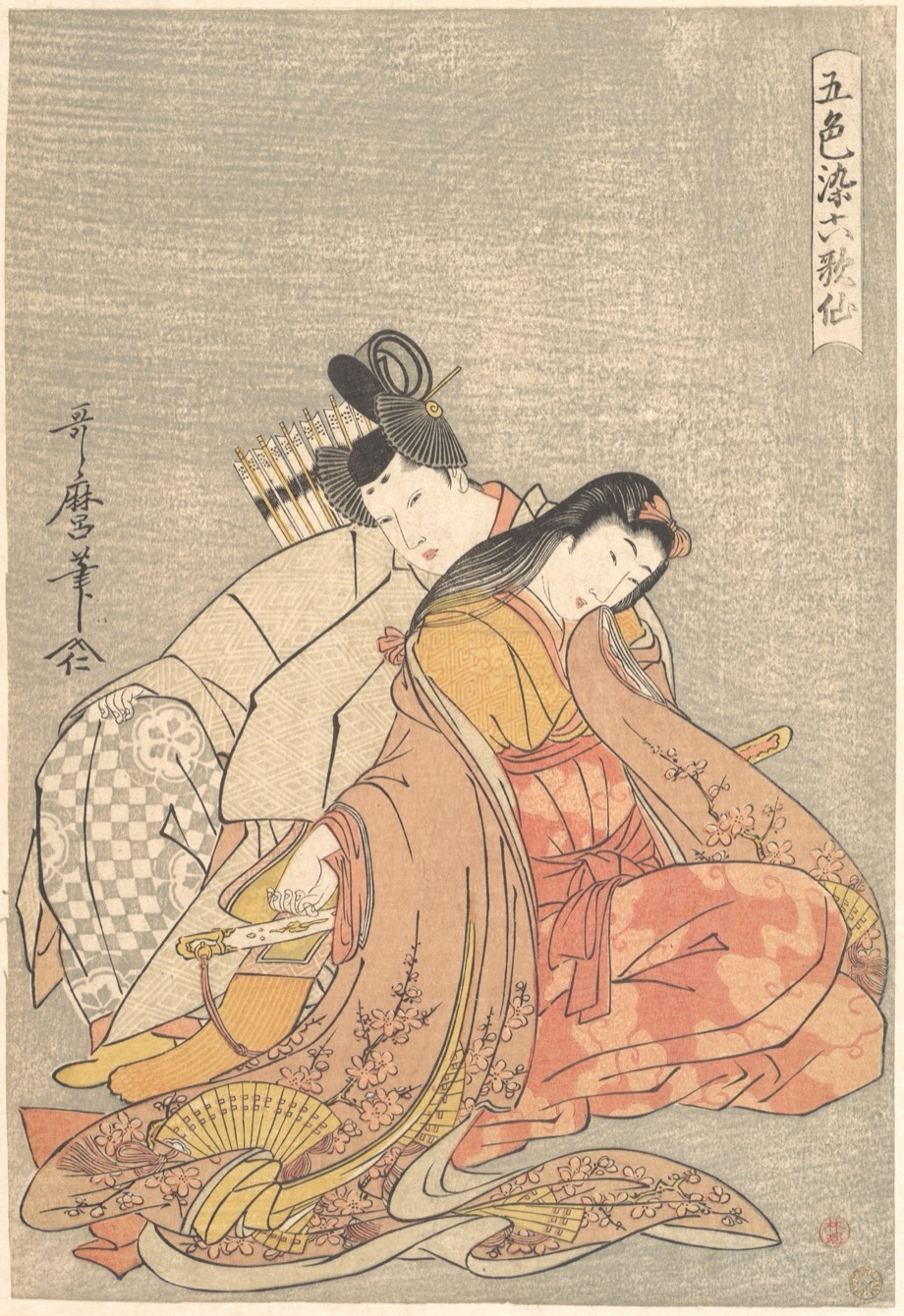
Ariwara no Narihira with Ono no Komachi — c. 1798 (later imagined depiction)
The courtier behind the famous lover
Ariwara no Narihira lived from 825 to 880, but his cultural life did not end with the historical courtier. The poems attributed to him helped furnish the Tales of Ise, whose unnamed men, lovers, and travelers were increasingly gathered around his identity. Later paintings and performances made the association vivid. The familiar romantic hero is therefore both connected to Narihira and larger than the evidence for his actual life.
He belonged to an aristocratic family with imperial ancestry and became one of the major names in the early waka tradition. The Kokin Wakashū preserves thirty poems attributed to him, and its Japanese preface discusses him among six prominent poets. These are firmer anchors than a complete itinerary assembled from the Ise episodes. Poems, critical judgments, and stories overlap, but their overlap does not make all their claims equally biographical.
Narihira remains Untyped because the surviving personal evidence is insufficient. The charming, restless, or passionate figure familiar from literature cannot supply the behavioral record missing from the courtier’s biography. The decision leaves his artistic importance intact. It also prevents a type from becoming one more modern version of the legendary lover, confidently attaching an inner nature to a name whose literary associations have long exceeded its secure historical details.
A season returns to a changed place
One of his best-known poems questions the relation between a familiar moon, returning spring, and a self that seems to remain unchanged. In the fourth episode of the Tales of Ise, the verse belongs to a man revisiting the place of an ended love affair. The woman has gone, and the setting can no longer restore the experience associated with it. The narrative supplies an occasion that gives the poem’s questions an immediate emotional force.
The poem’s structure is more subtle than a statement that the speaker feels sad. Recurring things seem at once recognizable and estranged. Spring’s return cannot return the relationship; the continuing body cannot guarantee a continuous world. The questions unsettle the comparison between sameness and change instead of resolving it. Their effect does not depend on a reader identifying the absent woman or accepting the narrated occasion as a verified event in Narihira’s life.
A later painting by Sumiyoshi Gukei makes the scene visible, placing a courtier at the remembered setting and inscribing the poem above him. The Smithsonian’s account explicitly identifies the figure as an unnamed courtier traditionally associated with Narihira. That qualification matters. The artwork realizes a reading of the story, rather than supplying a portrait drawn from observation. Its veranda and longing gaze belong to a later act of interpretation.
An autumn poem associated with Narihira offers a different kind of transformation. Scarlet maple leaves alter the appearance of the Tatsuta River, inviting comparison with vividly patterned cloth. The scene becomes legible through an imaginative change of medium: water carries color as if it had been worked into a textile. That act of perception is evidence of poetic craft. It does not demonstrate a habitual sensory preference, any more than the spring poem establishes the author’s private emotional history.
A journey made of episodes and poems
The ninth Ise episode takes a man and companions eastward from the capital. Travel produces encounters with places, homesickness, and opportunities for verse. At the Eight Bridges, the poem incorporates the sounds of kakitsubata, the iris, into its sequence. Its ingenuity joins a local plant to a memory of what has been left behind. The formal constraint does not interrupt feeling; it provides the shape through which feeling becomes shareable.
This journey became one of the most frequently represented passages of the work. Yet a represented itinerary is not necessarily an established journey by Narihira. The narrative is a literary arrangement, and its traveler remains unnamed. A historical identification can be suggestive without being conclusive. The dates and duties of the courtier must be established from appropriate records rather than inferred solely from how persuasively the tale makes movement and longing coincide.
Later artists could be strikingly free with the material. An Utamaro triptych turns the journey into a display of fashionable Edo-period women, exchanging the tale’s subdued travelers for an elaborate contemporary spectacle. This is not a failed attempt at historical documentation. It is a deliberate transformation made possible by an audience’s recognition of the classical subject. The more familiar the story, the more an artist could alter its appearance while keeping the allusion intelligible.
The same principle operates in objects that omit a human figure altogether. Irises and bridges can be enough to evoke an entire narrative for a viewer who knows the poem. Narihira’s afterlife therefore includes an unusual kind of presence through absence: a place, plant, or pattern brings the poet to mind without showing him. The historical person becomes a cultural association that survives in materials very distant from the original written verse.
Canonization was a continuing act
The Tales of Ise developed over time. Its eventual collection of 125 episodes contains material beyond what could be assigned to Narihira’s own lifetime or authorship. That development is a strong reason to resist calling the whole work his autobiography. An early association between poems and stories could be extended by subsequent compilers, readers, and commentators. What survives is a layered text, not a single courtier’s continuous testimony.
The Kokinshū supplies another layer. Ki no Tsurayuki evaluates Narihira’s poetry in the Japanese preface, establishing a critical reputation as well as transmitting attributed works. Later categories of poetic immortality gave the name further authority. The poems were copied and read within a canon that selected particular voices and taught readers how to compare them. Fame depended on those acts of selection as much as on an imagined personal magnetism.
The link with Ono no Komachi belongs primarily to that canon. Both poets were included among the six prominent figures and became major subjects of later literary and visual traditions. This connection is historically meaningful without a claim that they had a romance. Such a claim would repeat the process by which literary proximity becomes invented personal intimacy. Their shared place in cultural memory is already sufficient to explain why their portraits appear together.
The literary Narihira also helped shape later ways of imagining courtly life. His poetic association with love, travel, and sensitive response made him available to writers and artists across centuries. That influence should be described through the works that show it, rather than used to infer that the historical man personally embodied every quality later audiences admired. A reputation can reveal the desires of its inheritors as clearly as it reveals its subject.
Connected Figures
Further Reading
- Tales of Ise — Translated by Helen Craig McCulloughA carefully annotated translation that makes the relation between poems and narrative occasions available for study.
- The Ise Stories: Ise monogatari — Translated and commented on by Joshua S. Mostow and Royall TylerA modern translation with episode-by-episode commentary on a layered literary work.
- Kokin Wakashū: The First Imperial Anthology of Japanese Poetry — Translated and annotated by Helen Craig McCulloughPreserves Narihira’s attributed poems within the anthology and its critical framework.
- Pictures of the Heart: The Hyakunin Isshu in Word and Image — Joshua S. MostowPlaces canonical verse within a continuing history of commentary and visual interpretation.
