 Historical Figure MBTI
#1293 · 9-25-26 · Heian Japan
Ki no Tsurayuki
Poet · Anthology Editor · Author of the Tosa Diary
c. 872–945 or 946
7 min read
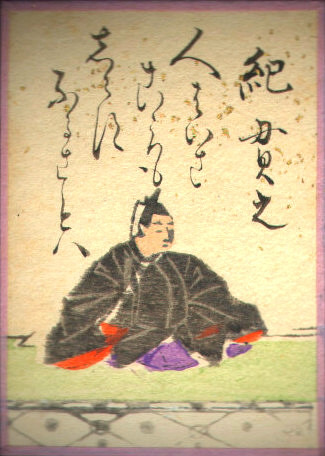
Portrait of Ki no Tsurayuki — Edo period (1603–1868) (later depiction)
A preface that taught readers how to read
Ki no Tsurayuki helped make a body of poetry into a tradition with an account of its own meaning. As one of the four compilers of the Kokin Wakashū, he participated in selection and arrangement; as author of its Japanese preface, he explained why those poems mattered. The anthology was not merely a storage place for beautiful individual works. It joined verse to imperial recognition, literary history, and a vocabulary of judgment.
A low-confidence INFJ reading rests chiefly on that interpretive framing. Tsurayuki connects particular experiences and poems to an encompassing account of expression, then directs the account toward a community of readers. This can resemble Introverted Intuition with Extraverted Feeling. It does not follow from the fact that he wrote emotionally powerful verse. The preface is also a public literary argument shaped by earlier models and by the work it introduces.
His life extended from approximately 872 to 945 or 946, with uncertainty at both ends. He served at court and as governor of Tosa, while his poems and literary works acquired an influence exceeding those offices. His best-known prose work, the Tosa Diary, adopts a female narrator to describe a former governor’s return toward the capital. That deliberate distance between author and narrator is essential to reading the work, and limits the psychological conclusions a biography can draw from it.
An INFJ reading begins with dominant Introverted Intuition: Tsurayuki gave many poetic experiences a shared account of what expression could mean.
Ni — the many poems belong to one account
The preface begins by imagining poetry as growth from the human heart into an abundance of words. Perceived things and lived circumstances furnish the occasions of expression, while the sounds of birds and frogs place human verse within a larger world of song. The images give a compact account of how experience becomes language. They do not amount to a private confession that Tsurayuki himself always felt as the speakers of his selected poems did.
Dominant Introverted Intuition is proposed in the movement from many instances toward a governing interpretation. The poems can differ in occasion, author, and tone while belonging to one account of expressive activity. Tsurayuki’s preface supplies that account before readers encounter the collection. It makes a field comprehensible through a small number of connected claims, then carries the claims into literary history and critical evaluation.
This synthesis should not be described as creation from nothing. Chinese critical traditions furnished concepts and models that the prefaces adapted. The Japanese preface and the Chinese preface, written by Ki no Yoshimochi, both participate in that wider inheritance. The distinctive undertaking involved giving waka renewed public authority through established languages of literary value. An intuitive preference cannot be proved by neglecting the education that made the argument possible.
The anthology’s design provides a second setting for the hypothesis. Seasonal poems and love poems occupy sequences that can create progression across separate voices. An individual verse receives part of its effect from what precedes and follows it. Tsurayuki did not perform this editorial work alone: Ki no Tomonori, Oshikōchi no Mitsune, and Mibu no Tadamine share the commission. The resulting architecture supports a question about his interpretive habits, but not exclusive credit for every sequence.
Fe — expression enters a shared world
Tsurayuki’s literary argument gives expression a public setting. Poetry is something people can exchange, recognize, preserve, and judge. The preface addresses readers, not only an isolated writer working through feeling. The imperial anthology turns those relations into an institution: a selected poem can become exemplary, and a critical description can shape how later generations understand an author. The social consequence of interpretation is unusually visible here.
Auxiliary Extraverted Feeling is a tentative account of that orientation toward shared significance. The argument connects the inward occasion of verse with its capacity to be understood beyond the speaker. It then helps establish standards by which a community can value particular forms of expression. This is more informative than counting references to hearts, tears, or love. Such words belong to the literary material and cannot distinguish a feeling preference from a thinking preference.
His assessments of Ono no Komachi and Ariwara no Narihira demonstrate both the reach and the limitations of those standards. Canonical recognition did not prevent restrictive comparisons or sharp criticism. His description of Komachi links qualities of poetry to a gendered image of a woman. A modern personality portrait should not convert that judgment into proof of exceptional empathy. It is a historically situated act of evaluation with lasting consequences for another poet’s reception.
The Fe reading is therefore about the translation of meaning into a communal vocabulary, not an assumption of universal kindness. Public criticism may coordinate a readership while narrowing what it permits readers to hear. Tsurayuki’s influence includes that power to frame. The possibility that his literary purpose, rather than his habitual interpersonal preference, explains the same pattern remains substantial and keeps confidence low.
Ti — author, narrator, and the work between them
The opening of the Tosa Diary announces an experiment: a woman will attempt the sort of record associated with men. It then describes departures, farewells, prayers, and stages of travel in a voice positioned within the party. The former governor is an object of the narration, even though the author’s service in Tosa provides the historical background. The work creates perspective rather than merely changing the spelling of an official log.
Tertiary Introverted Thinking is suggested, cautiously, by the attention to the conditions of representation. A diary form carries expectations about who speaks and what counts as a record. Tsurayuki’s chosen narrator alters those expectations from the beginning. The distinction between author and voice allows irony, observation, and feeling to operate through a designed position. This demonstrates literary intelligence; it does not by itself establish an analytical psychological preference.
The work’s grief and humor consequently require the same care as its introductory experiment. A passage may be connected to an experience in the author’s life while still being shaped by narrative selection, timing, and tone. We should not label every feeling expressed by the narrator as a direct sample of Tsurayuki’s temperament. Nor should the female voice be treated as a transparent declaration of personal identity. Both moves collapse a literary construction into a biographical assertion.
The more defensible observation concerns a sustained interest in how language gives experience a form other people can encounter. The preface theorizes that process; the diary tries a conspicuous way of performing it. Their connection supports the proposed portrait without requiring the two works to speak in precisely the same voice. There is insufficient evidence to illustrate a characteristic inferior Se response, and bodily travel in a narrative cannot supply that missing psychological record.
Why INFJ Over INFP
Why not INFP?
INFP is plausible when the expressive account of poetry and the individual poems receive greatest emphasis. The INFJ preference here gives additional weight to his comprehensive framing and the direction of that framing toward a canon and a readership. The distinction is slight because a public preface naturally serves collective purposes. Authored emotional verse does not establish an inward value preference, just as editorial influence does not establish an outward feeling preference.
INTJ would also be credible if the anthology’s structure and the preface’s system of judgments were foregrounded. The proposed INFJ reading emphasizes the relation between synthesis and shared expression, with low confidence. Tsurayuki’s education, commission, and literary ambitions provide strong alternative explanations for the evidence. A surviving oeuvre is richer than a legend, but remains a selective record of a person.
Connected Figures
Further Reading
- Kokin Wakashū: The First Imperial Anthology of Japanese Poetry — Translated and annotated by Helen Craig McCulloughIncludes the prefaces, poems, and the Tosa Diary in their literary settings.
- The Kokinshū Prefaces: Another Perspective — John Timothy WixtedReconstructs the Chinese critical antecedents that complicate a purely national account of the prefaces.
- Navigating Narratives: Tsurayuki’s Tosa Diary as History and Fiction — Gustav HeldtReassesses narrator, genre, parody, and the historical settings of the diary.
- Tosa Nikki — Classical Japanese Portal, Ohio State UniversityA language-centered presentation that distinguishes the narrative perspective from the historical author.
