 Historical Figure MBTI
#1291 · 9-25-26 · Heian Japan
Ono no Komachi
Waka Poet · Historical Figure Behind Later Legends
fl. mid-9th century; birth and death unknown
10 min read
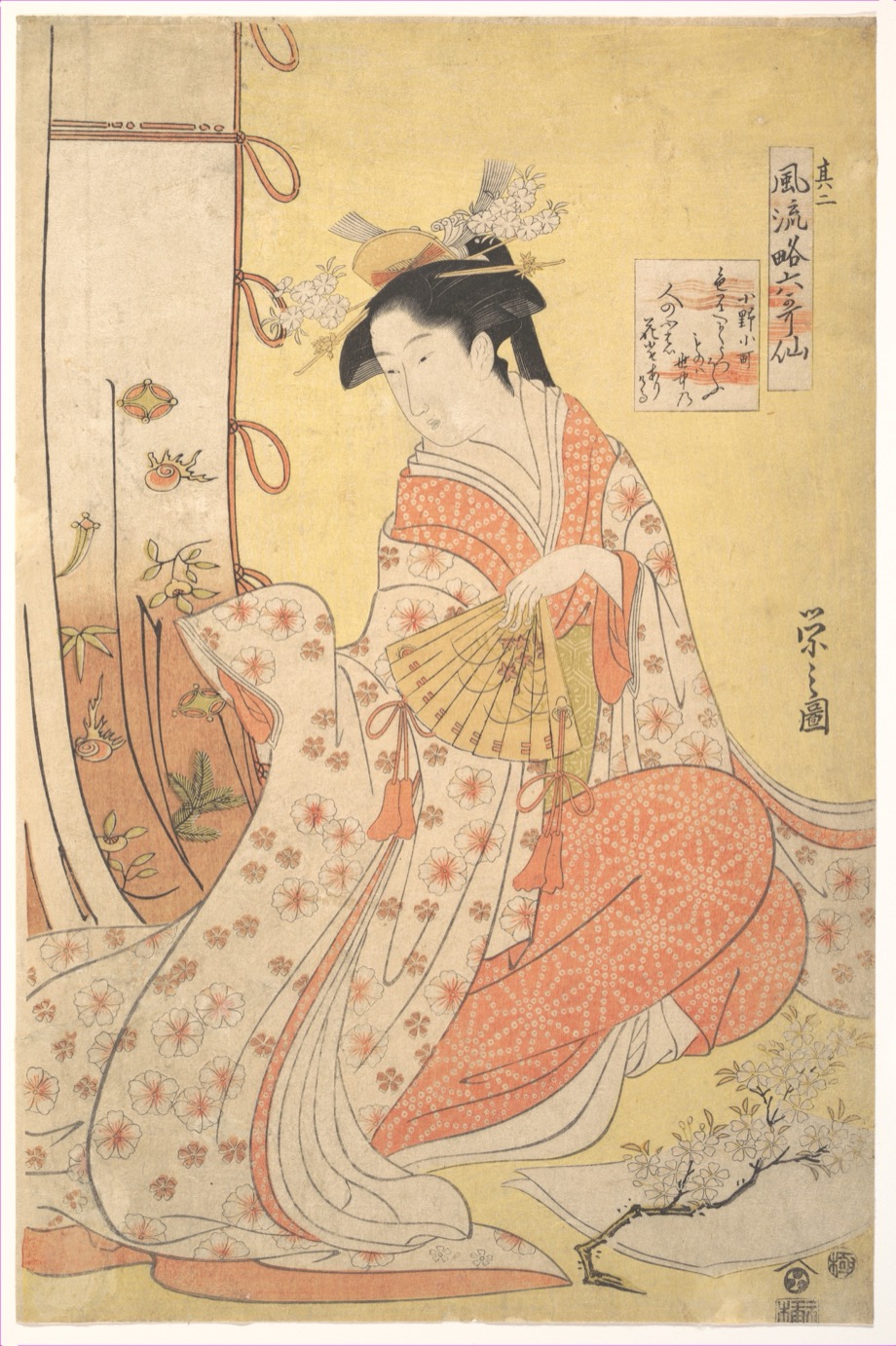
Imagined portrait of Ono no Komachi — 1790s (later depiction)
The poems remain; the life recedes
Ono no Komachi is more securely present in a handful of poems than in a sequence of biographical events. Her birth and death are unknown. Her family connections have been proposed rather than firmly established, and later traditions supply an abundance of adventures that the ninth-century record cannot confirm. The apparent contradiction is central to her historical importance: a poet whose life is difficult to reconstruct became one of Japan’s most recognizable literary figures.
The proper starting point is not the legendary beauty or the destitute old woman. It is the attributed verse preserved in early anthologies, especially the eighteen poems of the Kokin Wakashū. The anthology’s Japanese preface places her among six prominent poets, in a discussion written after her period of activity by Ki no Tsurayuki. That recognition helped create the category of the Six Poetic Immortals. It is an act of critical reception, not a transcript of Komachi describing herself.
She remains Untyped. Love poems may expose a finely made experience of longing without providing dependable evidence of the author’s everyday behavior. A first-person speaker is not automatically a witness under oath. In Komachi’s case, sparse biography and expansive later legend make that distinction especially important. It leaves ample room to read the poetry closely while declining to classify a private personality that the surviving evidence does not adequately disclose.
A dream can change the terms of desire
One celebrated poem, numbered 552 in the Kokinshū, begins from thinking about a person and meeting that person in sleep. Its force arrives with the recognition that the meeting belonged to a dream and the wish not to have awakened. The short form contains a reversal: what initially appears to be a fulfillment becomes a loss when consciousness names it. The poem does not need a detailed setting to make the reversal intelligible.
The absent details matter. We are not told a securely identifiable lover, a date, a chamber, or a sequence of events sufficient to reconstruct a relationship. That absence makes the experience portable across readers. It also makes the poem vulnerable to biographical embellishment. A later reader may readily imagine a particular betrayal behind it, but the imaginative act belongs to the reader unless another source supports it. The poem can be precise about experience while remaining indeterminate about an occasion.
Poem 553 changes the emphasis. After seeing the beloved while dozing, its speaker begins to rely on dreams. This is less a description of a single disappointment than an account of altered expectation. What cannot be obtained reliably in waking life may become available in sleep. The reliance is precarious because the medium that permits the meeting also makes it impossible to keep. The poem understands desire through the conditions of its appearance.
The craft lies partly in how little explanation it needs. It does not present a general theory of love and then illustrate it. A small movement between waking and sleeping allows a reader to experience the problem without resolving it. Calling such verse merely emotional understates the deliberate arrangement that makes the emotion legible. Conversely, its control of arrangement is not evidence that the historical poet habitually made decisions in a particular psychological way.
These poems participate in a literary world where dreams could connect separated people and carry significance beyond ordinary fantasy. That background should neither be stripped away nor converted into a literal report of supernatural travel. The speaker’s reliance can be understood within the poetic conventions available to her. What the work asks of a reader is attention to the fragile meeting, not assent to a biographer’s invented account of where Komachi’s spirit went.
The flower is not a portrait photograph
The poem beginning hana no iro wa, later chosen for the Hyakunin Isshu, makes fading flowers, prolonged rain, and absorbed contemplation overlap. Its Japanese wordplay permits weather and the passage of a human life to occupy the same brief space. A translation must make choices about those simultaneous meanings. The resulting English can sound like a direct confession about aging even when the original allows the flower and the person to remain less neatly separated.
The poem’s placement among spring poems in the Kokinshū is a useful check on that tendency. Cherry blossoms are not decorative scenery added to a preexisting autobiography. The seasonal subject gives the poem its immediate field of meaning. A reading that hears fading personal beauty may be persuasive, but the interpretation should remain a reading rather than become a verified episode in which an aging Komachi examined her face.
This distinction does not diminish the poem. Its capacity to hold more than one scale of time is part of its durability. A blossom loses color; rain continues; a person gazes or broods; a span of life becomes perceptible through a small event. The relation among these movements is more interesting than a moral that beautiful women must grow old. A moral closes the poem’s possibilities too quickly, especially when it carries the weight of a later legend.
Another attributed poem turns from visible blossoms to the changeability of a person’s heart. Its comparison asks how one can perceive a fading whose colors cannot be inspected in the same way as a flower’s. The image gives emotional uncertainty a concrete limit: the world displays some changes clearly while withholding others. A lover may know that feeling has altered without possessing the kind of evidence available in a garden.
Chōbunsai Eishi’s eighteenth-century print places that poem beside an imagined Komachi dressed in contemporary robes. The visual transformation is openly separated from her lifetime by centuries. It is useful evidence of the poet’s continuing availability to later artists, who could make her speak in the fashions of their own world. It is not evidence of her actual clothes or appearance. The poem travels more reliably than the body the artist supplies.
Recognition came with a critical frame
A poem can also create distance from its own intensity. The speaker who regrets awakening has already recognized the condition that makes the desired meeting unavailable. The statement holds attachment and knowledge together. It need not be interpreted as either a helpless confession or a complete philosophical surrender. The unresolved relation is the experience the reader encounters, and the brevity gives it unusual concentration.
That concentration helps explain why biographical certainty is not a prerequisite for literary attention. We can ask what changes between the opening and the ending, what an image allows us to perceive, and what remains unstated. These questions recover agency at the level where it is most defensible: someone made consequential choices about words and their relation. They do not require supplying a temperament, a catalogue of lovers, or a moral explanation for an undocumented old age. The poet’s work is already an achievement, even where the poet’s itinerary cannot be recovered.
Tsurayuki’s preface praises Komachi’s expressive distinction while describing it through a gendered comparison. He associates her poetry with a beautiful woman who seems troubled and explains an absence of strength in terms of women’s verse. The evaluation is historically important precisely because it is not neutral. It recognizes a major poet while fitting her work into a framework that links literary qualities to an imagined female body.
The modern reader need not accept the framework in order to understand its consequences. It encourages an interpretation of the poems as evidence of the poet’s beauty, suffering, and delicacy. That interpretation can then reinforce the stories later attached to her. One reception gives another reception an apparently biographical foundation, even when the initial judgment was itself a critical metaphor. The accumulation makes a compelling figure without necessarily making a better documented life.
The presence of Ariwara no Narihira in the same critical canon offers a legitimate connection. Both poets became highly visible figures through verse, stories, and images. It does not establish a romance between them. A gallery, anthology, or later narrative may place them together for reasons of poetic status and cultural memory. Their proximity in those works must not be silently converted into a meeting in the ninth century.
The editors’ arrangement of love poems is another mediation. A sequence can make separate poems appear to move through stages of a relationship, even when they come from different authors or lack known occasions. Reading Komachi within that sequence reveals the anthology’s art as well as hers. It should not tempt us to assemble every attributed poem into one continuous diary. The collection creates relations among voices that need not reproduce relations among events.
A stage figure with many lives
The later Komachi stories have their own historical significance. In Noh drama she can appear as an aged woman, a brilliant disputant, a poet defending her reputation, or a figure caught in the consequences of a lover’s longing. These roles explore different problems. Their diversity is a warning against treating the whole tradition as one stable character sketch. The name holds together dramatic possibilities that emerged in later cultural settings.
The hundred-night courtship belongs to that legendary world. A suitor is required to visit repeatedly, and the failure to complete the ordeal becomes the basis for grief and haunting. The story can produce an image of a merciless beauty, but it does not supply reliable evidence that the historical poet imposed such a condition. It records what later audiences and writers could do with a famous name and with the danger of unfulfilled desire.
The aged Komachi presents another kind of reversal. A once celebrated woman becomes physically diminished or socially marginal while retaining extraordinary knowledge of poetry. This is a dramatic argument about transience and recognition. It can challenge the equation of value with youth even when it depends on the legend of unparalleled beauty. Reading it as drama allows those tensions to remain active; reading it as a death certificate removes the artistry without securing the fact.
Nor does caution require dismissing the traditions as worthless. Plays, prints, and local stories document the continuing work performed by Komachi’s reputation. They explain why a small poetic record became culturally enormous. Their appropriate place is the history of memory and performance. The unknown stretches of her actual life remain unknown, even when a later telling is moving, famous, or attached to a physical site.
Connected Figures
Further Reading
- Kokin Wakashū: The First Imperial Anthology of Japanese Poetry — Translated and annotated by Helen Craig McCulloughThe poems and their anthology setting offer the soundest beginning for reading Komachi.
- Brocade by Night: Kokin Wakashū and the Court Style in Japanese Classical Poetry — Helen Craig McCulloughAnalyzes poetic techniques, conventions, and the development of court style.
- Pictures of the Heart: The Hyakunin Isshu in Word and Image — Joshua S. MostowExplores how commentary and images change the meanings attached to canonical poems.
- The Nō Plays of Japan — Translated by Arthur WaleyIncludes dramatic reworkings of Komachi’s legend, to be read as later performance rather than biography.
- Ono no Komachi — National Diet Library, Japan SearchA collection of manuscripts, prints, and performance materials that distinguishes sparse biography from expansive reception.
