 Historical Figure MBTI
#1290 · 9-24-26 · Heian Japan
Emperor Saga
Emperor · Cultural Patron · Calligrapher
786–842
5 min read
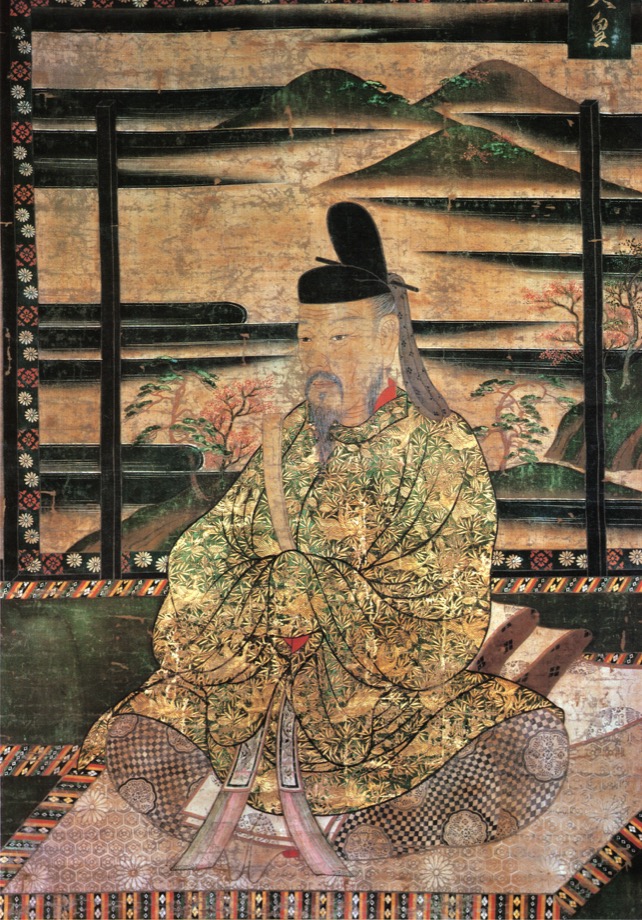
Portrait of Emperor Saga — 14th century (later depiction)
The emperor at the other end of a letter
Kūkai’s religious and literary projects required more than a compelling doctrine. They needed permissions, places, materials, and people willing to recognize their value. Emperor Saga appears at the other end of that work as a patron and learned interlocutor. Their shared interests in Chinese poetry and calligraphy supplied a relationship through which cultural accomplishment could meet imperial authority. It is a more specific starting point than the familiar portrait of an emperor who simply appreciated beautiful things.
Saga, a son of Emperor Kanmu, reigned from 809 to 823 and died in 842. His support helped give Kūkai’s institutions a durable place in early Heian Japan. The tentative ENFJ reading has low confidence. It concerns the conjunction of cultivated exchange and practical recognition of other people’s work, while acknowledging that the surviving record describes public patronage much more clearly than private temperament.
Saga’s tentative ENFJ reading centers on dominant extraverted feeling: his cultural relationships join recognition of learned people with the practical authority that gives their work a place.
Shared cultivation that has practical consequences
David Gardiner’s account emphasizes Saga and Kūkai’s common literary interests rather than treating their closeness as exclusively Buddhist. Poetry and calligraphy supplied forms of exchange in which an emperor could recognize a monk’s accomplishment beyond ritual expertise. The relationship matters because recognition was consequential. Saga authorized Kūkai’s proposed foundation on Mount Kōya in 816 and supported his involvement with Tōji in the capital.
The proposed feeling interpretation concerns how that connection mediates action. A capable practitioner does not remain merely the object of admiration; he gains opportunities to establish and teach. Relationship and institutional support reinforce one another. This is more discriminating than saying that patronage proves warmth. An emperor could cultivate useful experts for several reasons. The tentative reading becomes plausible where a shared cultural language appears to accompany the decision to sustain their work.
Saga’s court was not an egalitarian conversation among friends. Imperial approval and a monk’s request occupied different positions within a hierarchy. The same event can therefore register personal appreciation, ritual policy, and the enhancement of royal prestige. Those explanations need not exclude one another. Low confidence reflects the difficulty of determining their relative weight from documents designed to secure or record an official result.
A cultivated court with a continuing direction
The permission to establish a mountain center had consequences that extended beyond an enjoyable exchange. A religious project required a place in the political and institutional landscape. Saga’s recognition helped Kūkai move from the circulation of teachings toward foundations that could outlast their immediate relationship. It would overstate the evidence to attribute all of Shingon’s later development to an imperial plan, but the approval did more than reward a momentary performance.
The tentative auxiliary introverted intuition reading sees a possible coherence in this patronage: learned accomplishment, religious practice, and the distinction of the court can support a shared direction. The qualification matters. Coherence may be supplied by historians selecting related events, and institutional durability can result from other people’s persistence after permission is granted. The proposed function does not prove that Saga anticipated what later generations would build.
A comparison with another cultivated monk broadens the context. Nakamura Honnen examines Saga’s relationship with Eichū, including the chronicle’s account of the monk presenting tea during an imperial visit to Ōmi in 815. Buddhist status and cultural learning meet in that encounter. It places the emperor within networks of cultivated exchange, rather than making his relationship with Kūkai a unique expression detached from court practice.
A brush is evidence of practice, not a complete mind
Saga is remembered with Kūkai and Tachibana no Hayanari among the eminent calligraphers of his period. That reputation tells us something about the prestige attached to writing and about the emperor’s participation in cultivated practice. It does not establish an intuitive function by itself. Calligraphy involves training, conventions, physical execution, judgment, and the reception of other people. The achievement cannot be reduced to a single modern category of cognition.
The same caution applies to poetry. A ruler’s literary activity can be personally meaningful while also serving the expected language of a court. We should resist both extremes: treating every surviving cultural act as an unguarded confession, or treating official form as proof that no personal preference exists beneath it. The record supports an active cultural patron, with a much less securely recoverable account of how he experienced that role.
Imperial permission also leaves substantial labor with the recipient. Kūkai still needed to gather resources, supervise construction, teach disciples, and negotiate with other institutions. Naming Saga’s contribution accurately means preserving that division of work. His agency lies in the authority and recognition he supplied; it does not require absorbing a monk’s achievements into the emperor’s character. A responsible psychological reading begins with the limited contribution that can actually be identified.
Why this tentative reading?
Why not ESFJ?
Careful stewardship of cultivated court relationships could support that alternative. ENFJ is a tentative preference because Saga’s recognition accompanies new institutional possibilities and a continuing cultural direction, rather than only the maintenance of established forms. The available evidence does not decisively distinguish these interpretations.
The distinction has less security than the historical relationship. Literary sophistication is not automatically intuition, and royal sponsorship is not automatically feeling. ENFJ remains an editorial hypothesis about the manner of cultural leadership represented here, not a conclusion that the emperor’s office or his admired handwriting can independently demonstrate.
Connected Figures
Further Reading
- Kūkai (774–835) — David L. GardinerA scholarly account of Kūkai’s networks, writings, and foundations that identifies the practical and literary dimensions of his relationship with Saga.
- On the Exchanges among Kūkai, Eichū, and Emperor Saga — Nakamura HonnenA Japanese-language study of cultivated encounters and correspondence, including the chronicle’s account of Eichū serving tea to Saga.
- The Weaving of Mantra: Kūkai and the Construction of Esoteric Buddhist Discourse — Ryūichi AbéPlaces Kūkai’s work within the political, textual, and institutional conditions that make royal patronage meaningful.
