 Historical Figure MBTI
#1287 · 9-24-26 · Heian Japan
Kūkai
Esoteric Buddhist Teacher · Scholar · Institutional Founder
774–835
10 min read
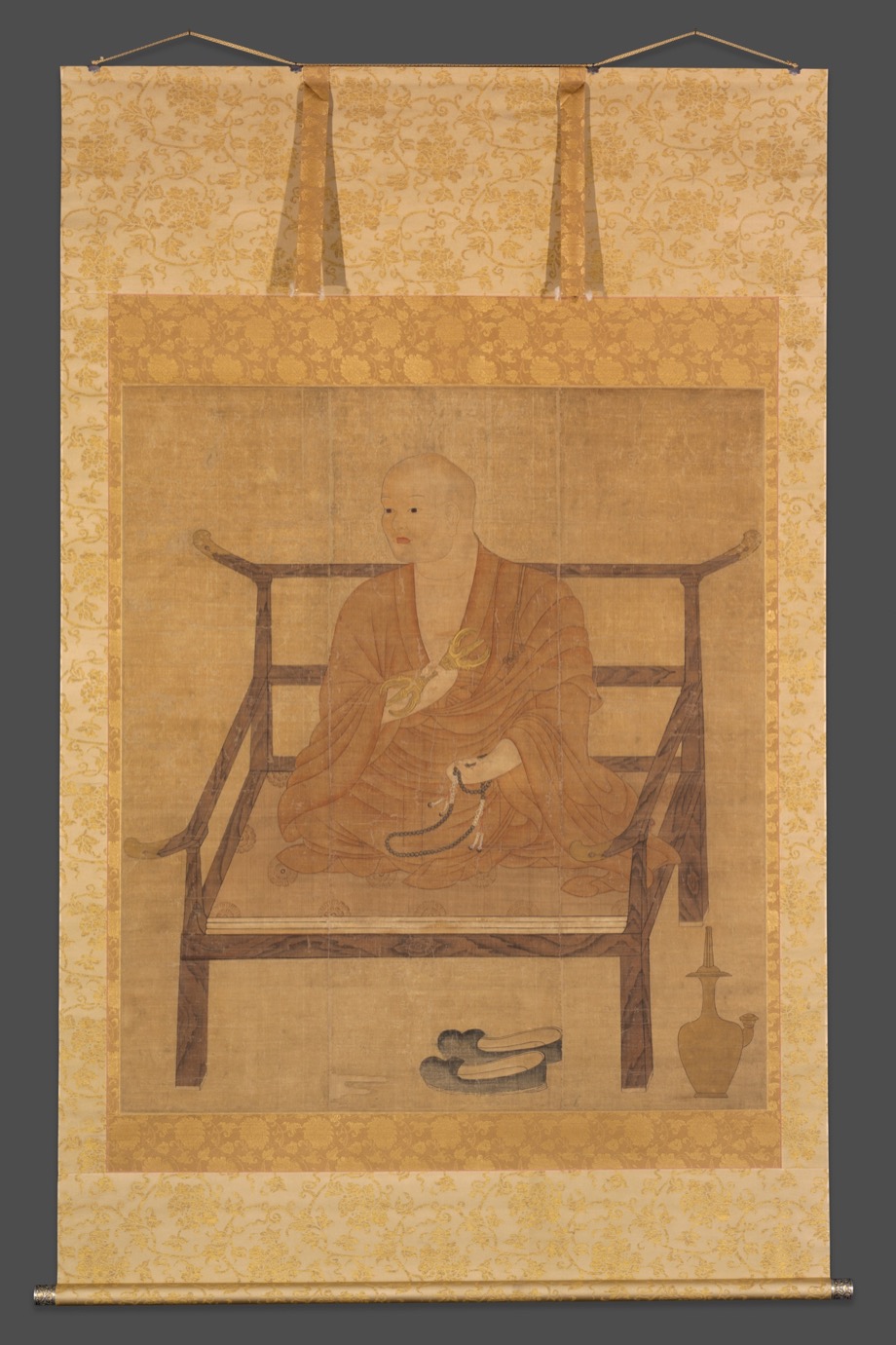
Portrait of Kūkai (Kōbō Daishi) — 14th century (later devotional depiction)
A world that could speak
Kūkai returned from China in 806 carrying scriptures, ritual implements, images, and a claim about what they meant together. The collection mattered; the interpretation mattered more. He presented esoteric Buddhism as a coherent account of awakening, language, and the living body, then spent decades finding places where that account could be taught and practiced. His achievement joined an intellectual architecture to actual mountains, buildings, students, and court permissions. Neither side can adequately describe him by itself.
An INTJ reading, with medium confidence, rests on that repeated movement from an encompassing conception toward a durable arrangement of practice. His doctrinal works do not merely accumulate interesting teachings. They place teachings in relation to an ultimate perspective, distinguish their reach, and argue that Shingon offers the fullest realization. This resembles dominant Introverted Intuition supported by Extraverted Thinking. It remains a modern interpretation of selected public writings, rather than a recovered psychological identity.
Born in 774 on Shikoku, Kūkai entered the world of classical learning before committing himself to Buddhist practice. The surviving record leaves gaps around his early movements and ordination. Later stories fill those gaps with prodigies. The useful distinction is between the young writer who defended his choice, the teacher whose works survive, and the saint whose admirers continued to enlarge his life after his death. All three belong to his history; they do not offer the same kind of evidence.
An INTJ reading begins with dominant Introverted Intuition: Kūkai sought a coherent account of reality, then built the means to practice it.
Ni — arranging the teachings around a center
In the dialogue known as Indications of the Goals of the Three Teachings, Kūkai stages a contest among religious and ethical alternatives. Its preface addresses objections from relatives and teachers: becoming a monk appeared to neglect obligations to family and ruler. His answer does not begin by declaring those obligations meaningless. Different people require different paths, and the available teachings differ in their ability to resolve human suffering. The literary debate supplies a justification for choosing Buddhism while disputing the charge that the choice must be socially irresponsible.
This is a constructed dialogue, not an unfiltered record of every conversation he had at home. Yet its form is revealing. Instead of answering each objection in isolation, he builds a setting in which competing accounts can be measured against a larger purpose. The interpretive habit proposed here is not simply an interest in religion. It is the recurrent effort to make disparate claims intelligible from one organizing standpoint, then to choose rather than leave the alternatives indefinitely open.
The same movement becomes much more elaborate in his account of ten stages of mind. Ordinary pursuits, ethical systems, and Buddhist teachings occupy a graded arrangement culminating in the esoteric perspective. Such an arrangement can acknowledge earlier teachings as meaningful while refusing them equal final authority. It should not be recast as modern religious pluralism. Kūkai is making a powerful claim for the completeness of his own transmission, not offering an impartial catalogue in which every school wins.
His account of Mahāvairocana, or Dainichi, gives the system its center. Reality is not merely a mute object about which a Buddha once spoke. Its sounds, forms, and activities can be understood as the expression of awakening itself. A mantra consequently belongs to a theory of how truth becomes manifest, not just a technique attached to an otherwise independent philosophy. His discussions of sound and sign ask the reader to reconsider the relationship between language and the world that language seems to describe.
This is the strongest basis for the proposed intuitive preference. He repeatedly compresses a large field into an interconnected account and then unfolds the consequences of that account. Even here, doctrine is not a personality test. Buddhist argument provided established conventions for synthesis and classification. The inference gains some weight because the same organizing tendency appears in his presentation of study, initiation, and institutions; it cannot gain certainty from the grandeur of the ideas alone.
Te — giving a transmission a place to survive
The journey of 804 brought Kūkai to Tang China, where he received esoteric instruction from Huiguo in Chang’an. When he returned two years later, a catalogue explained the texts and objects he had brought back and the significance of his training. That document served an outward purpose: a transmission acquired overseas had to become legible to the authorities and religious communities at home. The books could not confer institutional recognition merely by existing in his luggage.
His subsequent career depended on negotiations rather than a clean withdrawal from the state. The court granted Mount Kōya for a monastic establishment in 816. In 823 he received responsibility for Tōji, an existing temple in the capital, which became an important base for Shingon practice. These dates mark different steps; he neither founded Tōji on returning in 806 nor completed the whole Kōya complex with a single act of inspiration. Building required supplies, labor, continuing support, and successors.
An auxiliary Extraverted Thinking interpretation concerns the conversion of an argument into conditions under which other people could actually use it. A teacher needs trained pupils, a ritual requires suitable objects, and a school needs rules governing admission and transmission. Kūkai sought these arrangements through petitions and appointments. Their success also depended on powerful patrons, especially Emperor Saga, and on the religious institutions with which he worked. The resulting structure was collaborative, even when his intellectual contribution was distinctive.
The school associated with his later years offers a particularly concrete example. In a surviving statement about education, he contrasts the availability of schools in China with Japan’s concentration of higher study in a government college. Distance and poverty obstruct access. The proposed remedy is a place of learning for those otherwise excluded, not simply a lament about declining scholarship. His argument identifies a barrier and names an institutional response to it.
That educational proposal should not become a claim that he invented universal modern schooling. Its setting and scale were different, and its history was limited. Its value as evidence lies in the way he turns a principle into a practical problem: what provision would allow a student without the right resources to study? The same question, applied to ritual learning, helps explain his attention to authorized places and qualified teachers. Vision needed a working route into other lives.
Fi — a commitment that had to be defended
The family objections in his early dialogue make conviction visible because conviction had a cost. A promising course of classical study offered recognizable duties and advancement. Religious departure required an account of why another life could be legitimate. Kūkai’s response draws on inherited teachings, but it also insists that the choice cannot be judged solely by the expectations attached to the path he was leaving. A settled allegiance becomes the starting point for explanation.
Tertiary Introverted Feeling is a cautious interpretation of that allegiance. The evidence does not allow a reconstruction of his private emotional life, and a religious defense can be rhetorically strategic. What survives is a writer prepared to articulate the worth of a commitment against charges of failure or disloyalty. His texts return to the possibility that a different outward course can express rather than cancel serious obligation. That is more specific than assuming an inward value system from the fact that he became a monk.
His relationship with Saichō also resists the picture of effortless spiritual harmony. Saichō received esoteric initiations from him, but differences emerged over what transmission required and how textual study related to training under a teacher. A disagreement about access to teachings could become a disagreement about the authority that made those teachings effective. Neither man needs to be reduced to a jealous sectarian caricature for their competing projects to be real.
The limits of accommodation matter to the typing argument. Kūkai’s capacity for court friendship and persuasive language does not mean that preserving agreement was always his governing objective. He defended distinctions that his system treated as essential. This can fit a private criterion sustained beneath public cooperation. It can equally arise from the obligations of an initiated lineage. The function reading is useful only while that competing historical explanation stays in view.
Se — the body cannot be left outside the argument
Kūkai’s philosophy makes bodily action central. Hand gestures, recitation, and concentrated attention participate together in practice; the three activities are not disposable illustrations of a truth apprehended elsewhere. The possibility of becoming a Buddha in this very body gives present existence a significance that cannot be postponed entirely to remote future lives. This remains a demanding religious claim involving cultivation and transmission, rather than a promise of effortless personal transformation.
It would be a mistake to label all this inferior Extraverted Sensing simply because bodies and images appear in it. Ritual traditions require sensory forms whatever their practitioners’ personalities. The limited observation is that Kūkai’s abstract system repeatedly seeks realization through embodied, carefully arranged action. His calligraphy, his concern with ritual implements, and his treatment of sound show a thinker for whom the concrete medium is consequential. An interpretation that imagines him as indifferent to material expression would misread the surviving work.
The proposed inferior position concerns the relationship between levels, not a lack of skill. In this account, the visible gesture gains its fullest meaning from the larger vision it enacts. We do not possess reliable evidence of a characteristic sensory stress response, and later miracle stories cannot supply one. Tales of impossible feats of writing or supernatural journeys reveal the admiration surrounding the saint. They should remain evidence for reception rather than be promoted into observations of his everyday behavior.
Why INTJ Over INFJ
Why not INFJ?
INFJ remains a serious alternative. His concern for suffering, teaching, and religious communities can support a reading organized around shared spiritual transformation. The INTJ preference here rests more narrowly on his recurrent insistence on doctrinal distinctions and the practical architecture of transmission. His public texts make the system and its requirements unusually explicit. They give less access to whether interpersonal attunement or structural coherence ordinarily governed his private decisions. Compassion itself cannot settle that distinction.
INTP is also plausible if the analytical treatment of language is emphasized. Against it, the surviving works tend to bring inquiry toward a ranked conclusion and an authorized practice, rather than keep the conceptual field open. Genre and religious responsibility could account for that difference. Medium confidence recognizes a substantial authored record without pretending that doctrinal consistency exposes the whole person.
Connected Figures
Further Reading
- Kukai: Major Works — Kūkai; translated and introduced by Yoshito S. HakedaA substantial selection of writings, with biographical and doctrinal context.
- Shingon Texts — Kūkai and Kakuban; translated by Rolf W. Giebel and Dale A. TodaroIncludes Kūkai’s arguments about language, embodied awakening, and the hierarchy of teachings.
- The Weaving of Mantra: Kukai and the Construction of Esoteric Buddhist Discourse — Ryūichi AbéPlaces religious language and ritual within the institutions and political culture of early Heian Japan.
- Sources of Japanese Tradition, Volume 1 — Compiled by Wm. Theodore de Bary, Donald Keene, George Tanabe, and Paul VarleyPrimary texts place religious argument, court institutions, and literary culture within their historical settings.
- Kūkai — David L. GardinerA scholarly encyclopedia treatment that distinguishes the documented career from later sacred biography.
