 Historical Figure MBTI
#1286 · 9-23-26 · The Carolingian World
Hincmar of Reims
Archbishop · Political Counselor · Theorist of Governance
c. 806–882
5 min read
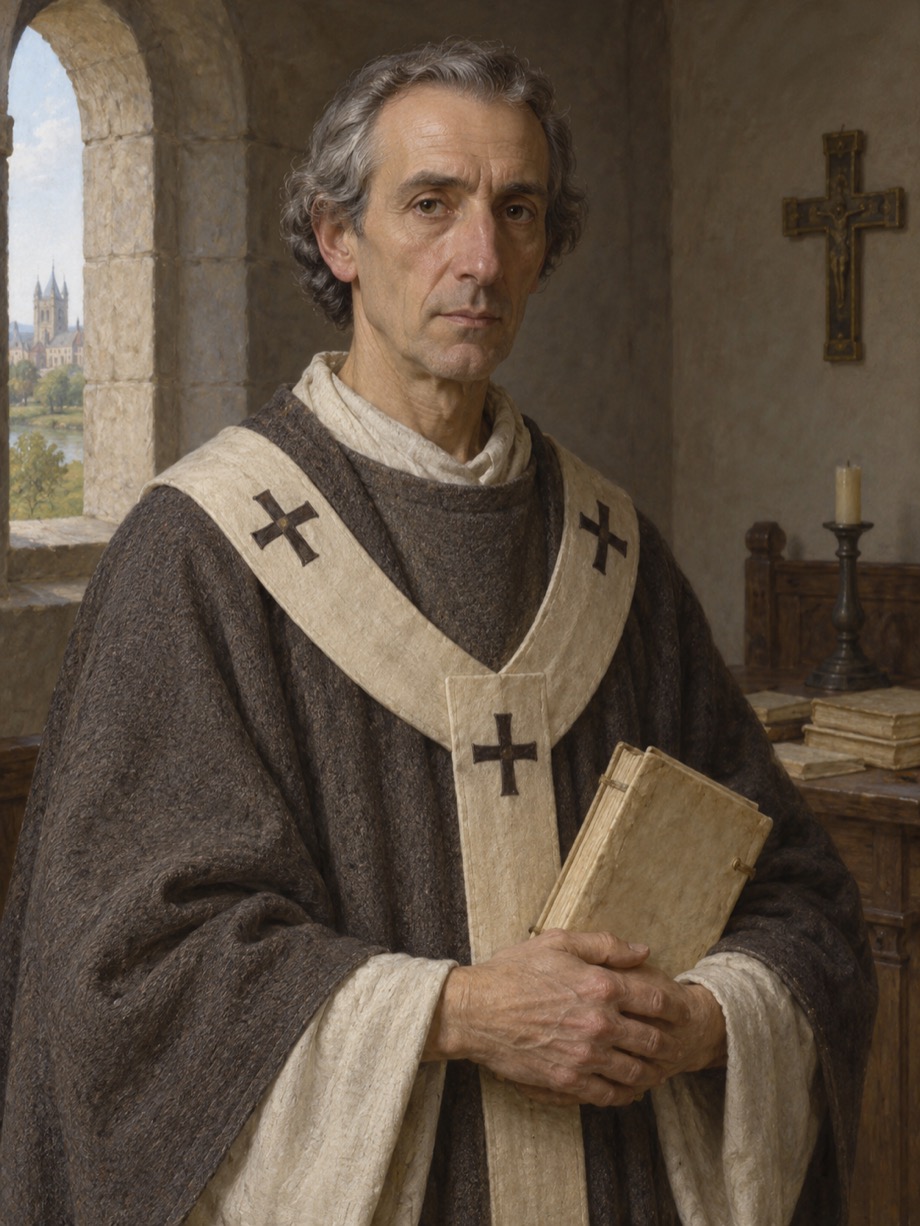
AI-assisted Portrait of Hincmar of Reims
An archdiocese across a royal frontier
Hincmar became archbishop of Reims in 845, after Verdun had divided the Carolingian empire. His church’s interests did not fit neatly inside one kingdom. He owed his principal royal allegiance to Charles the Bald, but territory and relationships essential to the archdiocese also lay within Lothair I’s sphere. A bishop could not simply choose one ruler and make the other cease to matter.
The problem is characteristic of Hincmar’s career. He worked through texts, offices, counsel, and negotiation to defend ecclesiastical authority in a changing political landscape. His learning was inseparable from institutional interests. The tentative INTJ reading concerns a sustained attempt to preserve that authority by understanding how different parts of the political order constrained one another.
It is a low-confidence interpretation. The surviving record is largely public and often shaped by Hincmar’s own efforts to justify positions. An archbishop producing elaborate arguments was doing expected professional work. The case for type must therefore concern the recurring use of that work, not the assumption that scholarship proves intuition or influence proves an extraverted function.
The tentative INTJ reading centers on dominant Ni: Hincmar treated particular disputes as parts of a longer struggle over ecclesiastical authority.
The institution had to outlast the quarrel
Hincmar’s dealings with Lothair show the value of a perspective broader than a single allegiance. Loyalty to Charles did not remove the emperor’s practical importance. Lothair’s access to Rome could affect appeals to the pope, while the divided archdiocese made cross-border cooperation necessary. Hincmar needed a relationship that protected the church without abandoning his primary royal connection.
The possible Introverted Intuition pattern lies in holding those pressures within a continuing institutional objective. An individual negotiation mattered because of what it might permit or obstruct later. The archbishop’s task was not merely to win an exchange, but to preserve a position from which his church could continue acting. This is an interpretation of his political method, not proof of a hidden master plan.
Elina Screen’s study places improved relations with Lothair around 847 and stresses religious and practical circumstances. It also warns that retrospective and sometimes falsified material makes reconstruction difficult. The evidence therefore supports the importance of accommodation more securely than any precise account of Hincmar’s personal motives. The archbishop’s strategy must be described with that uneven foundation in view.
An argument needed an institutional form
Hincmar’s authority operated through recognizable procedures as well as persuasion. Episcopal office, royal counsel, written argument, and appeals could give a position force beyond the moment of speaking. Auxiliary Extraverted Thinking is one possible way to describe the effort to make an institutional interpretation usable in public government.
His De ordine palatii, prepared in 882 for the young king Carloman II, shows how counsel could take the form of an organized account of rule. The text discusses responsibilities and the ordering of palace affairs, including the practical handling of problems by a king and his advisers. It presents government as work requiring differentiated duties and informed deliberation, not simply the expression of royal will.
Hincmar incorporated material associated with Adalard of Corbie and an earlier royal world. Modern scholarship continues to debate the layers of the work and the circumstances of its presentation. It should therefore be read as an intervention made in 882, rather than as a transparent handbook showing exactly how Charlemagne’s court always functioned. The older model acquired meaning through the later archbishop’s decision to offer it.
Counsel could also preserve the counselor
A sustained concern for ecclesiastical authority does not make every intervention disinterested. Hincmar spoke from an important office whose standing he was trying to defend. His account of the proper order could elevate the place of bishops and learned advisers within it. The personal, institutional, and religious dimensions of that work overlapped rather than falling into separate compartments.
That overlap makes a simple portrait of a detached visionary inadequate. He was involved in disputes and depended on political relationships. Written principles could constrain rulers, but also served as resources within contests for authority. The interpretation should recognize intellectual coherence without assuming that coherence settled every question fairly or removed the interests of its author.
Why this tentative reading?
Why not ISTJ?
Hincmar relied on inherited authorities, earlier models, and established offices, which gives a Si–Te reading real plausibility. INTJ is preferred tentatively because his deployment of those materials repeatedly served a broader account of how ecclesiastical authority could survive changing political relationships.
The distinction is uncertain, since learned ecclesiastical practice required both precedent and strategic judgment. The preserved texts show arguments shaped for an audience more clearly than the mental processes that produced them. INTJ should remain an editorial hypothesis, with ISTJ a serious alternative and the complete function stack less secure than either label suggests.
Connected Figures
Further Reading
- An unfortunate necessity?: Hincmar and Lothar I — Elina ScreenExamines dual loyalties, practical constraints, and the retrospective evidence for relations with Lothair.
- De ordine palatii — Hincmar of Reims; edited and translated by Maurice ProuPrimary text in Latin and French; its older materials must be distinguished from its presentation in 882.
- Advice for the modern king: Revisiting Hincmar’s De ordine palatii — Charles West and Grigorii BorisovRecent scholarly reassessment of authorship, manuscript evidence, and the text’s political setting.
- De ordine palatii: Text and editions — Cour de FranceGuide to the surviving transmission and modern editions, useful for avoiding an uncritical reading of older printings.
