 Historical Figure MBTI
#1283 · 9-23-26 · The Carolingian World
Charles the Bald
West Frankish King · Emperor · Builder of Coalitions
823–877
6 min read
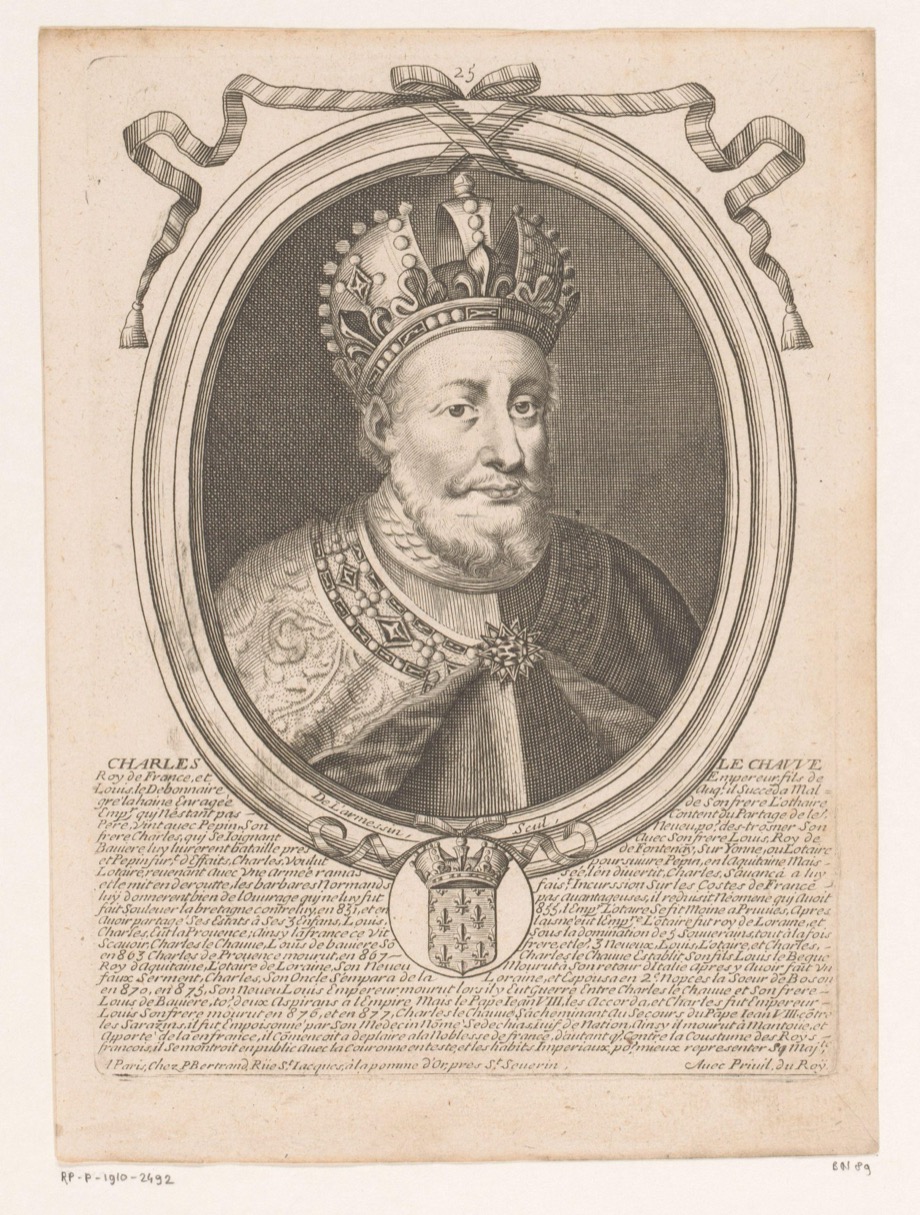
Portrait of Charles the Bald — 1642–1678 (later depiction)
A throne that had to be assembled
Charles the Bald inherited a name that could open doors, but no uncontested place in the family settlement. Born in 823 to Louis the Pious and Judith, he arrived after his father had already arranged the succession around three older sons. Providing for the youngest prince disturbed promises on which powerful men had built their expectations. His childhood unfolded inside a dispute about what a father could revise, what brothers could demand, and whose oath still bound whom.
When Louis died in 840, Charles could not turn ancestry into obedience by announcement. His older half-brother Lothair claimed imperial seniority; another brother, Louis the German, had his own kingdom and supporters. Charles needed an army, allies, and recognition from people who possessed resources of their own. The western kingdom he eventually held was an achievement of repeated political work, not a parcel delivered intact by his father.
A tentative ENTJ reading rests on his recurring effort to assemble effective authority from competing interests. It does not rest on being a king, winning a battle, or supposedly founding France. His world was Carolingian, and its bargaining cannot be made into a modern national destiny. The evidence permits a cautious picture of political method; it leaves the private person much less visible.
The tentative ENTJ reading centers on dominant Te: Charles repeatedly sought to make scattered loyalties serve a workable kingship.
Power counted in people who would act
The alliance with Louis the German made a clear practical difference. Together the brothers defeated Lothair at Fontenoy in 841 and strengthened their cooperation at Strasbourg in 842. Their agreements gave military opposition a durable public form. Charles was trying to produce action, not merely to prove that his birth entitled him to it.
Nithard’s history supplies unusually close views of this process. After Fontenoy, Bernard of Septimania offered cooperation through his son William and promises concerning Aquitaine. Charles accepted a bargain over benefices. The episode shows authority moving through negotiated exchanges. It also shows why calling him simply commanding misses much of the labor: a Carolingian ruler needed men who could refuse, delay, or change their allegiance.
Extraverted Thinking offers one possible description of a recurrent emphasis on securing usable commitments. Yet Nithard served Charles and wrote with an interest in vindicating his cause. A scene presenting Charles as generous and reasonable is evidence of a transaction and of its public justification, not unrestricted access to his mind. The type remains low confidence precisely because the narrative makes a political case.
Keeping a kingship in view
Verdun in 843 gave Charles a western kingdom, but boundaries alone did not settle obedience. Regional magnates, rival royal claimants, and external attacks continued to test what his title could accomplish. The task was to keep a recognizable kingship operating through circumstances in which no single agreement could secure every frontier or every aristocrat.
The possible Introverted Intuition pattern lies in that sustained effort to connect local settlements to a larger royal position. Charles could bargain over a particular office or ally without treating the transaction as the whole objective. He sought a kingdom in which royal authority remained worth approaching, contesting, and defending. This interpretation concerns continuity of purpose rather than a claim that he secretly foresaw later French history.
His imperial coronation in 875 widened the horizon, but it should not be read backward into every earlier decision. Opportunities changed as relatives died and Italian politics shifted. A ruler can pursue a coherent position while revising his ambitions. That combination fits the proposed reading better than a story in which an infallible planner executes a scheme devised in youth.
An ally could become an invader
Louis the German’s intervention in the western kingdom in 858 exposes the fragility underneath royal ceremony. The brother who had sworn assistance at Strasbourg could become the focus of opposition to Charles. Cooperation had protected each man against Lothair; it had never abolished their separate interests or the ambitions of their followers.
Janet Nelson’s study treats this crisis as one in which Charles’s own choices mattered, including politically poor decisions. That qualification is essential. Effective coalition building does not mean uninterrupted judgment, and a proposed strategic temperament cannot rescue a ruler from the consequences of miscalculation. A method can be recurrent without being reliably successful.
Bishops and aristocrats were participants in the recovery of authority, not extensions of the king’s will. Hincmar of Reims supported western kingship while insisting on the responsibilities and limits of royal office. Charles’s relationship with him therefore involved counsel and constraint. The ruler’s dependence on such people gives his political achievement its scale: he held together interests that remained capable of resisting him.
Royal display belonged to the same practical work. Manuscripts presenting Charles receiving a magnificent book offered an image of ordered Christian kingship, with learned and ecclesiastical service gathered around the ruler. Such a picture tells us what supporters wanted authority to look like, not whether Charles was inwardly confident. Its order is especially striking beside the unstable loyalties described in narrative sources. To read the reign well requires holding both views together: an elevated king in a carefully composed image and a political actor who needed other people to keep answering his summons. Neither view by itself supplies a complete portrait.
A claim was also a personal inheritance
Charles’s position began in a family whose changing promises exposed him to exclusion. It would be tempting to explain every later expansion as revenge for that insecurity. The surviving material does not justify such a diagnosis. Dynastic claims, religious duty, and practical opportunity already supply public reasons for his behavior without inventing a private wound behind each action.
Inferior Introverted Feeling is therefore the least secure part of the proposed stack. His defense of his position may suggest personal identification with a royal claim, but this was also an expected feature of kingship. The account should acknowledge conviction without pretending to know its emotional texture. The strongest evidence remains his outward management of commitments, not a reconstructed inner monologue.
Why this tentative reading?
Why not ESTJ?
Charles worked through inherited offices, customary claims, and recognizable royal practices, which could support a Te–Si reading. The ENTJ preference is tentative and turns on the way he repeatedly combined changing alliances into a broader position rather than merely restoring a settled arrangement.
That distinction is narrow. Almost any competent Carolingian ruler had to combine precedent with adaptation, and the surviving sources emphasize public performance. ENTJ is a useful editorial interpretation of the pattern, not a finding that excludes ESTJ or proves a complete cognitive stack. Political success should never supply the missing evidence by itself.
Connected Figures
Further Reading
- Charles the Bald — Janet L. NelsonA major scholarly biography that treats royal power as negotiated and gives failures their place alongside achievements.
- The Strasbourg Oaths — Nithard; Internet History Sourcebooks ProjectPrimary text of the public alliance between Charles and Louis; read its justification as part of the conflict.
- Histories, Book III — Nithard; translated by Philippe LauerA participant’s account of war and bargaining, written in support of Charles and requiring source criticism.
- An unfortunate necessity?: Hincmar and Lothar I — Elina ScreenStudy of an archbishop whose cross-border responsibilities complicate any picture of uncomplicated royal obedience.
