 Historical Figure MBTI
#1282 · 9-22-26 · The Carolingian World
Nithard
Historian · Soldier · Witness to Civil War
c. 800–844/845
6 min read
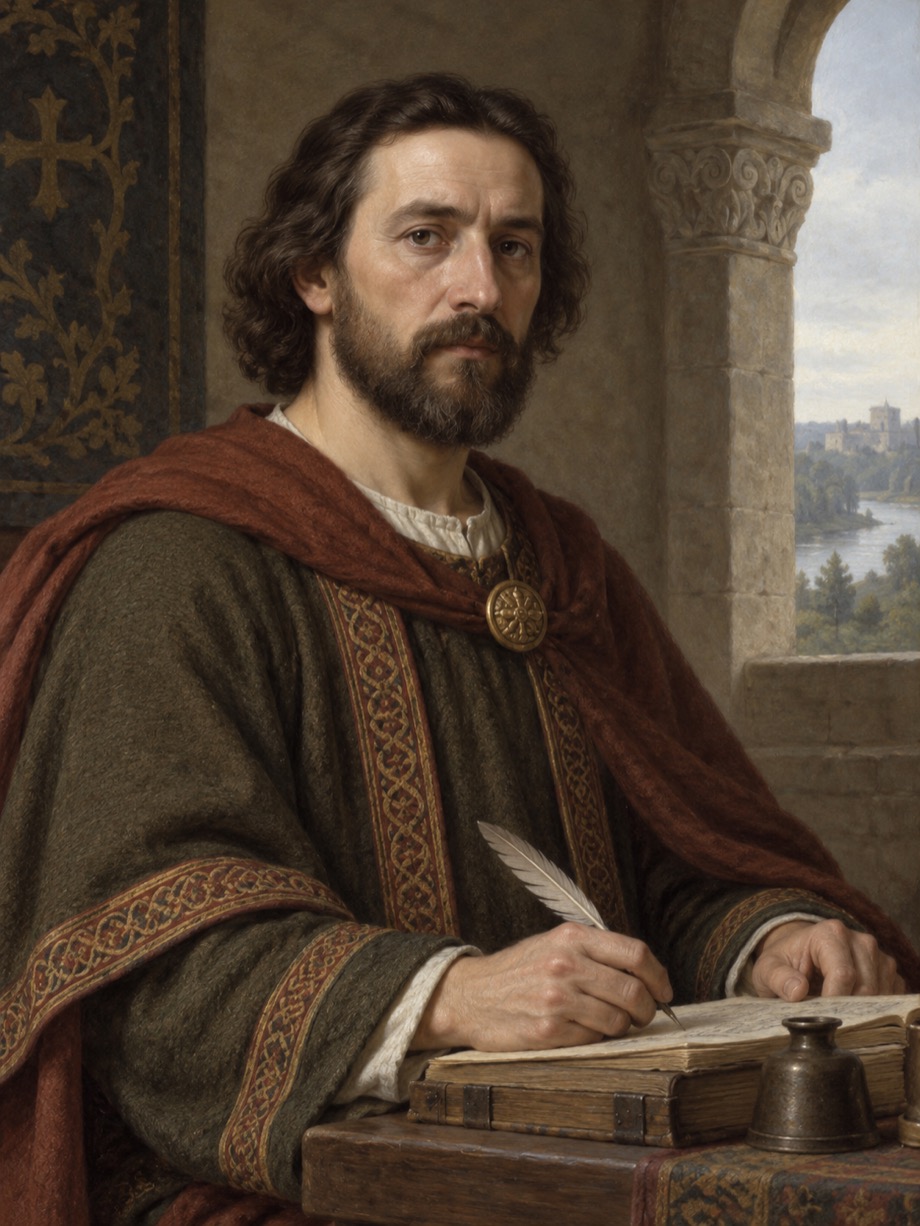
AI-assisted Portrait of Nithard
Writing Inside the Conflict
Nithard did not write the Carolingian civil war from a safe distance. He served Charles the Bald, negotiated within the conflict, and described events in which he participated. His four books turn those events into an argument about oaths, legitimacy, and the condition of the realm. A tentative INTJ reading concerns that structured political interpretation, not the assumption that a historian's profession proves a psychological type.
Born around 800, he was a son of Angilbert and Bertha, Charlemagne's daughter. His royal connections supplied a position within the political community whose divisions he described. Charles commissioned the work, and Nithard openly identified the pressures of writing while caught in the same upheaval as his patron. The narrative's closeness to events is one of its strengths, while its allegiance is a condition every reader must keep in view.
INTJ is a low-confidence interpretation of dominant Introverted Intuition: Nithard arranged changing events into a sustained explanation of legitimate and destructive political order.
An Explanation, Not Merely a Sequence
Nithard begins before the immediate civil war because he wants readers to understand its origins. Charlemagne appears as an exemplary ruler, while the reign of Louis supplies the succession arrangements and reversals from which the brothers' conflict emerged. This selection gives the history a direction: present disorder becomes intelligible through earlier failures of obligation and governance. The opening is already an interpretation, not a neutral inventory of everything that happened.
His portrayal of Lothair is especially severe. Repeatedly broken commitments, ambition, and the pursuit of domination explain why resistance becomes justified. Charles's actions receive a more favorable moral frame. Introverted Intuition offers a tentative description of this effort to see an organizing pattern across a confused sequence of movements and negotiations. Yet literary coherence can also follow the demands of advocacy. The narrative cannot independently establish how Nithard reasoned outside the work.
Details That Explain Political Action
The interpretation depends on concrete information. Nithard follows routes, assemblies, messages, military positions, and the allegiance of leading men. He appears in his own account as an envoy sent by Charles to Lothair. Later he identifies himself among representatives selected for arrangements between Charles and Louis. These notices locate the writer within practical government rather than in an exclusively scholarly setting.
His account of the Strasbourg Oaths in February 842 is the best-known example. Charles and Louis swore in languages intended to be understood by each other's followers, and the armies accepted conditional obligations if their own king broke the alliance. Nithard preserved the vernacular formulations within a Latin history. The passage is significant because it records a political procedure and its audiences, not because modern French and German nations had already emerged fully formed.
Extraverted Thinking is proposed cautiously where explanation becomes attentive to mechanisms: who promised what, how support was obtained, and what arrangements made cooperation possible. The relevant evidence is the combination of interpretation with participation and procedural detail. It should not be enlarged into an undocumented private preference for efficiency or detached management.
A Witness Who Also Justifies
After Fontenoy in 841, Nithard presents Charles and Louis as merciful victors reluctant to pursue their brother's people. Bishops interpret the victory as divine judgment and distinguish legitimate participation from individual wrongdoing. The passage shows how a battle's outcome could be converted into moral authorization. Reading it as an uncomplicated report of the winners' innocence would miss the argument being made.
The same caution applies to his account of the Stellinga movement in Saxony. He describes lower-status groups challenging their lords in a threatening and hostile frame, connected to the broader struggle among kings. His social position shaped what counted as legitimate order. A useful historian can still reproduce the interests of an aristocratic political community whose authority he considered necessary.
Nithard also records frustration with that community. His later books express weariness at disorder and a desire to withdraw. Such statements reveal the narrative's emotional and moral pressure, but they should not be converted into a clinical explanation or a complete private biography. The man who hoped to preserve a truthful account remained bound to events through service, kinship, and allegiance.
The Limits of the Surviving Career
Nithard died in 844 or 845, with the exact chronology and circumstances discussed by historians. That uncertainty should remain visible rather than be resolved through a confident anecdote. His work is brief compared with the scale of the struggle it describes, but its combination of participation, political judgment, and unusual documents makes it indispensable.
The text does not become worthless because Charles commissioned it. Its biases are themselves evidence for the claims through which supporters justified action. The historian's task is to compare those claims with other sources, identify where observation ends and attribution of motive begins, and resist treating Nithard's opponents as if they possessed no defensible position of their own.
Testing the INTJ Reading
Why not ISTJ?
ISTJ is a credible alternative because Nithard preserves precise events, established commitments, and documentary formulations. INTJ is preferred only tentatively for the way those details serve a comprehensive explanation of political disorder. That arrangement may reflect the commissioned work's purpose as much as a stable individual preference, so the distinction remains weak.
Why not INFJ?
His concern with moral order and the suffering of a divided Christian people can suggest INFJ. The record more clearly joins interpretation with practical political mechanisms and arguments about legitimate authority than with sustained relational mediation. INTJ is therefore the narrower hypothesis, while Christian historical convention accounts for much of the shared moral language.
His authored argument and public participation offer limited evidence for a pattern. They do not warrant typing every learned courtier or treating the narrative’s judgments as transparent facts about its subjects.
Connected Figures
Further Reading
- Histories — Nithard; translated and edited by Marco ContiA modern edition and translation of the four books, with attention to the work’s political setting.
- Carolingian Chronicles: Royal Frankish Annals and Nithard’s Histories — Bernhard Walter Scholz, with Barbara RogersTranslations of contemporary narratives whose loyalties and retrospective judgments require careful comparison.
- The Carolingian World — Marios Costambeys, Matthew Innes, and Simon MacLeanConnects court politics with landholding, monasteries, aristocratic networks, and the practical limits of imperial government.
- The Frankish Kingdoms under the Carolingians, 751–987 — Rosamond McKitterickPlaces the succession conflict and its narratives within the longer history of Carolingian government.
