 Historical Figure MBTI
#1281 · 9-22-26 · The Carolingian World
Bernard of Septimania
Imperial Chamberlain · March Lord · Contested Royal Favorite
c. 795–844
5 min read
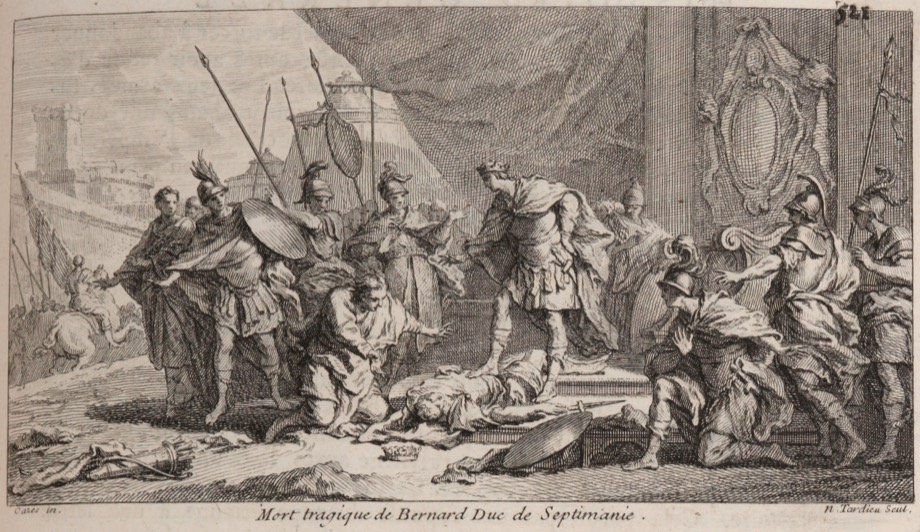
Death of Bernard of Septimania — Charles-Nicolas Cochin the Elder, 1730 (later depiction)
From Frontier Command to Court Conflict
Bernard of Septimania became powerful in settings where a favorable position could change quickly: a contested frontier, an imperial household, and a civil war among rival kings. A tentative ESTP reading concerns his tactical response to those changing circumstances. It should not turn a warrior's occupation into a type or accept his enemies' descriptions as a complete personal portrait.
Born around 795, Bernard was a son of William of Gellone and belonged to an aristocratic family with important southern connections. He married Dhuoda in 824. His command around Barcelona and Septimania preceded his elevation at Louis the Pious's court. He is distinct from Bernard of Italy, the emperor's nephew who died after blinding in 818. Confusing them collapses two different political crises and two different careers.
ESTP is a low-confidence hypothesis: dominant Extraverted Sensing fits Bernard’s repeated adjustment to immediate military and political opportunities.
Authority Tested at the Frontier
The Royal Frankish Annals describe Bernard's resistance during the disturbances on the Spanish frontier in 827. They also describe devastation around Barcelona and Girona when reinforcement arrived too late. This was not an uncomplicated tale of one commander winning a decisive victory. Frontier government depended on fortifications, local support, intelligence, and the timely movement of armies. Success and failure were distributed among several responsible actors.
Bernard's prominence in that setting helped precede his appointment as chamberlain in 829. The move carried southern military authority into the imperial household. Extraverted Sensing is proposed cautiously where his career shows engagement with changing immediate conditions and the use of an available opening. It does not imply that he was impulsive or incapable of long planning; neither conclusion follows from frontier command.
Bargaining Within a Changing Contest
Nithard provides a revealing account after Fontenoy in 841. Bernard had remained near the battle without supplying either side with assistance. Once Charles's victory was clear, he sent William to him with a conditional proposal involving Burgundian honors and promised to help bring Pepin of Aquitaine into agreement. This was a political bargain, not a simple declaration of permanent allegiance.
The episode suggests attention to how a particular arrangement could work in his favor under changed circumstances. Introverted Thinking offers a limited comparison for the calculation of conditions and leverage within that problem. Yet Nithard wrote for Charles and regarded Bernard with suspicion. The observable transaction is stronger evidence than the chronicler's implied judgment of opportunism. It also remains possible that uncertainty about the outcome encouraged the same behavior in men of many temperaments.
Dhuoda's handbook shows the cost of the arrangement from another position. William's service to Charles separated him from his mother and placed him between the obligations of father and royal lord. Bernard's political action therefore had consequences that a court narrative could overlook. The family does not exist merely to illustrate his tactical skill; its divided circumstances reveal what such bargaining required of other people.
Power and Its Accusers
Bernard's court influence became a focus of opposition to Louis in 830. Opponents associated him with Judith and accused the household of corrupting legitimate government. Allegations of adultery belong to this hostile campaign and should not be repeated as established fact. Bernard fled to the south when the coalition against the emperor gained control; his relatives also suffered within the wider conflict.
Neither the rise nor the flight establishes a stable psychological characteristic by itself. Court office rested on favor, access, and the cooperation of others, while removal could expose a whole family. The political language of corrupt counsel allowed enemies to explain a contested distribution of power as moral contamination. That language is important historical evidence, but it is also a mechanism for assigning blame.
Bernard's later dealings with Charles remained unstable. Charles had him executed in 844. The precise interpretation of the charges and his final political position requires comparison of partisan sources; a generic story of a gambler inevitably losing would obscure the actual conflict. His death demonstrates the danger of aristocratic bargaining in civil war, not a personality law that predicts the end of every adaptable courtier.
A Career Seen from Several Angles
The court annals, Nithard, Radbertus, and Dhuoda do not produce the same Bernard. One records frontier and household service; another evaluates bargaining from a king's side; a memorial makes him part of a corrupt court; his wife's book addresses the obligations of their separated son. Each perspective selects different consequences of the same political world.
Reading those perspectives together leaves room for agency without a caricature. Bernard used positions available to a well-connected commander and courtier, and he changed his relationships under pressure. His intentions cannot be reconstructed simply from success or defeat. The strongest historical account follows appointments, movements, proposals, and their consequences before attempting to infer a durable personal method.
Testing the ESTP Reading
Why not ENTP?
ENTP could fit the flexible bargaining and changing alliances. ESTP is preferred tentatively because the clearest surviving episodes concern direct responses to a military outcome and concrete opportunities rather than sustained exploration of alternative conceptual schemes. This is a narrow distinction resting on selected public actions, so confidence remains low.
Why not ESTJ?
His military and court offices also make ESTJ plausible, but office does not establish a preference for maintaining a settled administrative order. The episodes that distinguish him in the surviving record more often involve adjustment within an unstable contest. The ESTP proposal describes that pattern without claiming that every decision was improvisation.
The evidence supports a cautious comparison of public tactics; it does not justify an imagined interior life built out of accusations or an aristocratic job description.
Connected Figures
Further Reading
- Carolingian Chronicles: Royal Frankish Annals and Nithard’s Histories — Bernhard Walter Scholz, with Barbara RogersTranslations of contemporary narratives whose loyalties and retrospective judgments require careful comparison.
- The Carolingian World — Marios Costambeys, Matthew Innes, and Simon MacLeanConnects court politics with landholding, monasteries, aristocratic networks, and the practical limits of imperial government.
- Handbook for William: A Carolingian Woman’s Counsel for Her Son — Dhuoda; translated by Carol NeelReveals obligations and separations within Bernard’s family that court narratives treat differently.
- Epitaph for an Era: Politics and Rhetoric in the Carolingian World — Mayke de JongExplains the partisan memorial tradition that attacked Bernard and the court around him.
