 Historical Figure MBTI
#1279 · 9-22-26 · The Carolingian World
Dhuoda
Noblewoman · Author · Counselor to an Absent Son
c. 800–after 843
7 min read
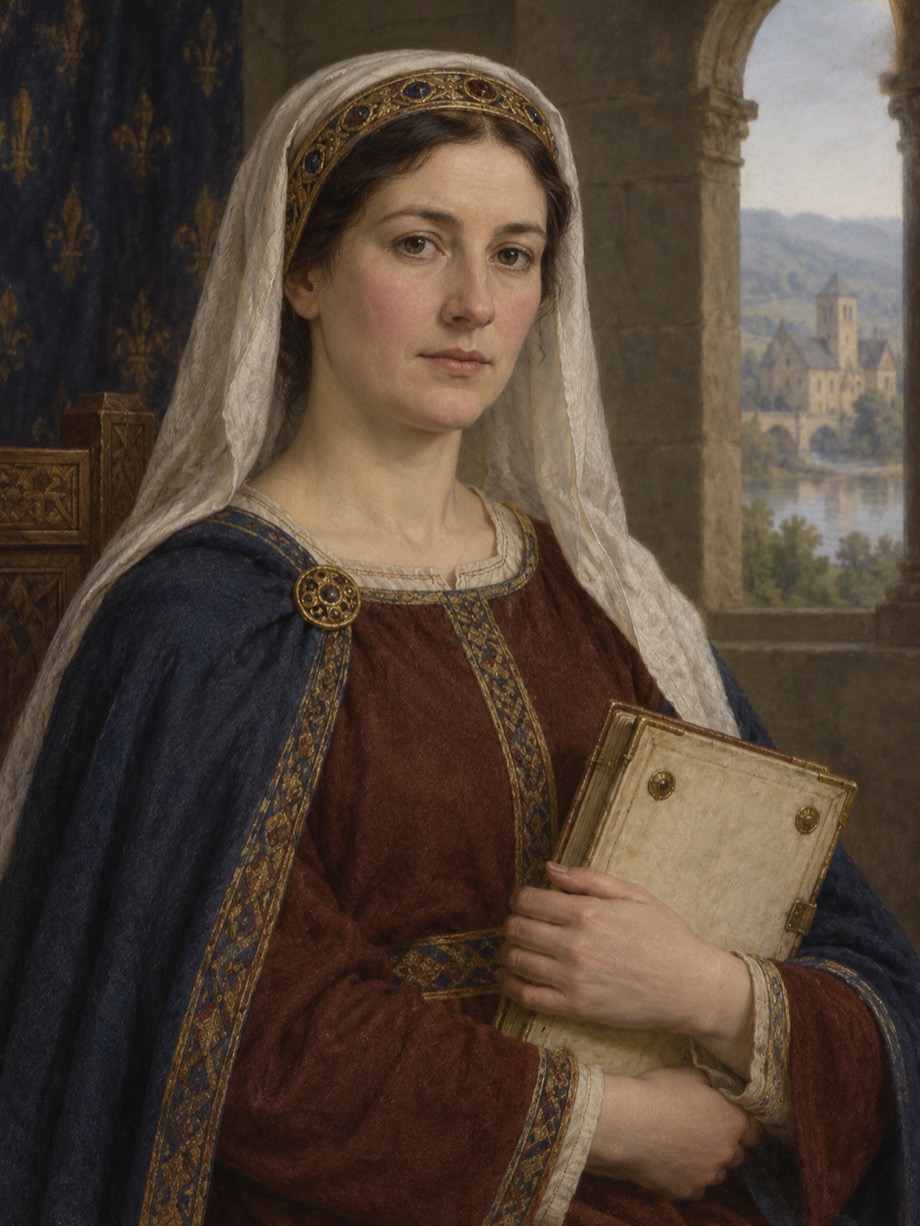
AI-assisted Portrait of Dhuoda
A Mother Present Through a Book
Dhuoda could not accompany her son William into the dangerous politics of the Carolingian court, so she sent him a book. Written between late 841 and February 843, her Liber manualis joins religious instruction, family memory, and advice about serving powerful men. The author speaks from separation rather than from a position of command. A tentative INFJ reading rests on the sustained integration of moral purpose and relational counsel across her work. It should not mistake a carefully fashioned teaching voice for an unfiltered view of her entire personality.
She married Bernard of Septimania at Aachen in 824. Their elder son William was born in 826, and another son in 841. Dhuoda remained at Uzès while both children were away from her. Bernard placed William with Charles the Bald after the battle of Fontenoy, when aristocratic loyalty was under intense scrutiny. Her younger child had also been taken from her. The handbook records these circumstances because the family relationship is essential to the authority she claims as its author.
Dhuoda's origins and the later course of her life remain much less certain. The surviving book provides dates, anxieties, obligations, and an extensive intellectual repertoire, but it does not answer every biographical question. Its intimate address makes it tempting to imagine a complete private person behind each sentence. A responsible reading distinguishes what she says about her situation from the examples and ideals she asks her son to adopt.
INFJ is a tentative interpretation of dominant Introverted Intuition: Dhuoda organized separated family bonds and competing obligations within one sustained moral vision.
A Whole Life Ordered Through Counsel
The handbook is not a collection of disconnected consolations. Dhuoda gives William a framework in which service to God, father, lord, relatives, and neighbors belongs to one accountable life. Scripture, numerical patterns, prayers, and recollection reinforce that framework. The book's organization allows a reader to return repeatedly to the same governing concerns in different forms. It was meant to remain useful when the mother who wrote it could not be physically present.
Her discussion of numbers makes this especially visible. Calculation becomes a way to remember duties and spiritual meanings. The movement from one number to another can represent correction, forgiveness, or progress toward perfection. Such devices should not be exoticized as mysterious private insight: numerical interpretation belonged to Christian learning. The more individual feature is the way she selects and arranges inherited material around William's future conduct.
An Introverted Intuition reading concerns the concentration of varied instruction into an overarching purpose. Dhuoda repeatedly directs attention beyond an immediate success or grievance toward the sort of person her son should become. The inference has more textual support than a guess based solely on social position, yet it remains an inference about an authored work. A coherent book does not prove that its writer approached every part of life in the same way.
Loyalty Without Forgetting the Vulnerable
Dhuoda's guidance is relational and hierarchical. William owes service to his father and his earthly lord, while his conduct toward peers and other people also matters. These obligations could conflict in a civil war. Bernard had his own political interests; Charles required reliable followers. The handbook does not offer a modern declaration of personal independence from both. It seeks a morally defensible way to inhabit bonds that its recipient could not simply discard.
Her counsel also reaches beyond powerful patrons. She urges assistance to poor people, hospitality to travelers, and attention to widows, orphans, and those in distress. Mercy should shape the exercise of judgment. These passages prevent the book from becoming merely a manual for advancement at court. They do not make Dhuoda a social egalitarian: she wrote within an aristocratic Christian order whose differences of rank she accepted.
Extraverted Feeling is a tentative description of this repeated effort to orient conduct through responsibilities to others. Her purpose is not merely to make William agreeable. She wants him to remain faithful without participating in destructive contention and to exercise power with restraint. The strongest evidence is the persistence of that concern across the handbook, rather than the assumption that motherhood naturally discloses a particular psychological function.
Learning and Self-Presentation
Dhuoda presents herself with humility while assembling substantial scriptural and literary material. Conventional declarations of inadequacy should not erase the competence visible in the work. She could organize a long Latin text, adapt authoritative passages, and use formal patterns to aid remembrance. At the same time, her learning should not be expanded into an undocumented curriculum or an imagined place in a royal school. The book shows what she could do, not every step by which she learned it.
The voice is sometimes anxious, insistent, and practical. She wants William to read, pray, remember named relatives, and preserve the connection represented by the manuscript. Maternal authority is made durable through repeated acts of reading. That is a response to an actual political predicament, not an escape from history into private devotion. The courts and battlefields that separated the family remain present even where the instruction concentrates on prayer.
Her husband's fortunes also show why moral counsel could not guarantee security. Bernard was executed under Charles in 844; William's later career ended violently as well. These outcomes belong to events after the handbook's composition and should not be inserted as knowledge Dhuoda necessarily possessed. Her death date is uncertain. The surviving text ends with a completed work and hope for its use, not with a securely documented account of her later life.
Memory as an Obligation
Near its conclusion the handbook directs William toward prayer for living people and the dead. Family names preserve relationships that political upheaval might otherwise obscure. Dhuoda also asks that her own soul be remembered. The request connects personal vulnerability with the broader Christian practice of commemoration. It is at once an established religious duty and a mother's attempt to remain within her son's future.
This sustained concern explains why the book matters beyond the rarity of its author. It records how an aristocratic woman used writing to exercise authority despite absence. The practical audience was a young man entering service, but the authority he encountered was neither an emperor's decree nor a male cleric's sermon. Dhuoda adapted the resources available to her into a form of counsel that could travel farther than she could.
Testing the INFJ Reading
Why not ISFJ?
ISFJ is a strong alternative because the handbook preserves family memory, named obligations, and received religious practice. INFJ is preferred tentatively for the way these details are organized into a single interpretive account of William's moral future. The distinction is not decisive, and the evidence would support less confidence about the woman outside her book.
Why not INFP?
Her intimate address and separation can suggest INFP, but grief and affection alone do not establish a type. The work repeatedly organizes responsibility through shared relationships and a structured moral hierarchy, which favors the INFJ proposal over a primarily individual articulation of values. Christian literary convention remains an important alternative explanation.
Confidence is moderate only in the consistency of the written pattern, and lower for a comprehensive assessment of her life. Her own text provides evidence unavailable for many contemporaries, without removing the distance between a teaching voice and a private person.
Connected Figures
Further Reading
- Handbook for William: A Carolingian Woman’s Counsel for Her Son — Dhuoda; translated by Carol NeelAn accessible translation of the complete work, including its family setting and moral instruction.
- Handbook for Her Warrior Son: Liber Manualis — Dhuoda; edited and translated by Marcelle ThiébauxPlaces the Latin text and its teaching voice within the circumstances of Carolingian aristocratic life.
- Carolingian Chronicles: Royal Frankish Annals and Nithard’s Histories — Bernhard Walter Scholz, with Barbara RogersTranslations of contemporary narratives whose loyalties and retrospective judgments require careful comparison.
- The Carolingian World — Marios Costambeys, Matthew Innes, and Simon MacLeanConnects court politics with landholding, monasteries, aristocratic networks, and the practical limits of imperial government.
