 Historical Figure MBTI
#1275 · 9-21-26 · The Carolingian World
Louis the Pious
Frankish Emperor · Patron of Reform · Penitent Ruler
778–840
6 min read
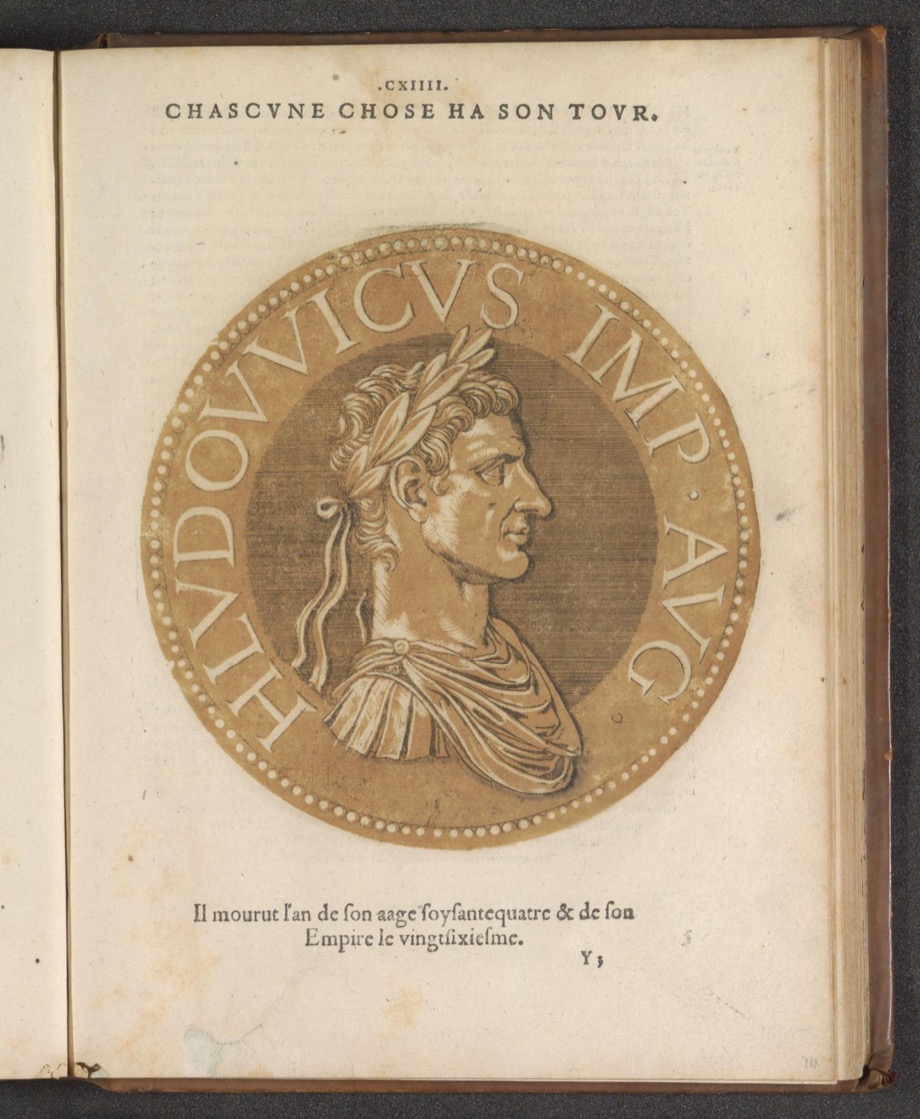
Printed coin-style portrait of Louis the Pious — 1557/1559 (later depiction)
An Emperor Responsible Before God
Louis the Pious inherited an empire whose rulers were expected to answer for more than victories. They were guardians of churches, judges of disputes, protectors of communities, and fathers responsible for a dynasty. His reign made the tensions among those duties unusually visible. He sought religious and political order through reform, succession agreements, and public reconciliation; his sons and their supporters repeatedly contested the order he proposed. A tentative ISFJ reading concerns his persistent reference to inherited responsibilities and established relationships, not the assumption that a devout emperor must possess a particular personality.
Born in 778 to Charlemagne and Hildegard, Louis became king of Aquitaine as a child in 781. That regional kingship gave him a long apprenticeship in government before he succeeded his father in 814. He was crowned co-emperor in 813, when the deaths of his brothers had left him the principal surviving legitimate son. His accession was therefore prepared rather than improvised. Yet the imperial household, the Italian kingdom, and the aristocratic networks of the wider realm retained interests that could not be reduced to one ruler's instructions.
His familiar epithet can obscure the political force of religious language. Piety was not an alternative to government in the ninth century. It supplied standards against which government could be praised, corrected, or condemned. Court annals, biographies, bishops, and partisan narratives disagree about Louis because the meaning of responsible Christian rule was itself contested. They offer substantial evidence about his decisions, but less secure access to an enduring private psychology.
A low-confidence ISFJ reading emphasizes dominant Introverted Sensing: Louis repeatedly tried to repair imperial government through inherited duties and recognized bonds.
Preserving an Inheritance
Louis did not simply maintain everything Charlemagne had done. His court encouraged reform, and changes in personnel could sharply disrupt established interests. The relevant pattern is his preference for making change legitimate through a recovered or clarified order. With Benedict of Aniane, he supported a more consistent monastic observance. Assemblies, written provisions, and the distinction between kinds of religious communities translated broad ideals into obligations that institutions could recognize.
The succession settlement of 817 expressed the same concern on a dynastic scale. The Ordinatio imperii placed Lothair above his younger brothers, who received subordinate kingdoms. Its preamble presented the empire as a unity entrusted by God, something parental affection alone should not divide. The arrangement attempted to reconcile two inherited expectations: sons should receive meaningful provision, while an emperor should preserve the whole. It was neither a modern constitution nor a simple division into future national states.
For Introverted Sensing, the suggestive evidence is this repeated appeal to continuity, proper position, and entrusted responsibility. The settlement did not emerge from memory alone; councillors, bishops, and interested relatives shaped it. Nevertheless, Louis's recurring response to danger was to redefine and reaffirm the bonds that made the imperial inheritance intelligible. That pattern provides a more defensible basis for comparison than his religious reputation by itself.
Reconciliation as Public Government
The treatment of Bernard of Italy exposed the gulf between responsible kingship and punitive power. Bernard resisted the settlement that privileged Lothair, then surrendered. In 818 he was sentenced to death, a penalty Louis commuted to blinding; Bernard died after the operation. Calling the commutation merciful without its consequences would reproduce the court's justification. The emperor also removed opponents and compelled several relatives into religious life. His reign included coercion as well as reform.
At Attigny in 822, Louis publicly acknowledged wrongs associated with Bernard and with members of his own family. This was not the forced humiliation of 833, which belongs to a different political crisis. In 822 repentance could display an emperor's willingness to correct his government and reconcile estranged relatives. The Royal Frankish Annals describe a collective setting involving bishops, leading men, and the wider assembly. Responsibility was performed before a community whose recognition mattered.
An Extraverted Feeling interpretation concerns the effort to restore relationships through an acknowledged moral vocabulary. It does not mean Louis avoided conflict or treated everyone kindly. His penitential acts worked within unequal institutions, and recognition by the political community could strengthen authority. The later use of penance against him demonstrates the danger: a practice intended to repair legitimate rule also furnished opponents with a language for declaring him unfit to exercise it.
A Household That Changed the Settlement
Ermengarde, Louis's first wife and the mother of his elder sons, died in 818. He married Judith of Bavaria the following year, and their son Charles was born in 823. Providing for Charles challenged the earlier arrangement without making the older sons' claims disappear. Judith sought a future for her son; Lothair and other princes defended their own positions. Aristocrats and churchmen entered these disputes because succession affected offices, patronage, and the security of their families.
Rebellions in 830 and 833 therefore cannot be explained as an emperor's personal indecision alone. Alliances among the sons shifted, and opposition drew authority from competing accounts of the empire's proper order. In 833 Louis lost the support of his army and underwent a public degradation under pressure. His restoration in 834 showed that the coalition against him was unstable and that a substantial constituency still accepted his kingship. He continued governing until his death in 840.
The familiar story of a weak father destroying a strong father's achievement compresses a much more difficult inheritance. Carolingian rulers distributed authority through relatives and aristocrats whose cooperation they needed. Louis had to maintain the empire while adjusting to deaths, births, and changing political circumstances. His responses sometimes failed disastrously. Those failures belong to institutional and dynastic history as well as to the assessment of an individual ruler.
Testing the ISFJ Reading
Why not ISTJ?
ISTJ is a strong alternative because written settlements, religious standards, and inherited duties are central to the record. A more impersonal emphasis on administration might favor that reading. ISFJ is preferred only cautiously because Louis repeatedly used reconciliation and publicly shared obligations to repair authority. Councillors and clerical narrators may account for much of this emphasis, so the distinction remains uncertain.
Why not INFJ?
The vision of a united Christian empire can suggest INFJ, but it was a widely shared political ideal rather than evidence unique to Louis. His surviving decisions more often concern preserving or renegotiating recognized relationships than projecting a distinctive personal future. That difference supports ISFJ provisionally without denying that his government pursued ambitious reforms.
The low-confidence conclusion rests on a pattern of obligation and repair across decisions. It should not turn piety into a personality test, treat every political defeat as a cognitive failure, or explain family rebellion through an imagined private weakness.
Connected Figures
Further Reading
- The Penitential State: Authority and Atonement in the Age of Louis the Pious, 814–840 — Mayke de JongPlaces royal repentance within the language and institutions of Carolingian government, rather than treating it as simple weakness.
- Carolingian Chronicles: Royal Frankish Annals and Nithard’s Histories — Bernhard Walter Scholz, with Barbara RogersTranslations of contemporary narratives whose loyalties and retrospective judgments require careful comparison.
- The Carolingian World — Marios Costambeys, Matthew Innes, and Simon MacLeanConnects court politics with landholding, monasteries, aristocratic networks, and the practical limits of imperial government.
