 Historical Figure MBTI
#1255 · 9-16-26 · The Carolingian World
Charlemagne
Frankish King · Emperor · Patron of Reform
742/747/748–814 (birth disputed)
9 min read
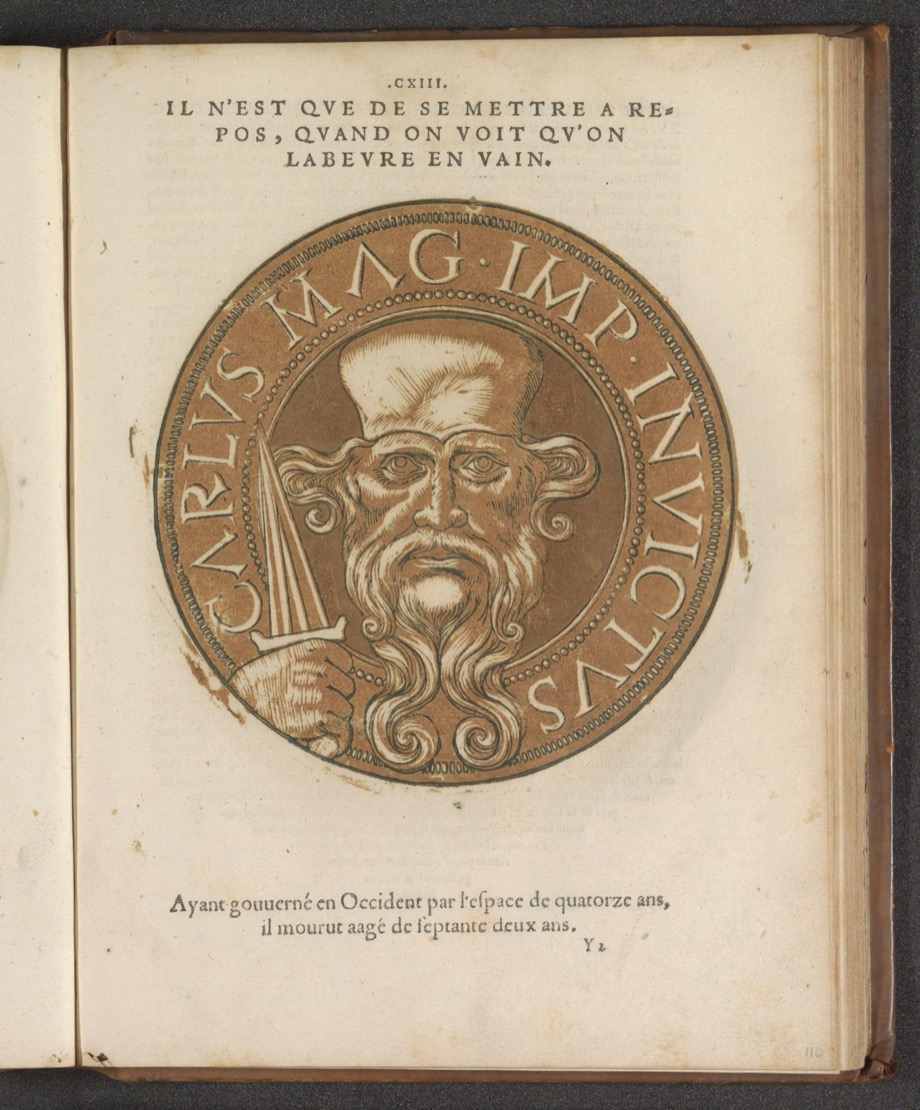
Printed coin-style portrait of Charlemagne — 1557 (later depiction)
The King Who Wanted Correction
A ruler can issue an order without making anyone obey it. Charlemagne knew the distance between those acts well enough to send investigators, demand oaths, gather assemblies, and repeat instructions that had already been announced. His surviving legislation describes a kingdom perpetually in need of correction. Judges could be corrupt, monks undisciplined, books inaccurate, and powerful men careless of other people’s rights. An empire did not become orderly because its ruler had been crowned.
This persistent dissatisfaction is a more revealing starting point than the image of an emperor contemplating a map. Charlemagne certainly conquered. Yet he also wanted the territory he commanded to possess better institutions, more reliable religious practice, and a learned culture capable of articulating his authority. The expansive ambition is visible in the connection between those demands, even when their implementation remained uneven. A tentative ENTJ interpretation follows that recurring organizing pattern, with moderate confidence.
His birth year is disputed, with 742, 747, and 748 among the proposed dates. He became king in 768 after the death of his father, Pepin the Short, initially sharing the inheritance with Carloman I. He died at Aachen in 814 as emperor. Between those secure endpoints lies a career described most fully by people attached to his dynasty, whose admiration is part of the evidence and also a reason to question it.
Charlemagne reads as an ENTJ through Extraverted Thinking: conquest, learning, and religious reform repeatedly became problems of organized action.
Instructions That Had to Travel
The general capitulary of 802 begins with chosen ecclesiastical and lay agents sent through the realm to investigate whether people were living according to law and justice. These royal envoys, the missi, connected the court to places the emperor could not personally supervise. The program included complaints about administration, protection of vulnerable people, and the conduct of those exercising authority.
The document is prescriptive rather than a report of success. Its concern with misconduct proves that misconduct existed, not that issuing rules eliminated it. Charlemagne had neither a modern bureaucracy nor an impersonal state standing apart from aristocratic power. Counts, bishops, abbots, and other prominent figures supplied much of the personnel through whom he governed. Their cooperation had to be secured within networks of rank, loyalty, and reward.
That constraint helps explain the repeated use of assemblies and delegated investigation. Government required people to know what the king expected, to interpret instructions locally, and to report difficulties upward. Written commands assisted the process, but their circulation depended on readers, messengers, meetings, and institutions capable of preserving them.
Extraverted Thinking is the proposed dominant pattern because Charlemagne repeatedly sought to translate a desired condition into responsibilities and procedures. The inference concerns this direction of effort, not the mere fact that a ruler governed. The practical ambition becomes especially clear where military success cannot explain it: the correction of texts, the supervision of church life, and the attempt to make justice accessible beyond the palace.
Even his admirer Einhard concedes that the effort to improve existing laws achieved less than the king intended. This qualification interrupts an otherwise magnificent portrait. It leaves us with a ruler capable of demanding systematic improvement without possessing the capacity to finish every scheme. Frustration and incomplete execution belong inside the interpretation, rather than being edited out of it.
A Kingdom with an Imperial Horizon
The defeat of Desiderius in 774 did not end with tribute from a surviving Lombard king. Charlemagne took the Lombard royal title himself. In Saxony, he sought incorporation accompanied by Christian conversion rather than an arrangement that left neighboring communities entirely outside his political and religious order. These different campaigns increasingly enlarged the scale of what Frankish rule claimed to be.
The coronation of Christmas Day 800 at Rome supplied another title and another set of problems. Einhard says Charlemagne would have avoided the ceremony had he known what the pope intended. Historians debate how to interpret this protestation. It cannot settle the question of advance planning by itself, especially when the biography’s presentation of the emperor is so carefully managed.
The result nevertheless mattered: Charlemagne now held an imperial dignity associated with Rome. The claim required diplomatic accommodation with the rulers of Constantinople, who had their own Roman imperial legitimacy. This was the Carolingian empire, not the later Holy Roman Empire in an already completed institutional form. A coronation does not erase the differences between the eighth, ninth, and subsequent centuries.
Introverted Intuition offers a cautious account of the way territorial gains, Christian correction, and Roman prestige could converge upon a broader political horizon. It does not mean that every conquest had been planned from the beginning or that Charlemagne foresaw the states later formed within his territories. His project acquired meaning through circumstances and advisers as well as through royal intention.
Aachen made that ambition visible in stone. The palace chapel drew on Roman and Byzantine architectural resources and incorporated materials brought from Italy. Its presence at a northern royal center connected local power to an authoritative past. Architecture, ceremonial practice, and books could make a claim that an army alone could neither formulate nor sustain.
Learning as a Royal Obligation
The Admonitio generalis of 789 joined ecclesiastical discipline to educational demands. Correct reading, singing, calculation, and knowledge mattered because error could compromise worship and understanding. Charlemagne’s support for learning therefore operated within a Christian reform program. Calling it a project for universal modern education would misunderstand both its audience and its purposes.
Alcuin was among the scholars who gave the project practical and intellectual substance. Paul the Deacon, Theodulf, and other learned people brought different regional backgrounds and abilities to the court. Their work makes it impossible to attribute the cultural revival to the emperor’s individual invention. Patronage and collaboration were central mechanisms of the achievement.
Manuscript production preserved old texts and created new forms of careful presentation. The clearer script associated with Carolingian book culture improved legibility and transmission. These changes had consequences far beyond the reign, but their immediate setting was a network of courts, churches, and monasteries seeking reliable books. They were the work of scribes and teachers as well as patrons.
Einhard’s account of Charlemagne’s own learning adds an appealing limitation. The ruler studied with teachers and attempted to practice writing, yet reportedly began too late to achieve much skill with his hand. Whether every bedside detail should be accepted literally, the portrait distinguishes respect for learning from mastery of all its techniques. His power lay partly in recognizing and employing capacities he did not personally possess.
The Body and the Campaign
The emperor in Einhard’s biography is a physical presence: a rider, hunter, and swimmer who enjoyed the warm springs at Aachen. Such descriptions draw on literary conventions as well as recollection. They nevertheless resist an interpretation in which Charlemagne existed only as an abstract organizer. Royal authority was embodied in travel, assemblies, campaigns, hospitality, and the performance of rank.
Campaigns required attention to terrain, supply, seasons, and the movement of forces. The failed expedition toward Zaragoza in 778 exposes the limits of the triumphant narrative. On the return across the Pyrenees, attackers destroyed part of the rear guard and baggage train. Hruodland, the official later transformed into the epic Roland, was among the dead. The king could not simply convert defeat into immediate revenge.
Extraverted Sensing is a plausible supporting pattern in this readiness to engage with the tangible demands of command and public presence. It is less securely inferable than the organizing pattern, because physical activity was also expected of a Frankish king. Hunting or swimming cannot establish a type. Their relevance comes from the broader portrait of someone who combined institutional demands with direct participation in the world he ruled.
Delegation remained essential. Charlemagne did not personally fight every battle attributed to his reign, and his sons and commanders conducted important campaigns. The empire’s size made the monarch’s absence as significant as his presence. A personality account that imagines him directing every local encounter mistakes the language of royal credit for the actual distribution of military work.
The Violence Inside the Christian Project
The Saxon wars were prolonged, destructive, and accompanied by coercive conversion. Widukind’s resistance belongs within this history, rather than serving merely as the obstacle that lets the emperor demonstrate perseverance. Hostages, punitive expeditions, executions, and resettlement imposed costs on communities whose own accounts survive much less fully than Frankish ones.
The Royal Frankish Annals report the execution of 4,500 Saxons at Verden in 782. The episode and its transmitted number have generated extensive debate, but the violence cannot responsibly be dissolved into a benign story of educational renewal. Harsh legal provisions directed at Saxon religious practices also show how incorporation and salvation could become inseparable from coercion.
Charlemagne’s Christianity was not a private preference detached from government. It helped define the obligations he claimed for rulers and subjects. That moral framework could inspire almsgiving, correction, and patronage while authorizing punishments a modern reader finds appalling. Explaining the historical framework does not require adopting the court’s assumption that resistance made the victims blameworthy.
The evidence for Introverted Feeling within the proposed stack is particularly indirect. Personal grief, religious conviction, and family attachments are visible through mediated narratives, but none establishes a private decision mechanism. Leaving that part of the interpretation lightly drawn is preferable to inventing an inner drama in order to complete a symmetrical set of function stories.
Testing the ENTJ Reading
Why not ESTJ?
ESTJ is a serious alternative: Charlemagne relied on inherited Frankish kingship, existing law, aristocratic service, and established Christian authority. His recurring inspections and demands for proper conduct could reflect a sustained concern with reliable practice. ENTJ is preferred because the record repeatedly connects practical organization to an enlarged political and cultural claim, extending beyond the maintenance of what he inherited. The distinction is interpretive, and medieval government supplies evidence for both readings.
The ENTJ reading has moderate confidence because the evidence is unusually rich for an early medieval ruler, yet richness does not remove mediation. Laws reveal programs, monuments reveal patronage, and Einhard reveals a carefully shaped memory. Together they support an expansive organizing pattern without giving unrestricted access to the emperor’s private mind.
Connected Figures
Further Reading
- Two Lives of Charlemagne — Einhard and Notker the Stammerer, translated by David GanzContrasts a courtier’s carefully composed biography with the later anecdotal memory of the emperor.
- King and Emperor: A New Life of Charlemagne — Janet L. NelsonReconstructs the ruler through political relationships, family decisions, and close reading of the sources.
- Charlemagne: The Formation of a European Identity — Rosamond McKitterickExamines government, communication, and the production of a historical identity without treating empire as a modern nation.
- Carolingian Chronicles — Translated by Bernhard Walter Scholz with Barbara RogersMakes the Royal Frankish Annals and Nithard accessible while preserving the need to distinguish their viewpoints.
