 Historical Figure MBTI
#1265 · 9-18-26 · The Carolingian World
Theodulf of Orléans
Bishop · Poet · Author of Imperial Arguments
c. 750–821
5 min read
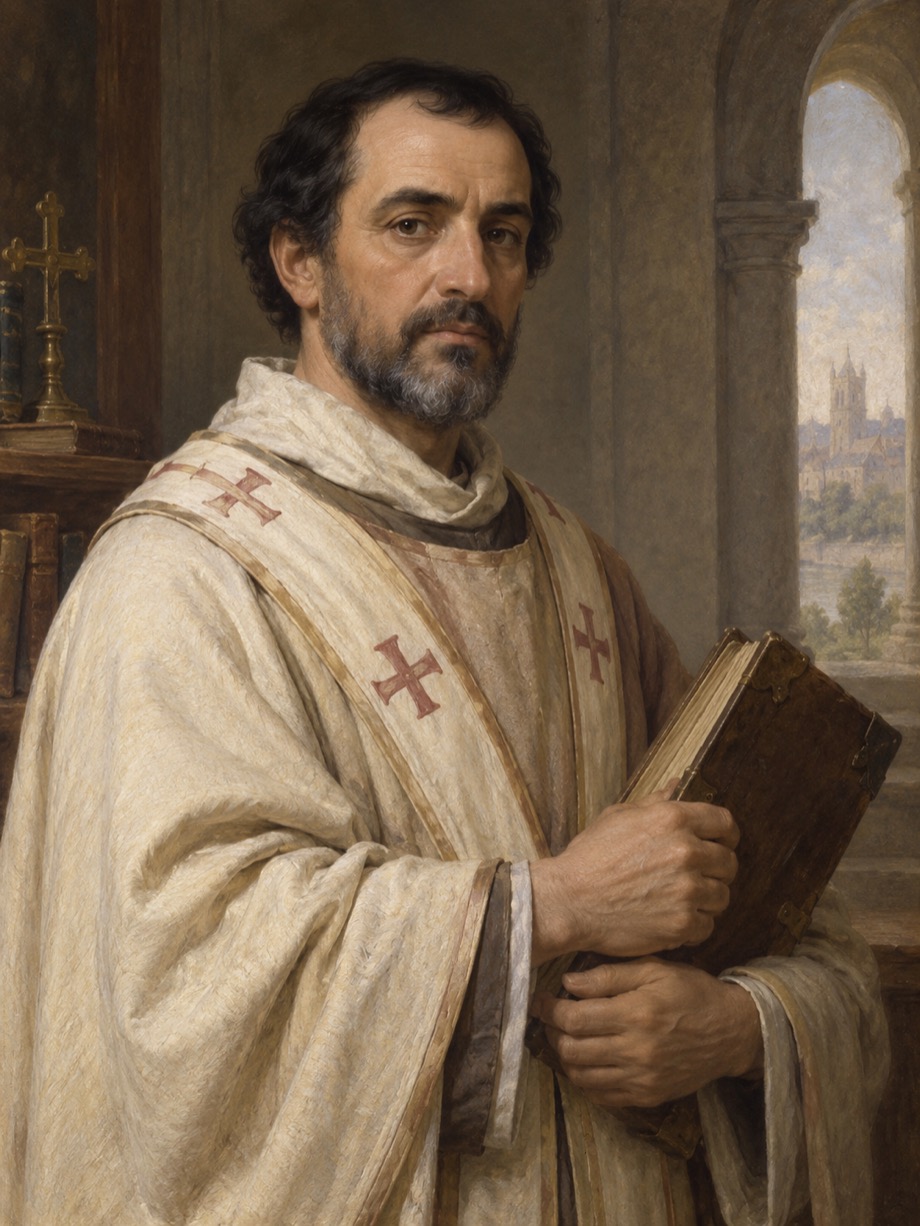
AI-assisted Portrait of Theodulf of Orléans
An image needed an argument
Theodulf of Orléans did not treat the religious image as a question that could be settled by enthusiasm or disgust. In the work associated with him and issued in Charlemagne’s name, the Opus Caroli, images should neither be destroyed nor receive worship. That position required distinctions about objects, words, authority, and the practices through which Christians expressed reverence.
The text emerged from a dispute with the Second Council of Nicaea and from the Frankish court’s understanding of its decisions. It cannot be reduced to one scholar calmly correcting everybody else’s error. Translation problems, the claims of rival political centers, and revisions within the Frankish manuscript all matter. Theodulf’s intellectual confidence worked inside this contested setting.
The low-confidence INTJ interpretation concerns his tendency to organize difficult questions around a coherent framework and give that framework practical force. Scholarship and episcopal office do not themselves establish the type. The case rests on a particular conjunction of systematic argument and programs for correction, with substantial room for another reading.
The tentative INTJ reading places dominant Introverted Intuition in Theodulf’s drive to make theology, learning, and conduct answer to an integrating framework.
The distinction beneath the disputed word
Introverted Intuition is plausible in the effort to ask what an image can properly be within Christian life before deciding how it should be treated. Theodulf’s argument draws particular practices into a larger relationship between material objects and religious truth. Neither the destruction of images nor their elevation into objects of worship supplies the desired order.
Yet the framework was not perfectly settled from the beginning. Recent analysis of manuscript alterations shows continuing disputes over the meaning of adoration. Some revisions distinguish worship from respectful greeting and complicate earlier formulations. This evidence makes the work more interesting than an account of effortless coherence. Its coherence was pursued through argument, reconsideration, and intervention by more than one participant.
The type claim therefore concerns an orientation rather than a finished system. Theodulf sought a governing account that could judge a range of practices. He was also a participant in the production of a royal text. We should not attribute every formulation or correction to a solitary mind merely because modern discussion commonly attaches his name to the work.
A rule had to reach a village
Theodulf’s concern with correct understanding extended into institutions. His instructions to priests included the establishment of schools in towns and villages. The educational obligation was meant to reach beyond a learned court. A bishop could formulate a standard, but its effect depended on local clergy receiving children and doing the work of teaching.
Auxiliary Extraverted Thinking offers a possible description of this translation from an aim into an arrangement. The point is not that issuing regulations automatically proves the function. Episcopal office required regulations. The more useful evidence is his repeated interest in the channels by which improvement might become operative: the corrected text, the priest’s school, and the judge’s conduct.
His poem against judges brings another institutional difficulty into view. Gifts could corrupt judgment, while gift giving also belonged to accepted social exchange. The poem’s attention to particular offerings exposes the problem rather than resolving it through a simple claim that every gift is the same. Literary criticism and royal reform overlap. The bishop’s norm must contend with the practices of the world it seeks to correct.
The learned bishop remained vulnerable
Theodulf was a poet as well as a theologian and administrator. The church he built at Germigny-des-Prés, with its surviving mosaic and inscription, belongs to that wider investment in the expression of religious learning. His criticism of image worship did not entail an absence of art. A material representation could have a place without possessing the authority of the divine.
His fall under Louis the Pious in 818 placed a different limit on intellectual order. Accused of involvement in Bernard of Italy’s rebellion, he was removed and exiled. The accusation and punishment are clearer than a secure reconstruction of his guilt. A narrative that makes his fall the inevitable result of arrogance would convert uncertainty into a convenient personality story.
Why this tentative reading?
Why not INTP?
The precision of his distinctions and willingness to contest theological language make INTP a serious alternative. INTJ is preferred cautiously because the arguments repeatedly belong to a program of ordering Christian institutions and practices. The framework is intended to govern action, rather than remain principally an exploration of logical possibilities.
That balance cannot be detached from his assignments. A royal theologian and bishop was expected to make scholarship useful. The evidence supports a characteristic intellectual project more strongly than it establishes whether its direction came from a stable private preference. Confidence remains low, and the interpretation should not absorb the work of his collaborators.
Connected Figures
Further Reading
- What is adoration? Contesting meaning in the margins of the Opus Caroli regis contra synodum — Huw FodenUses manuscript revisions to complicate the familiar explanation of the image dispute as a single mistranslation.
- Théodulf d’Orléans: Histoire et mémoire d’un évêque carolingien — Claire TignoletA modern study of the bishop’s career and later memory, discussed in The Medieval Review.
- Theodulf of Orléans: Charlemagne’s Spokesman against the Second Council of Nicaea — Ann FreemanCollected studies of the image controversy, manuscript revisions, and Theodulf’s place at court.
