 Historical Figure MBTI
#1266 · 9-18-26 · The Carolingian World
Paulinus II of Aquileia
Patriarch · Theologian · Pastoral Teacher
c. 726–802/804
5 min read
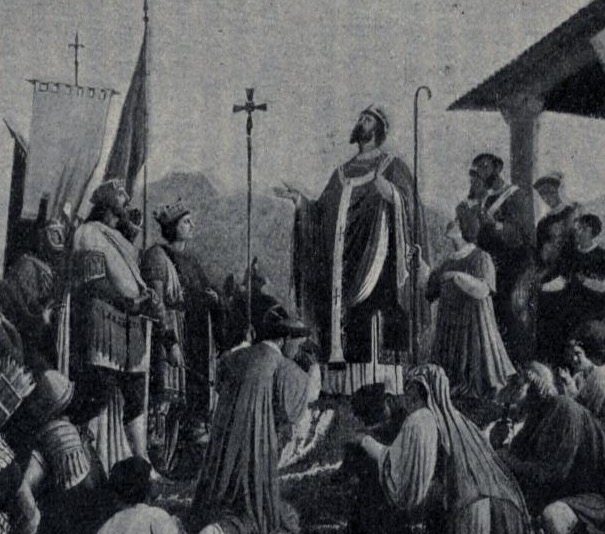
Paulinus II blessing an army — reproduced 1910; underlying artwork undated (later depiction)
Victory had not finished the work
After the Frankish defeat of the Avars, a group of bishops assembled beside the Danube in 796 to discuss a problem that victory had not resolved. What did it mean to bring the inhabitants of a conquered territory into Christian life? Paulinus of Aquileia helped address questions of instruction, baptism, and the circumstances in which a rite could be considered valid.
The questions were exact, but their implications were larger than ceremonial correctness. A person had to learn before the new religious identity could mean what the conquerors claimed it meant. Military power could create an opening for mission without completing the work of belief. Paulinus’s participation places the learned patriarch at the point where a confident political project encountered the slower demands of formation.
The low-confidence INFJ reading concerns the attempt to connect a religious vision with the guidance of actual people. It is not established by sanctity, poetry, or episcopal rank. Those categories describe his work and reputation. They cannot tell us directly how he habitually perceived a problem or reached a judgment.
The tentative INFJ reading places dominant Introverted Intuition in Paulinus’s effort to connect doctrinal meaning with a coherent vision of Christian formation.
The rite had to mean what it claimed
Paulinus entered Charlemagne’s learned circle as a teacher of grammar before becoming patriarch of Aquileia in 787. His theological work included opposition to Adoptionism, the contested teaching about Christ’s sonship that drew the attention of the Frankish court. He participated in the Council of Frankfurt in 794 and in subsequent discussion of doctrine within his own ecclesiastical setting.
Introverted Intuition is a possible way to describe the integrating concern behind these activities. A formula, a teaching, and a community’s religious identity should belong to the same intelligible account. Correct language matters because it expresses a truth that is meant to organize belief and conduct. The scholar’s task is to keep these levels from coming apart.
The inference is limited by its historical setting. Carolingian theologians generally treated doctrinal consistency as essential, and Paulinus’s office required him to defend it. An orthodox conclusion cannot prove an intuitive process. The stronger basis is the movement between theological definition and pastoral formation, though even that may reflect a shared ecclesiastical program as much as an individual preference.
Instruction before incorporation
The Danube assembly concentrated on the terms under which people could enter the Christian community. Its discussions addressed timing, verbal formulae, earlier baptisms, and adequate instruction. Paulinus and his colleagues were trying to establish a process, not merely count a new population as Christian because it had fallen under Frankish power.
Auxiliary Extraverted Feeling is plausible in the effort to make the community’s religious standards communicable. The candidate for baptism has to become a participant who understands something of the identity being assumed. That emphasis allows a concern for people and a concern for doctrine to reinforce each other. Guidance is the means by which a common life can become more than a label.
It should not be transformed into a claim that Paulinus stood outside the ambitions of the conquering empire. His mission followed conquest and assumed that Christianization was desirable. The difference concerned preparation and the character of incorporation. To acknowledge that difference without giving him a modern doctrine of equal religious choice is to take his pastoral position seriously in its own conditions.
The teacher had more than one voice
Paulinus’s surviving work extends beyond conciliar argument. His poetry includes religious compositions and an elegy for his friend Eric of Friuli, killed in 799. A theological writer could also address loss, memory, and the moral responsibilities of powerful people. These forms enlarge the public voice through which we encounter him, although they do not provide an unrestricted view of private life.
His later reputation as a saint adds another layer of mediation. Devotional accounts tend to arrange prudence, learning, and pastoral zeal into an exemplary whole. Their claims about particular writings or offices can be assessed, but their moral portrait is a purpose of the account rather than independent psychological evidence. Admiration should not substitute for discrimination among kinds of testimony.
Why this tentative reading?
Why not ISFJ?
Careful transmission of doctrine and concern for the people entrusted to him make ISFJ a credible alternative. INFJ is adopted tentatively because his work appears to connect exact religious teaching to an integrating vision of formation. The difference is slight in the surviving record, where preservation and interpretation are both central.
Confidence remains low because the available evidence concerns a public theologian fulfilling public responsibilities. We can establish that he joined teaching, doctrine, and pastoral practice. We cannot securely rank the mental preferences behind that combination. The type offers a provisional account of the pattern, while the historical narrative should remain useful to a reader who declines it.
Connected Figures
Further Reading
- Conventus episcoporum ad ripas Danubii — Paulinus and the assembled bishops; edited by Albert WerminghoffThe record of the Danube assembly in 796 documents the practical and liturgical questions raised by mission.
- How the East Became the East — Helmut ReimitzA modern analysis of the tension between conquest, baptism, and lasting integration in the eastern territories.
- St. Paulinus II, Patriarch of Aquileia — Aluigi CossioAn older ecclesiastical account of his career and writings, useful when its devotional judgments are kept distinct from evidence.
