 Historical Figure MBTI
#1263 · 9-18-26 · The Carolingian World
Alcuin
Teacher · Correspondent · Adviser to Charlemagne
c. 735–804
6 min read
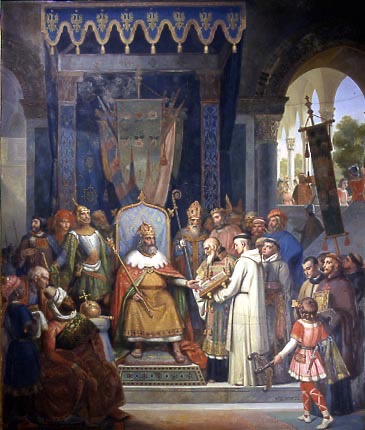
Alcuin presenting manuscripts to Charlemagne — Jean Victor Schnetz, 1830 (later depiction)
A garden that needed books
At Tours, Alcuin could imagine a garden of learning more readily than he could supply its shelves. In a letter to Charlemagne in 796, he described teaching Scripture, grammar, and astronomy through images of food, drink, and decoration. Then the imaginative abundance met a material shortage. Books he had known in York were missing. He proposed sending young men across the sea to obtain what the school needed.
The request brings his characteristic scale of attention into view. A pupil’s development, the availability of a manuscript, the support of a king, and the future of Christian learning belonged to the same undertaking. He could praise an exalted patron without forgetting that an educational ideal needed readers, teachers, and a workable journey. The letter makes affection and logistics partners.
The tentative ENFJ reading begins with that conjunction. It does not follow from the fact that Alcuin taught or wrote warmly. His stronger claim is a recurring concern to draw people into a common purpose and then equip them to carry it forward. Yet a public teacher’s letters also perform a role. They disclose a cultivated voice, not an unfiltered interior life.
The tentative ENFJ reading places dominant Extraverted Feeling in Alcuin’s effort to make learning a shared responsibility among pupils, friends, and rulers.
People were the means of continuity
Alcuin was educated in York and entered the learned circle around Charlemagne after their meeting in Italy in 781. His subsequent work at court and at Tours depended on relationships across distance. Letters maintained those relationships when a shared classroom could not. They offered advice, correction, encouragement, and reminders of obligations that survived a change of place.
Extraverted Feeling offers one possible description of the attention behind this practice. He repeatedly addressed the person who could make an intellectual or religious purpose effective: the pupil who should continue studying, the patron who could support a school, the bishop facing a difficult mission. Knowledge became a responsibility exchanged between people. His authority relied on persuading recipients that their conduct mattered to a larger community.
The distinction is more precise than calling him kind. Correction could be demanding, and his Christianity supplied standards that others were expected to accept. Warmth was not an absence of judgment. It was a way of establishing the relationship within which judgment could be heard. The evidence favors a socially directed teaching voice, while leaving his temperament outside that voice less certain.
The pupil beyond the immediate lesson
The Tours letter does more than list subjects. Its garden image makes the movement of books from York into the Loire valley part of a future in which learning bears fruit elsewhere. Alcuin treats a local shortage as an interruption in a larger process of cultivation. The desired result is not simply a fuller collection but people capable of extending the work.
Auxiliary Introverted Intuition is plausible in this movement from particular needs to an organizing future. Scripture, grammatical competence, and other studies serve a coherent understanding of Christian formation. The learner should eventually read responsibly, teach others, and participate in the correction of religious life. Education has a destination beyond the successful completion of an exercise.
There is a necessary historical limit to that inference. The image of cultivation came from biblical and literary traditions, and Alcuin’s metaphors were not private inventions that prove a function. What matters is how he joins the image to action: identify what is absent, move pupils and resources, and create a second center of growth. The pattern suggests a guiding vision, without making every elegant comparison evidence of intuition.
The value of this vision depended on continuity. A ruler could summon a scholar, but a summons did not guarantee that students would keep studying or that another place would possess the necessary books. Alcuin’s appeal imagines education surviving his own presence. That is a stronger basis for the intuitive reading than treating the grandeur of the Carolingian court as his personal ambition. His horizon was expressed in the transfer of capacities: a recipient could become a teacher, and a borrowed intellectual inheritance could sustain a new community.
Counsel within a conquering world
Alcuin’s commitment to formation also appears in discussions of mission. After the campaigns against the Avars, he and other ecclesiastical advisers emphasized teaching and preparation for baptism. Conquest could force an outward submission. It could not by itself produce the understanding and commitment that Christian life required. The distinction questioned the speed with which royal success might be translated into religious success.
This was a consequential disagreement within a shared project. Alcuin remained a supporter of Christian kingship; he was not advancing modern religious pluralism. His argument concerned how conversion should become real, and it could still assume that the people addressed ought to convert. Recognizing the distance between his position and a modern principle of liberty prevents an attractive fragment of counsel from becoming an anachronistic portrait.
His Life of Willibrord supplies another caution. The missionary is presented through the conventions of sanctity, while non-Christian opponents are described in sharply hostile terms. Alcuin could favor instruction and write within a tradition that denied the legitimacy of other beliefs. These positions belonged to the same religious world. His educational patience should be understood within it rather than purified of its exclusions.
Correct understanding required distinctions
The network of teachers needed more than sympathetic communication. Alcuin’s intellectual work included grammar, theological argument, and attention to the accuracy of texts. A shared Christian purpose could fail through misunderstood words as well as through indifference. Learning therefore required distinctions that affection alone could not supply.
Introverted Thinking is useful here as a limited part of the interpretation: the need to test how a proposition or expression holds together. It does not justify diagnosing an “inferior-function struggle” from the presence of controversy. Alcuin was a trained scholar carrying out demanding tasks. The evidence shows intellectual discipline integrated with teaching, while offering little basis for reconstructing private episodes of psychological stress.
Why this tentative reading?
Why not INFJ?
A long view of Christian education and a reflective religious vocabulary make INFJ a serious alternative. The balance here favors ENFJ because the surviving voice so often begins with the recipient and the relationship through which an aim can become effective. The future is cultivated through a circle of people rather than chiefly presented as a solitary insight that others must recognize.
That preference remains moderate in confidence. Correspondence preserves a socially engaged Alcuin because correspondence itself requires social engagement. We cannot measure how much of the pattern belongs to the man and how much to his office. ENFJ is an economical interpretation of repeated choices in his surviving work, not a claim that a medieval letter collection provides a modern assessment.
Connected Figures
Further Reading
- Letter to Charlemagne, 796 — AlcuinThe Tours letter joins metaphors of nourishment to a concrete request for books and students from York.
- The library of Alcuin’s York — Mary GarrisonExamines what the evidence for York’s books reveals about learning and its social setting.
- The Life of Willibrord — Alcuin; translated by C. H. TalbotA saint’s life that shows the author’s missionary ideals and the limits of treating hagiography as neutral reporting.
- How the East Became the East — Helmut ReimitzPlaces instruction and conversion within the tensions of Carolingian conquest and integration.
