 Historical Figure MBTI
#1262 · 9-17-26 · The Carolingian World
Pope Hadrian I
Pope · Guardian of Roman Claims
d. 795
5 min read
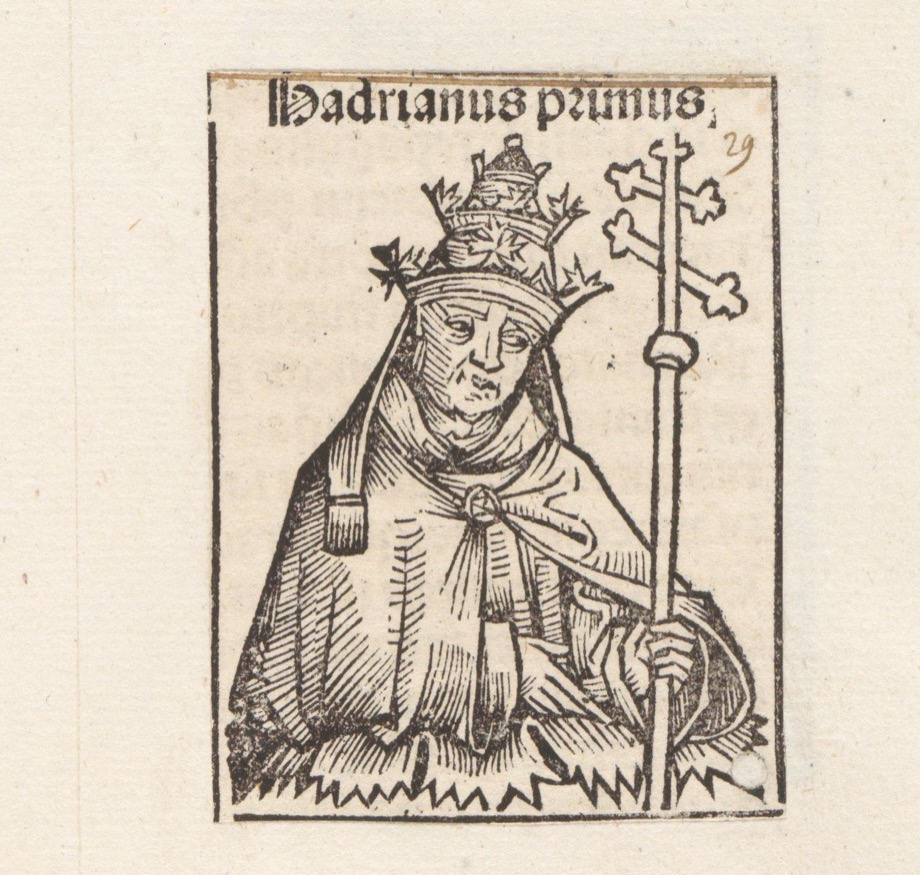
Imagined portrait of Pope Hadrian I — 1493 (later depiction)
The Ally Who Kept Asking
The removal of a dangerous neighbor did not make a pope’s work simple. After Charlemagne defeated Desiderius in 774, Hadrian I still had to negotiate what Frankish protection meant, which territories Rome could claim, and how earlier promises should be fulfilled. The king had eliminated an independent Lombard monarchy by becoming king of the Lombards himself.
Hadrian’s long pontificate, from 772 to 795, is visible through papal biography, letters, monuments, and the memory of his Frankish partner. A tentative ISTJ interpretation follows his persistence in defending institutional claims and remembered obligations. It has low confidence. Being pope does not prove a type, and the records most favorable to his position cannot give unmediated access to the person.
Hadrian I can cautiously be read as an ISTJ through Introverted Sensing: remembered commitments and the continuity of Roman authority repeatedly anchored his negotiations.
Promises with a Past
The papacy’s dealings with Frankish rulers already possessed a history when Hadrian took office. Pepin’s interventions and promises supplied a language through which Rome could ask for protection and territorial restoration. Hadrian did not have to invent every claim anew. He could present current demands as fulfillment of obligations that a legitimate partner should recognize.
Desiderius initially offered negotiation, but papal accounts describe continuing territorial pressure and unreliable assurances. The biography naturally makes the pope’s position appear justified. It nevertheless preserves the specific problem of governing amid incompatible claims to towns, resources, and rights. Roman authority was not secured simply by the sacred standing of Saint Peter.
Charlemagne’s visit to Rome during the campaign of 774 reinforced the relationship. Subsequent correspondence shows that agreement at a ceremonial meeting did not settle every practical question. A promise had to be interpreted geographically and enforced politically. The repeated appeal to its past meaning could become a tool for obtaining present action.
Introverted Sensing is a cautious description of this reliance on continuity, precedent, and remembered commitment. The inference is narrower than an assertion that Hadrian disliked change. His situation required adaptation, but he repeatedly sought to legitimate adaptation through existing rights rather than treating every negotiation as a transaction without history.
A Claim Needed Resources
Hadrian also governed a city with material needs. The papal biography credits him with extensive work on churches and monasteries, the walls, and the water supply. Modern archaeological scholarship identifies repairs to four aqueducts and to the long covered approach leading toward Saint Peter’s. These projects made authority tangible in services, defenses, and the movement of people.
The biography’s concentration on papal works can obscure other contributors. Its purpose was not to distribute credit neutrally across every artisan, donor, or administrator. Yet the scale and range of the recorded activity show that Hadrian’s role cannot be reduced to sending appeals for help. Maintenance and restoration were themselves part of the political responsibility of the Roman church.
Extraverted Thinking offers a tentative supporting interpretation in this effort to secure resources and make institutional claims operational. It remains difficult to separate personal preference from the demands of office. The strongest evidence concerns what his government repeatedly pursued, not a recovered description of the private reasoning behind each building project.
The relationship with Charlemagne consequently joined dependence to bargaining. A powerful ally could defend Rome while pursuing interests of his own in Italy. Hadrian needed Frankish strength without surrendering every Roman claim to the king’s convenience. Their partnership was durable because it continued to be worked upon, not because disagreements ceased to exist.
An Ally in Other People’s Disputes
The negotiations surrounding Tassilo III in 787 drew Hadrian into the contest over Bavaria. The Frankish annals present the pope as warning the duke to fulfill obligations and threatening religious penalties if he did not. That account serves the king’s case, but it demonstrates the political usefulness of papal authorization beyond the immediate defense of Rome.
The relationship also encompassed books, church discipline, and disputes over religious images. Such exchanges resist a simple model in which a warrior supplied protection and a pope supplied blessings. Both courts made claims about correct Christian practice, and communication required texts, interpreters, envoys, and negotiated understanding.
Hadrian died in December 795. Einhard describes Charlemagne grieving as though he had lost a close member of his family. A commemorative epitaph associated with Alcuin joined the emperor’s memory of the pope to a Roman setting. These accounts show how the alliance was remembered; they should not be used to supply a complete emotional portrait of Hadrian himself.
Testing the ISTJ Reading
Why not ISFJ?
ISFJ is a plausible alternative because Hadrian’s appeals drew on sacred relationships, shared loyalty, and care for the religious community. ISTJ is slightly preferred for the repeated work of specifying claims, pressing obligations, and securing practical restoration. The evidence does not make that distinction firm: official papal communication required both relational persuasion and institutional argument, regardless of its author’s personal preferences.
Confidence remains low. The type is an editorial reading of a sustained public pattern, bounded by the conventions of papal letters and biography. Friendship, religion, and restoration cannot be assigned to particular functions as if each were a diagnostic act. They matter most when considered within the recurring defense of Roman continuity.
Connected Figures
Further Reading
- The Lives of the Eighth-Century Popes — Translated by Raymond DavisHadrian’s biography preserves the papal account of conflict, patronage, and restoration.
- Charlemagne and Rome: Alcuin and the Epitaph of Pope Hadrian I — Joanna StoryExamines the material and literary memory of the pope and his Frankish ally.
- Codex Epistolaris Carolinus — Rosamond McKitterick, Dorine van Espelo, Richard Pollard, and Richard PriceThe papal letters illuminate repeated negotiations with Frankish rulers; read their appeals as situated political communication.
