 Historical Figure MBTI
#1257 · 9-16-26 · The Carolingian World
Desiderius
Lombard King · Dynastic Diplomat · Rival of Rome
d. after 774
5 min read
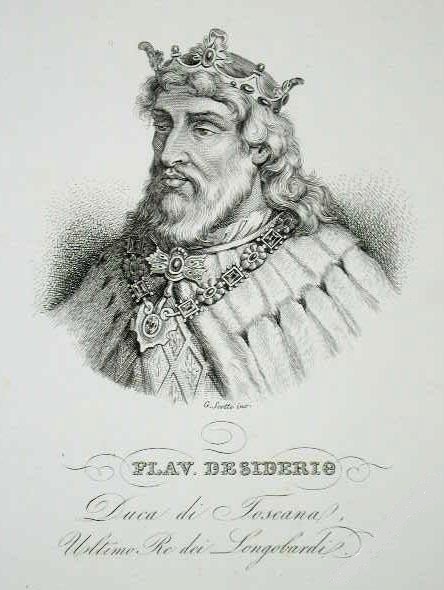
Portrait of Desiderius — 1840 (later depiction)
The King Outside the Victors’ Story
Desiderius enters many histories at the moment another king removes him. In 774, Charlemagne captured Pavia and assumed the Lombard royal title. The defeated monarch became proof of Frankish strength and papal vindication. Yet Desiderius had ruled since 757, and his earlier choices reveal a political actor working among neighbors whose interests could converge temporarily and then diverge sharply.
His record comes chiefly through those neighbors. Papal narratives emphasize threats to Roman rights; Frankish accounts celebrate an invasion justified by protecting the church. These sources establish important actions but make a difficult foundation for claims about his private character. The proposed ESTP reading is therefore deliberately tentative, based on a pattern of tactical maneuver rather than the caricature of a rash enemy defeated by a greater man.
Desiderius can cautiously be read as an ESTP through Extraverted Sensing: he repeatedly worked with the immediate leverage offered by marriages, territorial pressure, and rival dynastic claims.
Alliances That Could Be Reversed
A marriage between Charlemagne and a daughter of Desiderius briefly made Lombard and Frankish interests appear compatible. Bertrada helped arrange the connection around 770. Desiderius also had a family link to Tassilo III of Bavaria through another daughter, Liutberga. These marriages connected courts across the Alps without making their policies permanently identical.
Charlemagne’s repudiation of the Lombard marriage altered the arrangement. The reasons remain uncertain; reducing a subsequent invasion to personal revenge would claim more than the evidence allows. Desiderius’s court then received the widow and children of Carloman I. Their potential claims to Frankish rule offered another form of leverage after the earlier relationship had failed.
Papal accounts allege that Desiderius wanted the boys anointed as rulers, thereby complicating Charlemagne’s authority. The allegation reveals what Rome feared as well as what the Lombard court may have attempted. Its strategic logic is intelligible: dynastic alternatives could be used to unsettle a neighboring king. Its precise implementation and Desiderius’s own explanation are less accessible.
This responsiveness to shifting circumstances gives the Extraverted Sensing interpretation some plausibility. It remains a weak inference because almost any successful medieval ruler needed tactical flexibility. The case rests on the repeated substitution of one available pressure point for another, not on treating marriage diplomacy as evidence of a type by itself.
Testing the Available Bargain
When Hadrian I became pope in 772, Desiderius sent envoys seeking agreement. The papal biography reports assurances about restoring rights alongside subsequent Lombard territorial seizures around the former exarchate. Negotiation and force were not separate policies. Each could improve the terms under which the other proceeded.
A tentative Introverted Thinking reading concerns the conditional structure of these maneuvers: what concession would secure recognition, which territorial gains would strengthen a demand, and whether a rival claimant could alter another ruler’s calculation. We cannot prove that Desiderius privately reasoned in this manner. The sources document transactions and accusations, not a surviving account of his deliberations.
The strategy also had limits. Papal resistance brought a request for Frankish help, and Charlemagne crossed the Alps in 773. Desiderius withdrew behind Pavia’s defenses while his son Adelchis pursued another line of survival. The siege continued into 774 before surrender. Immediate leverage could not compensate for the military pressure once the coalition against him became sufficiently strong.
It is important that defeat does not retroactively make all prior bargaining irrational. An alliance might have worked under different circumstances, and a defensive position might have seemed viable before its collapse. Equally, the existence of a recognizable strategy does not establish exceptional insight. Desiderius’s history permits an account of constrained choices without either mocking him or converting him into a misunderstood genius.
Religious patronage complicates the portrait of a ruler interested only in immediate pressure. Desiderius and his wife Ansa founded the women’s monastery of San Salvatore at Brescia in 753, before his accession. The complex, now preserved within the Santa Giulia Museum, became a place where family, sacred memory, and dynastic authority were joined. It supplies a material counterweight to the hostile narrative of the last campaign. The foundation suggests investment in durable legitimacy, although it cannot disclose his personal motives or settle the tentative type comparison. A monastery could serve devotion, family continuity, and political standing simultaneously.
Testing the ESTP Reading
Why not ENTJ?
ENTJ is a plausible alternative because marriage networks, territorial demands, and support for rival claimants could serve a sustained project of Lombard predominance in Italy. ESTP is marginally preferred because the surviving sequence foregrounds immediate pressure and changing opportunities more clearly than a consistent organizing program. The distinction is fragile: the documentation was selected by opponents and may conceal a coherence visible at his own court.
Confidence remains low. The useful claim is a tentative preference for tactical engagement, not a diagnosis of the last Lombard king. His opponents’ descriptions of arrogance or deceit should not supply the missing personal evidence, and no speculative story about weaker functions is needed to complete the profile.
Connected Figures
Further Reading
- The Lives of the Eighth-Century Popes — Translated by Raymond DavisPapal biographies supply a central, partisan account of Lombard relations with Rome.
- The Lombards — Neil ChristiePlaces the last independent king within the kingdom’s longer political and material history.
- King and Emperor: A New Life of Charlemagne — Janet L. NelsonReconstructs the ruler through political relationships, family decisions, and close reading of the sources.
- Carolingian Chronicles — Translated by Bernhard Walter Scholz with Barbara RogersMakes the Royal Frankish Annals and Nithard accessible while preserving the need to distinguish their viewpoints.
