 Historical Figure MBTI
#1254 · 9-15-26 · The Carolingian World
Bertrada of Laon
Frankish Queen · Dynastic Mediator
c. 720–783
5 min read
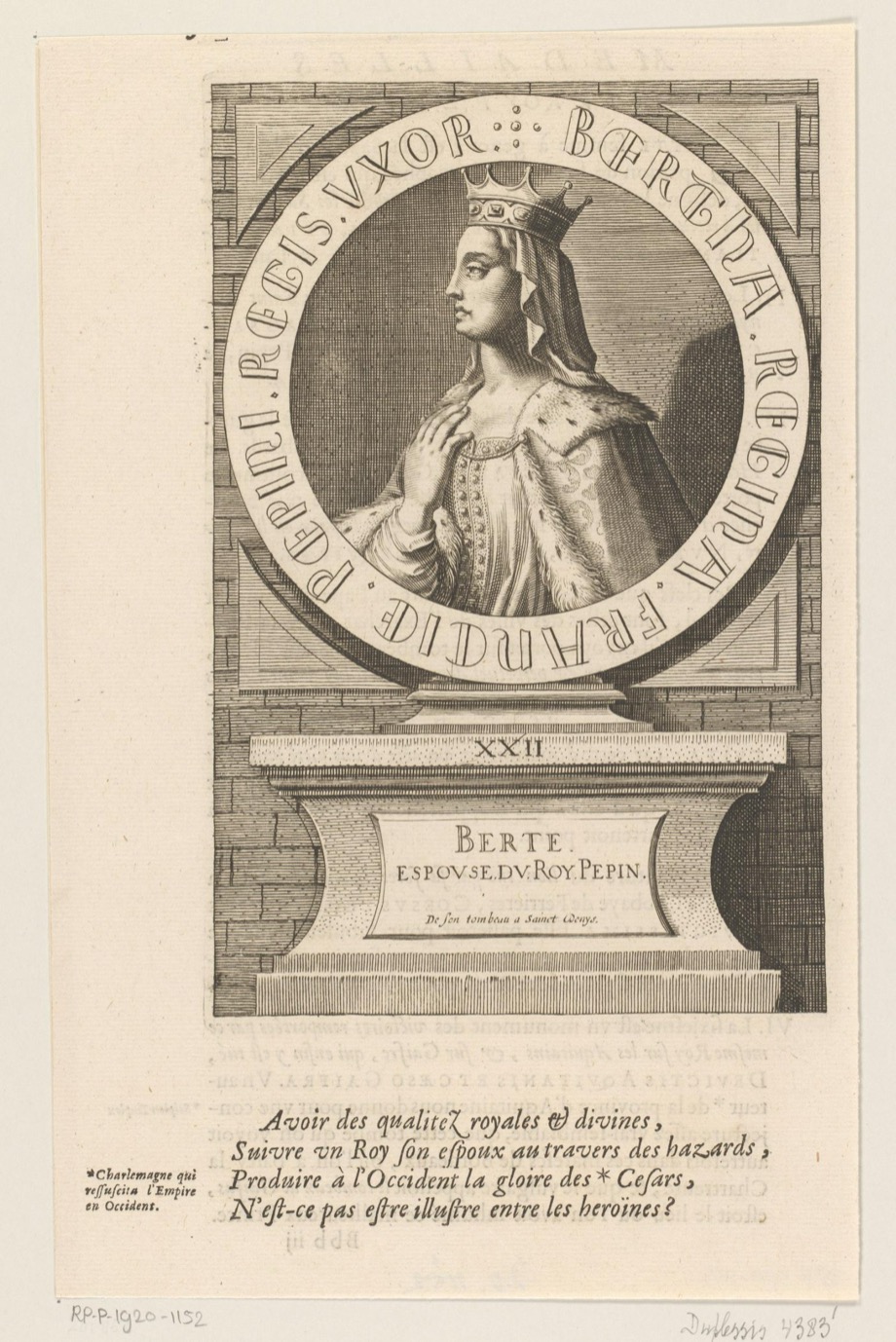
Imagined portrait of Bertrada of Laon — 1635 (later depiction)
A mother could still cross borders
In 770, Bertrada of Laon traveled to Italy by way of Bavaria. Before the journey, she met her son Carloman at Seltz. The Royal Frankish Annals preserve these movements with little explanation. Their brevity is striking: a queen mother moved through the political world between the kingdoms of her sons and the Lombard court, but the record gives no corresponding account of her conversations.
A second notice supplies a consequential result. Einhard says that Charlemagne married a daughter of Desiderius at his mother’s urging. The marriage joined families whose interests might otherwise become antagonistic. Charles repudiated it after about a year. Bertrada’s diplomacy was effective enough to shape a royal decision, but could not bind the king permanently to the arrangement she had promoted.
The low-confidence ENFJ interpretation concerns this attempt to direct politics through personal ties and an envisioned alignment. Motherhood does not establish the type, and mediation alone is not sufficient evidence of Extraverted Feeling. The reading remains an inference from a small number of public interventions, preserved by writers more interested in her son than in her.
The tentative ENFJ reading places dominant Extraverted Feeling in Bertrada’s effort to make family relationships carry a wider political agreement.
The relationship was a political instrument
Bertrada’s position rested in part on her marriage to Pepin and her motherhood of the two succeeding kings. After Pepin’s death in 768, Charles and Carloman possessed separate shares of the kingdom. Their relationship was politically consequential rather than simply a matter of affection. Cooperation could shape the security of both rulers; disagreement could offer opportunities to others.
Extraverted Feeling is plausible in her use of access to the people whose agreement mattered. A meeting with Carloman and the promotion of a marriage for Charles suggest attention to the connections through which a settlement could become acceptable. Her leverage came from her place within the family and from the possibility of speaking across positions that the kings themselves did not readily reconcile.
The surviving record does not let us narrate the emotional means by which she did this. We cannot assume that a diplomatic journey proves exceptional warmth or that family mediation meant a dislike of conflict. She may have defended strong interests of her own. The interpretation concerns a visible method: work through relationships that can bind decision makers, instead of treating kinship as a decorative background to decisions.
A marriage could organize a future
The Lombard marriage had a horizon beyond a single meeting. Joining Charles to a daughter of Desiderius could change how the Frankish and Lombard courts understood their interests. Bertrada’s travel belongs to a moment in which an alignment involving family ties still offered a possible direction for the region. It was not rendered foolish merely because a later king chose another course.
Auxiliary Introverted Intuition is possible in the effort to make several separate relationships part of one future arrangement. The inference must remain modest. The annals establish the itinerary more securely than they disclose a comprehensive strategy. An older historical reconstruction can describe how the pieces might fit, but possibility should not become a reported conversation or a documented master plan.
The repudiation reveals the limits of her project. Charles could withdraw from the relationship she had helped establish. We do not know his reasons with confidence: Einhard explicitly declines to explain them. Nor does that withdrawal prove that Bertrada misread everyone involved. An agreement depends on choices made by other people after the person who promoted it has completed her work.
An honored mother in a son’s biography
Einhard says that Charles treated Bertrada with great respect and presents the repudiation as their only disagreement. That account deserves to be read as an account. Its ideal of filial honor helps characterize Charles, the subject of the biography. It cannot establish that every other issue between mother and son was settled without tension.
Later stories about “Bertha Broadfoot” move still further from recoverable politics. Literary narratives could give the royal mother adventures, substitutions, and a dramatic vindication. Such traditions show the appeal of the figure, not the details of the woman’s diplomatic life. Bertrada’s historical agency is already significant in the notices that survive; it does not need an invented episode to make it visible.
Why this tentative reading?
Why not ESFJ?
A queen mother seeking family accord and preserving dynastic connections makes ESFJ a serious alternative. ENFJ is preferred only tentatively because the Lombard marriage appears directed toward a new alignment that could organize several relationships at once. The difference is an interpretation of a narrow record, not a demonstrated contrast between two mental processes.
Confidence therefore remains low. We have evidence that Bertrada acted, traveled, and influenced a consequential decision. We have less evidence about the priorities behind those actions or the other possibilities she considered. The type should preserve that imbalance rather than lend an appearance of certainty to it.
Connected Figures
Further Reading
- Life of Charlemagne — Einhard; translated by Samuel Epes TurnerThe account of the Lombard marriage acknowledges Bertrada’s influence while idealizing her relationship with Charles.
- Royal Frankish Annals — Anonymous court-associated annalistsThe entry for 770 records her meeting with Carloman and journey to Italy through Bavaria.
- Italy and Her Invaders, Book VIII — Thomas HodgkinAn older reconstruction that discusses her diplomacy but also illustrates how conjecture can fill the gaps between surviving notices.
