 Historical Figure MBTI
#1253 · 9-15-26 · The Carolingian World
Pope Stephen II
Pope · Diplomat Across the Alps
d. 757
5 min read
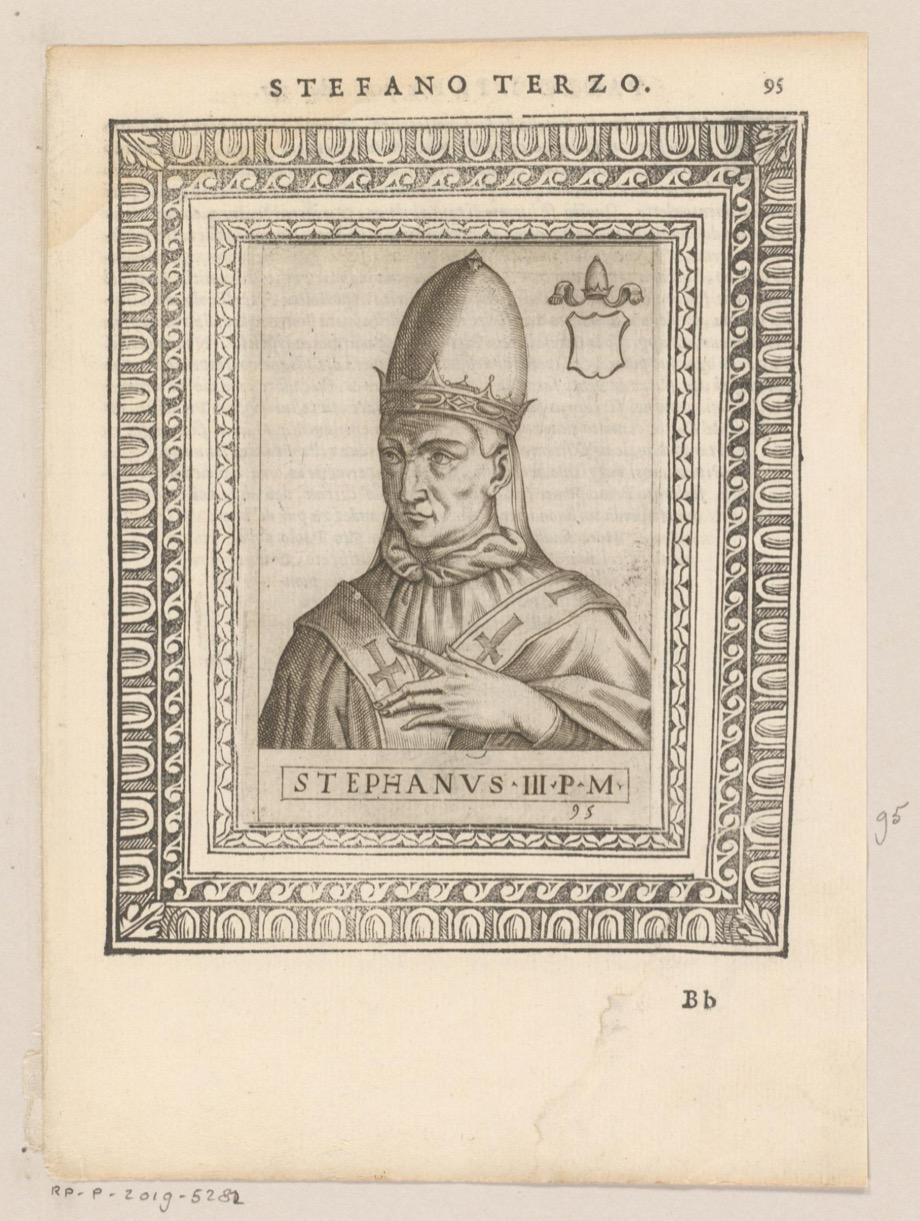
Imagined portrait of Pope Stephen II — 1587 (later depiction)
An alliance had to be made personal
Stephen II left Rome because an appeal sent from Rome had not been enough. Lombard power threatened the Roman church, and protection from the eastern emperor could not be relied upon to resolve the danger. The pope crossed the Alps and brought the claim of Saint Peter into the presence of Pepin, the king whose military resources might make that claim effective.
The journey gave an institutional problem a personal encounter. Stephen needed help; Pepin needed a secure account of the kingship his family had assumed. Their needs were different, but could be joined. At Saint-Denis in 754, Stephen anointed Pepin and his sons, making the royal household’s future part of a sacred relationship with the Roman church.
The tentative ENFJ reading begins with this repeated effort to create obligations through relationships and shared meaning. It does not follow simply from successful diplomacy. Popes were expected to persuade, and royal anointing had political uses. The question is whether Stephen’s surviving interventions disclose a characteristic way of directing people toward a common commitment.
The low-confidence ENFJ reading places dominant Extraverted Feeling in Stephen II’s effort to make protection of Rome a shared personal and sacred obligation.
A promise carried by people
Stephen met Pepin at Ponthion in January 754. The appeal was for the security and rights of the Roman church against Aistulf, the Lombard king. It required the pope to trust a ruler outside the Italian setting of the crisis. Pepin, in turn, had to treat the danger facing Rome as something that warranted Frankish action.
Extraverted Feeling offers a possible account of the attention to reciprocal commitment. Stephen’s diplomacy did not merely announce that one party possessed an interest another party should serve. It placed the parties within an obligation that each could recognize as meaningful. The pope could sanctify a dynasty’s authority; the king could become the protector whose action showed that the sacred relationship had substance.
The interpretation should not turn this into a picture of easy harmony. An alliance joins interests that may diverge, and solemn language can be a means of applying pressure. Appeals invoking Saint Peter could make refusal morally costly. Stephen’s relational method included insistence as well as reassurance. The evidence concerns the form of his public intervention, not a demonstrable capacity to read everybody’s emotions.
The crisis could bind a dynasty
The ceremony of 754 included the young Charles and Carloman alongside Pepin. The appeal therefore reached beyond an immediate military expedition. It associated the ruling family’s continuation with the defense of the Roman church. This was a way to give a present bargain a future structure, making protection something that the dynasty should inherit rather than briefly supply.
Auxiliary Introverted Intuition is plausible in this connection between crisis and enduring alignment. The concrete danger could be addressed through a relationship expected to outlast it. Yet Stephen should not be credited with foreseeing the later empire or every development of papal territorial rule. A persuasive direction is not the same thing as a complete plan of subsequent history.
The evidence for the anointing also needs discrimination. Modern source criticism distinguishes the well-attested papal ceremony of 754 from familiar but disputed accounts of an earlier anointing by Boniface. Repeating the older story as a seamless sequence would give the alliance a certainty it does not possess. Stephen’s intervention remains consequential without requiring every antecedent tradition to be true.
Ritual still needed an army
Pepin’s campaigns in the middle of the 750s forced concessions from Aistulf. The Frankish annals describe an initial promise, its failure, and a renewed expedition that secured Ravenna and other territories for Saint Peter. Their language presents military victory as divine assistance and the opponent’s conduct as wrongful. It records an alliance while also justifying it.
These events prevent sacred legitimacy from becoming a substitute for material power in the account. Stephen’s ceremony did not itself secure the contested places. Promises had to be enforced, and the pope’s continuing appeals belonged to that difficulty. Papal territorial authority developed through campaigns, transfers, and further contests; it did not emerge as a fully formed modern state from a single ritual.
Why this tentative reading?
Why not ESFJ?
A pope defending inherited rights through established religious forms makes ESFJ a credible alternative. ENFJ is preferred cautiously because Stephen used the immediate crisis to construct an alignment extending across the Alps and into the royal family’s future. The proposed distinction concerns direction, not a claim that his ritual language lacked precedent.
Confidence remains low. The surviving documents are instruments of papal diplomacy and Frankish remembrance. They favor a voice that persuades, consecrates, and demands, because those were the actions the situation required. ENFJ is a provisional interpretation of that pattern, while the historical case for his initiative stands independently of the label.
Connected Figures
Further Reading
- Royal Frankish Annals — Anonymous court-associated annalistsRecords the journey, anointing, and campaigns within a narrative that favors the Frankish dynasty.
- Letters and decrees of Stephen II — Pope Stephen II and associated textsThe Latin collection preserves appeals and ritual claims; distinguish papal letters from other material gathered by later editors.
- The Origins of Royal Anointing — Conor O’BrienSeparates strong evidence for the 754 papal anointing from disputed reconstructions of Pepin’s earlier consecration.
